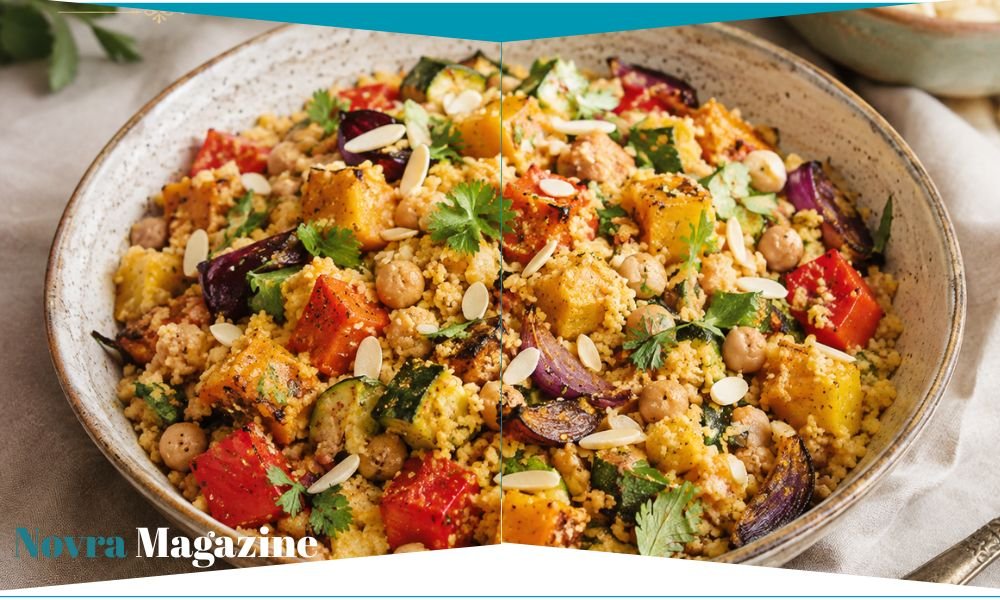
At first, Kouskousi may look like the name of a rare food that is completely different from anything you already know. However, the answer is much simpler. Kouskousi is commonly used online as another spelling or form of couscous, the famous North African food made from tiny pieces of rolled semolina. Couscous has deep roots in the Maghreb, where families have prepared it for generations with vegetables, chickpeas, meat, fish, broth, spices, or sweet ingredients. In fact, UNESCO recognized the knowledge and traditions connected with couscous in 2020 after Algeria, Mauritania, Morocco, and Tunisia submitted it together as shared cultural heritage.
What Is Kouskousi?
Kouskousi is generally another way of referring to couscous.
Recent food guides use the word for the small golden semolina pieces served across North Africa.
Although it may look like rice, it is not rice.
Instead, traditional couscous comes from semolina, which comes from durum wheat.
Small amounts of water help turn the semolina into tiny granules.
Traditionally, cooks then steam those granules until they become soft and light.
Is Kouskousi the Same as Couscous?
In most food-related search results, yes.
The exact spelling Kouskousi is much less common than couscous.
However, related spellings such as kouskous have existed for a long time.
Merriam-Webster lists “kouskous” simply as a variant spelling of couscous.
Wiktionary also records kouskous as an alternative spelling and gives examples going back more than a century.
So, the spelling may change, but the food being discussed is usually the familiar North African couscous.
Why Are There So Many Spellings?
Couscous has traveled through many languages, countries, and writing systems.
As a result, different spellings developed.
For example, Wikipedia lists names and forms such as seksu, kesksou, and other regional words.
English usually uses couscous.
However, people may also write:
kouskous
kuskus
kosksi
kousksi
kouskousi
kouskousi
The spelling often depends on language, pronunciation, region, or the way someone chooses to write an Arabic or Amazigh sound in Latin letters.
Where Does Kouskousi Come From?
Kouskousi, or couscous, comes from North Africa.
The dish is strongly connected with the Maghreb.
That region includes countries such as Morocco, Algeria, Tunisia, and nearby areas.
UNESCO specifically recognized couscous traditions shared by Algeria, Mauritania, Morocco, and Tunisia.
Therefore, calling couscous the food of only one country would miss the bigger story.
Several North African cultures have their own versions.
Each one can look and taste different.
Why Is Couscous So Important in North Africa?
Couscous is more than a quick side dish.
For many families, it is connected with home, family, hospitality, celebrations, and shared meals.
UNESCO says the practices around making and eating couscous carry ideas of sharing, togetherness, and social connection.
Traditionally, knowledge passes from one generation to another.
Children watch older relatives prepare the semolina.
Later, they learn to roll, steam, season, and serve it themselves.
That is why the tradition is about more than the final bowl of food.
The process matters too.
When Did UNESCO Recognize Couscous?
UNESCO added the knowledge and practices connected with couscous to its Representative List of the Intangible Cultural Heritage of Humanity in 2020.
Algeria, Mauritania, Morocco, and Tunisia submitted the nomination together.
That joint effort was important.
Food traditions can sometimes create arguments about which country “owns” a dish.
Instead, this application showed that several cultures could celebrate a shared tradition together.
What Is Kouskousi Made From?
Traditional couscous usually starts with semolina.
Semolina comes from durum wheat.
Food.com describes couscous as semolina that has been moistened and rolled into tiny bead-like pieces.
The finished dish can then include many other ingredients.
Common additions include vegetables, chickpeas, lamb, chicken, beef, fish, broth, spices, raisins, onions, nuts, and herbs.
However, there is no single recipe used everywhere.
Is Kouskousi Rice?
No.
This is one of the most common misunderstandings.
Kouskousi can look like tiny grains of rice.
However, it comes from wheat.
Therefore, it is much closer to pasta than rice.
Think about it like this.
Rice grows as a grain.
Couscous is made by taking wheat semolina and turning it into tiny pieces.
The final appearance is similar, but the ingredients and production are different.
Is Kouskousi Pasta?
Technically, couscous is often described as being closer to pasta because both usually use durum wheat semolina.
However, traditional couscous production is special.
The semolina is moistened, rolled by hand into tiny pieces, and then steamed. UNESCO specifically describes this rolling and steaming process as part of the traditional knowledge surrounding couscous.
So, saying “tiny pasta” can help a beginner understand it.
Still, traditional couscous has its own history and cooking culture.
What Does Kouskousi Taste Like?
Plain couscous has a mild taste.
That is one reason it works with so many foods.
On its own, it is not very spicy or strong.
Instead, it absorbs flavors from broth, vegetables, meat, sauces, herbs, and spices.
For example, couscous cooked under a rich vegetable stew can soak up some of that flavor.
Likewise, a light salad version may taste fresh because of lemon, herbs, and olive oil.
What Is the Texture Like?
Good couscous should feel light and fluffy.
The small pieces should separate easily.
Traditional steaming can produce a soft but slightly springy texture.
However, overcooking or adding too much water can make couscous sticky.
Instant couscous usually becomes softer faster because manufacturers have already partly cooked and dried it.
That is why boxed couscous can be ready within minutes.
How Is Traditional Kouskousi Made?
Traditional preparation takes more work than instant couscous.
First, cooks prepare the semolina.
Then they slowly add moisture and roll it into tiny granules.
After that, they steam the couscous.
Often, the couscous sits above a pot containing stew, vegetables, or meat.
Steam rises through the grains.
Then the cook may remove the couscous, separate the pieces, add a little water or oil, and steam it again.
The exact process changes from family to family.
UNESCO notes that traditional preparation involves several steps and special utensils.
What Is a Couscoussier?
A couscoussier is a traditional cooking pot used for couscous.
It normally has two main levels.
The lower part holds stew, broth, vegetables, or meat.
The upper part holds the couscous.
Steam rises from the lower pot and cooks the grains above.
This method lets the couscous become soft while also picking up aromas from the food cooking underneath.
It is one of the classic ways to prepare the dish.
Can You Make Kouskousi Without a Couscoussier?
Yes.
Modern packaged couscous is much easier to make.
Usually, you bring water or broth to a boil.
Then you add the couscous, cover it, and allow it to absorb the hot liquid.
After a few minutes, you fluff it with a fork.
Food.com notes that couscous can be steamed or combined with boiling liquid until it absorbs the moisture.
So, you do not need traditional equipment for a simple home version.
What Is Moroccan Couscous?
Moroccan couscous often appears with vegetables and meat.
Carrots, zucchini, pumpkin, chickpeas, cabbage, onions, and turnips can appear in different versions.
Lamb, chicken, or beef may also be added.
Some Moroccan versions include a sweet onion-and-raisin topping called tfaya.
The exact recipe changes by family and region.
Therefore, there is no single “correct” Moroccan couscous plate.
What Is Algerian Couscous?
Couscous is also deeply important in Algeria.
A study indexed by FAO describes couscous as an ancient food found widely across North Africa and a staple dish in Algeria.
Different Algerian regions prepare it differently.
Some use lamb.
Others use chicken.
Vegetables, chickpeas, spices, and sauces vary as well.
Even the size and preparation of the couscous grains can differ.
That regional variety is part of the dish’s appeal.
What Is Tunisian Couscous?
Tunisian couscous often has a stronger, spicier character.
Tomato-based sauces and harissa may appear in many versions.
Meat is common, but seafood versions are also popular in coastal areas.
Some Tunisian cooks make couscous with fish or octopus.
Others serve it with lamb, vegetables, chickpeas, or special regional ingredients.
The dish can change greatly from one part of Tunisia to another.
What Is Mauritanian Couscous?
Mauritania also shares the couscous tradition recognized by UNESCO.
Its food culture reflects North African, Saharan, and West African influences.
Couscous may appear with meat, vegetables, sauces, or locally available ingredients.
Again, there is no need to treat one country’s version as the original form and all others as copies.
The tradition developed across connected communities over a very long time.
Is Kouskousi Eaten With Meat?
Yes, but meat is not required.
Lamb is a popular choice in many North African couscous dishes.
Chicken and beef can also appear.
In coastal regions, fish or seafood may be used.
However, vegetarian couscous can be delicious too.
Chickpeas, pumpkin, carrots, zucchini, onions, and other vegetables can create a full meal without meat.
Can Vegetarians Eat Kouskousi?
Yes, as long as the broth and toppings are vegetarian.
Plain couscous itself is made from wheat.
Therefore, a vegetable-based version can work well for vegetarians.
For example, you can serve it with roasted vegetables, chickpeas, herbs, lemon, nuts, and olive oil.
However, always check packaged flavored couscous.
Some mixes may contain chicken stock or other animal ingredients.
Is Kouskousi Vegan?
Plain couscous can be vegan.
Semolina and water are normally the basic ingredients.
However, the final recipe may include butter, meat, or animal-based broth.
Therefore, the complete dish matters.
A vegan version can use vegetable stock, olive oil, chickpeas, vegetables, herbs, dried fruit, and spices.
Is Kouskousi Gluten-Free?
No, traditional couscous is not gluten-free.
It comes from durum wheat.
Therefore, people with celiac disease or a medical need to avoid gluten should not eat standard wheat couscous.
Some products use corn, rice, or other gluten-free ingredients and imitate the couscous texture.
However, those are alternatives rather than traditional semolina couscous.
Always read the package label carefully.
Is Kouskousi Healthy?
Kouskousi can fit into a healthy diet.
However, the full meal matters more than the couscous alone.
Plain couscous provides carbohydrates and some protein.
When you add vegetables and legumes, the meal can also provide fiber, vitamins, and minerals.
Meanwhile, very large portions, heavy sauces, large amounts of oil, or fatty meat can increase calories.
So, the answer is not simply “healthy” or “unhealthy.”
It depends on portion size and preparation.
Does Kouskousi Have Protein?
Yes.
Because couscous comes from wheat, it contains some protein.
However, it is not normally considered a high-protein food by itself.
You can increase the meal’s protein by adding chickpeas, lentils, chicken, fish, meat, or another protein source.
That is one reason traditional couscous meals can feel complete.
The couscous provides the carbohydrate base while other ingredients add protein and vegetables.
Is Kouskousi Good for Weight Loss?
No single food automatically causes weight loss.
Couscous can fit into a calorie-controlled meal because you can combine a moderate serving with plenty of vegetables and lean protein.
However, portion size matters.
A very large bowl can provide many carbohydrates.
Also, oil, butter, fatty meats, sauces, and sweet toppings add more calories.
Therefore, people trying to manage weight should look at the whole plate, not just one ingredient.
Is Whole-Wheat Couscous Better?
Whole-wheat couscous usually contains more fiber than refined couscous.
That can help people feel full for longer.
It may also fit well into diets focused on whole grains.
However, traditional couscous does not have to be labeled “bad” simply because it uses regular semolina.
Both types can fit into a balanced diet.
Your portion and the foods served with it also matter.
What Is Pearl Couscous?
Pearl couscous consists of larger round pieces.
It is sometimes called Israeli couscous.
However, it is different from traditional tiny Maghrebi couscous.
The pieces are much bigger and usually have a chewier texture.
They are often toasted and then boiled.
So, while both carry the couscous name, they do not look or cook exactly the same way.
Is Pearl Couscous the Same as Kouskousi?
Usually not when someone is discussing traditional North African kouskousi.
Traditional couscous uses much smaller semolina granules.
Pearl couscous is larger.
Therefore, substituting one for the other changes the texture of a recipe.
Still, pearl couscous can work well in salads, soups, and side dishes.
What Is Instant Couscous?
Instant couscous is partly cooked and dried before packaging.
That makes home preparation very fast.
Usually, you only need hot water or broth.
After a few minutes, the grains absorb the liquid.
Then you fluff them and serve.
This convenience has helped couscous become popular far beyond North Africa.
However, traditional steamed couscous usually takes longer and may have a different texture.
How Do You Make Easy Kouskousi at Home?
A simple version needs only couscous, hot liquid, and a little seasoning.
Put one cup of couscous into a heat-safe bowl.
Next, add about one cup of hot water or broth, depending on the package instructions.
Cover the bowl.
Wait about five minutes.
Then uncover it and fluff the couscous gently with a fork.
After that, add vegetables, herbs, chickpeas, meat, olive oil, or whatever toppings you enjoy.
For best results, always follow the instructions on your specific couscous package because brands can vary.
What Vegetables Go Well With Kouskousi?
Many vegetables work well.
Carrots are common.
So are zucchini, onions, pumpkin, turnips, tomatoes, cabbage, and peppers.
Chickpeas are also very popular even though they are legumes rather than vegetables.
For a quick modern meal, roasted broccoli, sweet potato, cucumber, spinach, or cherry tomatoes can work too.
Couscous is mild, so it pairs easily with many flavors.
What Spices Are Used With Kouskousi?
The spices depend on the region and recipe.
Common possibilities include cumin, turmeric, ginger, cinnamon, pepper, paprika, saffron, coriander, and blends such as ras el hanout.
Tunisian versions may use harissa for extra heat.
However, not every couscous dish contains all these spices.
A simple vegetable couscous can be lightly seasoned.
A festive meat dish may have a much deeper flavor.
Can Kouskousi Be Sweet?
Yes.
Couscous does not always have to be savory.
Some recipes include raisins, dates, nuts, cinnamon, sugar, honey, milk, or other sweet ingredients.
Sweet couscous dishes and toppings exist in different North African traditions.
This shows how flexible the basic ingredient is.
The same small semolina grains can become dinner, a side dish, or even part of a sweet preparation.
Why Is Kouskousi Served at Family Gatherings?
Because couscous works very well as a shared meal.
A large dish can feed many people.
Vegetables and meat can be arranged around the top.
Then family members gather around it.
UNESCO specifically connects couscous culture with sharing meals, togetherness, and social life.
Therefore, the meal itself can become part of the gathering.
It is food and family time at once.
Is Friday Important for Couscous?
In parts of North Africa, especially Morocco, couscous is strongly associated with Friday family meals.
Families may gather after Friday prayers and eat together.
However, customs vary.
Not every household follows exactly the same tradition.
Couscous can also appear at weddings, celebrations, religious occasions, ordinary dinners, and community events.
Why Is Kouskousi Considered Cultural Heritage?
The important part is not only eating it.
UNESCO recognized the complete system around couscous.
That includes growing grain, preparing semolina, rolling it, steaming it, using traditional tools, passing recipes between generations, and sharing the finished food.
In other words, the heritage lives in people’s knowledge.
A packet of instant couscous alone does not tell the whole story.
The traditions around it matter too.
Did Women Play an Important Role in Couscous Traditions?
Yes.
UNESCO specifically noted the important role women have played in maintaining and passing on couscous knowledge.
For generations, preparation skills often moved through families by watching and helping older cooks.
That does not mean only women make couscous today.
Men also cook it.
However, historically, women have had a major role in protecting and teaching the tradition.
Is Couscous Popular Outside Africa?
Yes.
Today, couscous appears in supermarkets and restaurants across Europe, North America, the Middle East, and many other regions.
Packaged instant couscous made the food especially easy to prepare.
Modern cooks also use it in ways that are not always traditional.
For example, people put couscous in cold salads.
Others serve it with grilled chicken or roasted vegetables.
That global popularity shows how easily the food adapts to different kitchens.
How Should You Store Dry Kouskousi?
Keep dry couscous in a cool, dry place.
Once you open the package, close it tightly or place it in an airtight container.
Moisture can damage dry food.
Also, check the best-before date on the package.
Whole-wheat versions may have a shorter storage life because they contain more of the natural grain oils.
How Long Does Cooked Kouskousi Last?
Cooked couscous should not sit at room temperature for a long period.
Let leftovers cool safely, then put them in a covered container in the refrigerator.
Generally, cooked grain dishes are best eaten within a few days.
When reheating, make sure the food becomes properly hot.
Food-safety guidance can vary by country, so local health recommendations should take priority.
Can You Freeze Couscous?
Yes, plain cooked couscous can usually be frozen.
First, let it cool.
Then place it in a freezer-safe container.
When needed, thaw and reheat it.
Adding a small amount of water or broth can help restore moisture.
However, vegetables or sauces frozen with the couscous may change texture.
What Is the Difference Between Couscous and Quinoa?
They look somewhat similar when cooked, but they are very different foods.
Couscous comes from wheat semolina.
Quinoa is a seed.
Quinoa is naturally gluten-free, while traditional couscous contains gluten.
They also have different nutritional profiles and textures.
Therefore, quinoa can sometimes replace couscous in a recipe, but the final dish will not taste exactly the same.
What Is the Difference Between Couscous and Rice?
Rice is a naturally occurring cereal grain.
Couscous is made from processed wheat semolina.
Rice usually has larger individual grains.
Couscous is much smaller and cooks very quickly in instant form.
Both can act as a base for meat, vegetables, sauces, or curries.
Still, they are completely different ingredients.
What Is the Difference Between Bulgur and Kouskousi?
Bulgur comes from cracked wheat kernels that have usually been partly cooked and dried.
Couscous uses semolina rolled into tiny granules.
Bulgur often has a nuttier flavor and chewier texture.
Couscous tends to feel lighter and softer.
Both are wheat products, so neither traditional bulgur nor traditional couscous is gluten-free.
Why Is Kouskousi Becoming Popular Online?
Several recent blogs have started publishing guides specifically using the spelling “Kouskousi.”
One 2026 guide describes it as couscous made from durum-wheat semolina.
Other recent pages make the same connection with traditional North African couscous.
This suggests the unusual spelling itself is becoming a search term.
People see “Kouskousi,” do not recognize it, and search for an explanation.
That creates more articles and more search interest.
Is Kouskousi a New Food?
No.
The spelling may look new or unusual to some readers.
However, the food it usually describes is very old.
FAO-indexed research describes couscous as an ancient dish found widely across North Africa.
Therefore, it would be misleading to call Kouskousi a new 2026 food trend.
The internet keyword may be newer.
The culinary tradition is not.
Is Kouskousi a Brand?
There may be individual brands or accounts using similar names.
However, the food-related meaning does not belong to one company.
Kouskousi is mainly being used as a variation connected to couscous.
Therefore, people searching the word should look at context.
A product called Kouskousi could be a brand.
An article called “How to Cook Kouskousi” is almost certainly talking about food.
Why Do Some Kouskousi Articles Give Different Origin Stories?
Couscous is shared across several cultures.
That alone can create different explanations.
In addition, newer SEO websites sometimes try to give one simple origin story to a complicated traditional food.
However, UNESCO’s recognition is helpful here.
It treats couscous knowledge as a shared cultural heritage submitted together by Algeria, Mauritania, Morocco, and Tunisia.
That approach is safer than claiming one modern country owns every part of its history.
What Is the Most Accurate Meaning of Kouskousi?
Based on the food-related evidence, the best simple definition is:
Kouskousi is a less-common spelling or modern search form connected to couscous, the traditional North African food made mainly from small steamed granules of durum-wheat semolina.
That answer fits dictionary evidence for related spellings such as kouskous and recent Kouskousi food articles.
There is no need to create a mysterious new food around the keyword.
Its connection to couscous already explains it well.
What Should You Remember Before Trying Kouskousi?
First, remember that it contains wheat unless the package clearly says otherwise.
Second, do not worry if your version looks different from a photo online.
Couscous has many regional styles.
Third, start simple.
A little broth, vegetables, chickpeas, herbs, and olive oil can create a very easy meal.
Later, you can try more traditional steamed versions.
Final Thoughts
Kouskousi sounds mysterious, but the food behind the name is much easier to understand.
In current food-related search results, Kouskousi is mainly used as another form or spelling connected to couscous.
Traditional couscous comes from North Africa.
It uses tiny pieces of semolina, usually from durum wheat.
Those pieces can be steamed and served with vegetables, chickpeas, meat, seafood, broth, spices, or sweet ingredients.
Most importantly, couscous is far more than a simple wheat side dish.
For generations, families have prepared and shared it as part of everyday life and important occasions.
That cultural importance became internationally recognized in 2020.
UNESCO added the knowledge and practices connected with couscous to its Intangible Cultural Heritage list after a joint nomination from Algeria, Mauritania, Morocco, and Tunisia.
The recognition covers much more than a recipe.
It includes rolling the semolina, steaming it, using traditional tools, sharing meals, and passing skills from older generations to younger ones.
At the same time, couscous continues to change.
Today, people eat traditional steamed versions and quick instant versions.
They serve it with lamb or chicken.
Others choose vegetables or chickpeas.
Some make spicy Tunisian-style dishes.
Others prepare Moroccan family meals or Algerian regional recipes.
Modern cooks even put couscous into salads and fusion dishes.
Therefore, Kouskousi is best understood not as a strange new trend but as another doorway into a very old and rich North African food tradition.
Frequently Asked Questions
What is Kouskousi?
Kouskousi is generally used as another spelling or variation connected to couscous, the North African semolina-based food.
Is Kouskousi the same as couscous?
In most food-related sources, yes. It refers to the same general type of semolina food.
Is kouskous a real spelling?
Yes. Merriam-Webster lists kouskous as a variant spelling of couscous.
Where does Kouskousi come from?
The couscous tradition comes from North Africa and is especially associated with the Maghreb.
Which countries are famous for couscous?
Morocco, Algeria, Tunisia, and Mauritania all have important couscous traditions recognized by UNESCO.
What is Kouskousi made from?
Traditional couscous is usually made from semolina from durum wheat.
Is Kouskousi rice?
No. It may look like rice, but it is made from wheat.
Is Kouskousi pasta?
It is closer to pasta than rice because it usually comes from durum-wheat semolina, although traditional couscous has its own unique production method.
Is Kouskousi gluten-free?
No. Traditional couscous contains wheat and therefore contains gluten.
Is Kouskousi vegan?
Plain couscous can be vegan. However, the complete dish may include meat, butter, or animal-based broth.
Is Kouskousi vegetarian?
It can be. Vegetable and chickpea couscous is a popular meat-free option.
Is Kouskousi healthy?
It can fit into a balanced diet, especially when served in moderate portions with vegetables and healthy protein sources.
How do you cook Kouskousi?
Traditional couscous is steamed. Instant couscous can usually be covered with hot water or broth for several minutes and then fluffed.
What meat goes with Kouskousi?
Lamb, chicken, and beef are common choices. Seafood also appears in some regional versions.
What vegetables go with Kouskousi?
Carrots, zucchini, onions, pumpkin, turnips, cabbage, tomatoes, and chickpeas are popular additions.
Is Kouskousi Moroccan?
Morocco has a famous couscous tradition, but couscous is shared across several North African cultures.
Is Kouskousi Algerian?
Couscous is also an important Algerian staple with many regional versions.
Is Kouskousi Tunisian?
Tunisia has many traditional couscous dishes, including spicy meat and seafood versions.
Why did UNESCO recognize couscous?
UNESCO recognized the knowledge, skills, preparation traditions, and social customs surrounding couscous as shared cultural heritage.
When did couscous become UNESCO cultural heritage?
UNESCO added the related knowledge and practices to its Representative List in 2020.
What is the easiest definition of Kouskousi?
Kouskousi is best understood as a less-common spelling linked to couscous, the traditional North African semolina dish.
For more info, visit novra magazine