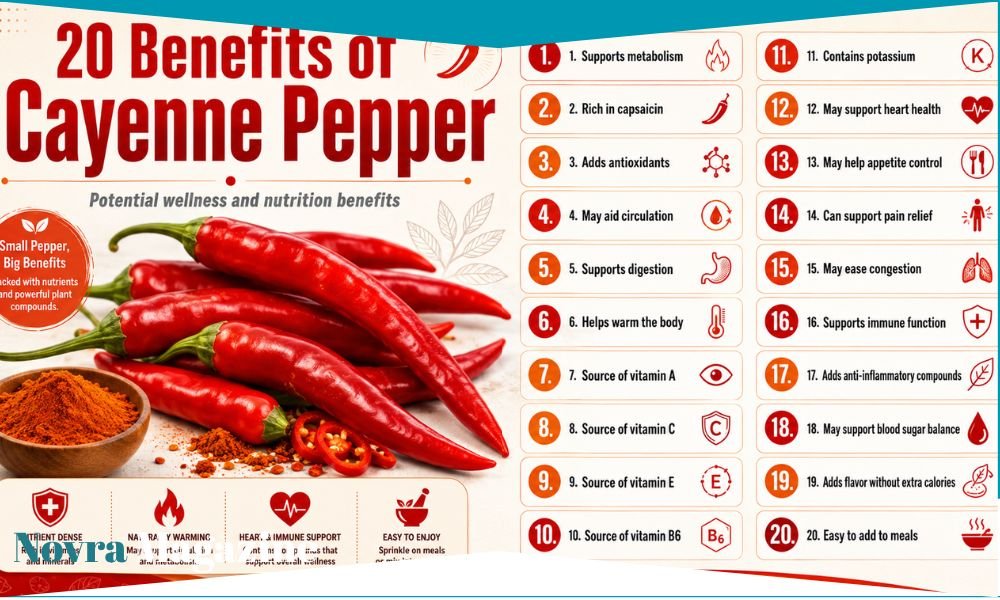
A small pinch of red powder can make your mouth feel like it is on fire, but could it also help your health? Searches for the 20 benefits of cayenne pepper often lead to huge claims about weight loss, blood pressure, digestion, pain, and even disease prevention. The truth is more interesting. Cayenne pepper contains capsaicin, the natural substance responsible for its heat. Human research suggests some real benefits, especially small effects on appetite and energy use, while medical capsaicin products have much stronger evidence for certain kinds of pain. However, cayenne is not a miracle cure, and many popular online claims go far beyond what science has actually proven.
What Is Cayenne Pepper?
Cayenne is a hot red pepper from the Capsicum family.
People often dry the peppers and grind them into the bright red powder found in kitchens around the world.
The ingredient responsible for most of the burning feeling is capsaicin.
Capsaicin activates a nerve receptor called TRPV1. That receptor normally helps the body detect heat and painful sensations.
This unusual action explains something that seems strange at first.
Capsaicin can cause burning when you first touch or eat it.
Yet specially prepared capsaicin medicines can also reduce certain types of pain after repeated or controlled exposure.
Are There Really 20 Proven Benefits of Cayenne Pepper?
Not exactly.
It would be misleading to say researchers have proven 20 major medical benefits from simply eating cayenne powder.
Some benefits have reasonable human evidence.
Others are possible benefits with smaller or mixed studies.
And several of the strongest medical uses involve topical capsaicin medicine, not cayenne pepper sprinkled onto dinner.
That difference matters.
Eating half a teaspoon of cayenne is not the same as receiving a medical capsaicin patch.
So below, each benefit is explained according to how strong the evidence really is.
1. Can Cayenne Pepper Add Strong Flavor Without Much Food?
Yes.
One of cayenne pepper’s simplest benefits is also one of the most useful.
You need only a small amount to create a lot of flavor.
Cayenne adds heat to eggs, beans, vegetables, soups, meat, fish, sauces, and many other foods.
Researchers have even found that capsaicin can increase perceived flavor and saltiness in some foods. A 2023 human study involving people with reduced smell found that adding capsaicin increased overall flavor intensity and perceived saltiness in tomato soup.
That may be useful for people trying to make lower-sodium food taste more exciting.
However, cayenne does not automatically make an unhealthy meal healthy.
2. Could Cayenne Help You Use Less Salt?
Possibly.
This is more interesting than simply saying spicy food tastes good.
Research has suggested that people who enjoy spicy flavors may prefer less salt.
One human study found an association between enjoyment of spicy foods, lower salt preference, lower daily sodium intake, and lower blood pressure.
Another controlled study found capsaicin could make low-sodium food taste saltier in people with smell loss.
That does not mean cayenne is a blood-pressure medicine.
But using spice instead of automatically adding more salt can be a useful cooking strategy.
3. Does Cayenne Pepper Provide Useful Plant Nutrients?
Yes.
Red cayenne peppers contain carotenoids, including compounds the body can use to make vitamin A.
They also contain other plant compounds and vitamins.
Vitamin A is important for normal vision, immune function, growth, and healthy cells.
However, there is one important detail.
People usually eat only a small amount of dried cayenne powder at one time.
So cayenne should not replace vegetables, fruit, or other major nutrient-rich foods.
Think of it as a useful extra rather than your main vitamin source.
4. Does Cayenne Pepper Contain Antioxidant Compounds?
Cayenne peppers contain carotenoids and other plant chemicals with antioxidant activity. Research into Capsicum annuum has identified several bioactive compounds in hot peppers.
Antioxidants help control chemical reactions involving unstable molecules in the body.
That sounds impressive.
But this is where health articles often make the story too big.
Finding antioxidant compounds inside a pepper does not prove that eating cayenne prevents cancer, heart attacks, or aging.
The food contains useful plant compounds.
The exact long-term clinical effect is much harder to prove.
5. Can Capsaicin Temporarily Increase Energy Use?
Yes, but the effect appears small.
Human experiments have found that capsaicin can temporarily increase the amount of energy the body uses.
One controlled study in young adults with obesity found an increase in resting energy expenditure after capsaicin.
Another review found that capsaicin and related compounds can raise energy expenditure, although the overall effect is modest.
This is sometimes described as “boosting metabolism.”
That phrase can be misleading.
Cayenne does not suddenly turn your body into a calorie-burning machine.
The increase is relatively small.
6. Can Cayenne Increase Fat Burning?
Capsaicin may slightly increase fat oxidation, which simply means the body uses more fat for energy under certain conditions.
Reviews of human research have found possible increases in fat oxidation after capsaicin or related compounds.
This is one reason cayenne appears in so many weight-loss products.
But do not confuse “slightly increases fat oxidation” with:
“Cayenne burns belly fat.”
Those are very different claims.
You cannot sprinkle cayenne on a large meal and expect it to cancel the calories.
7. Can Cayenne Pepper Make You Feel Fuller?
Possibly.
Several human studies suggest capsaicin can affect hunger and fullness.
One controlled trial found that adding capsaicin to meals increased feelings of fullness and helped reduce the desire to eat under some conditions.
Earlier experiments also found changes in appetite after red pepper consumption.
The effect is not huge.
And not every study finds the same result.
But capsaicin may make some people feel slightly more satisfied after eating.
8. Can Cayenne Help You Eat Fewer Calories?
There is some evidence for a small effect.
A meta-analysis found that daily capsaicinoid consumption may slightly reduce energy intake.
Another human study found that people who were not regular red-pepper eaters consumed less food after receiving red pepper than after a meal without it.
Interestingly, regular spicy-food eaters may become less sensitive to some of these effects.
So the body does not necessarily respond the same way forever.
The effect is also much smaller than what many weight-loss advertisements suggest.
9. Can Cayenne Pepper Help With Weight Management?
Maybe a little.
This is where several small effects come together.
Capsaicin may:
Increase energy expenditure slightly.
Increase fat oxidation slightly.
Increase fullness in some people.
Reduce calorie intake by a small amount.
Reviews therefore suggest capsaicin could modestly support weight management.
The word modestly is important.
Cayenne cannot replace a sustainable eating pattern, activity, sleep, or medical obesity treatment when needed.
It is a possible small helper.
It is not a stand-alone weight-loss treatment.
10. Can Capsaicin Help Pain After Shingles?
Yes, and this is one of the strongest capsaicin benefits.
But we are now talking about medical topical capsaicin, not eating cayenne.
The FDA has approved a high-concentration capsaicin topical system for neuropathic pain associated with postherpetic neuralgia, which is nerve pain that can remain after shingles.
Clinical studies found the high-strength treatment reduced pain compared with a low-dose control in appropriate patients.
These products are specially formulated.
Do not rub kitchen cayenne powder onto painful skin as a homemade replacement.
11. Can Capsaicin Help Diabetic Nerve Pain?
Certain medical capsaicin products can.
FDA labeling for the high-concentration Qutenza capsaicin system includes neuropathic pain associated with diabetic peripheral neuropathy of the feet.
This is another important distinction.
A doctor using a controlled capsaicin product for nerve pain is completely different from someone swallowing cayenne capsules.
The treatment has a specific concentration.
It has specific instructions.
And high-concentration treatment may need to be applied by healthcare professionals.
So this is a genuine capsaicin benefit, but not proof that eating spicy food treats diabetic neuropathy.
12. Can Capsaicin Help Knee Arthritis Pain?
There is reasonable evidence for topical capsaicin.
The National Center for Complementary and Integrative Health notes that clinical guidelines conditionally recommend topical capsaicin for knee osteoarthritis.
A 2024 meta-analysis also found topical capsaicin may reduce osteoarthritis pain compared with placebo.
Capsaicin works differently from swallowing a normal pain tablet.
It acts on pain-sensing nerves near the area where it is applied.
Burning or irritation at the application site is common.
So people should follow product instructions carefully.
13. Can Capsaicin Help Other Osteoarthritis Pain?
Possibly.
A review of randomized trials found topical capsaicin produced moderate reductions in osteoarthritis pain, although burning at the application site was very common.
The evidence differs by joint.
For example, current guidelines are more supportive of topical capsaicin for knee osteoarthritis and recommend against it for hand osteoarthritis because applying it around the hands creates practical concerns, including accidental contact with the eyes.
So “capsaicin helps arthritis” is too broad.
The body part and product matter.
14. Can Capsaicin Help a Constantly Runny or Blocked Nose?
Surprisingly, special intranasal capsaicin treatment has shown benefits in some people with a condition called idiopathic or nonallergic rhinitis.
Randomized studies have found improvements in nasal symptoms in selected patients.
A review concluded that intranasal capsaicin may be a reasonable option for some patients under medical supervision, but it has not been proven useful for every form of rhinitis, including ordinary allergic rhinitis.
Do not put cayenne pepper from your kitchen into your nose.
Medical nasal treatments use controlled preparations.
Kitchen cayenne could cause severe burning and irritation.
15. Could Red Pepper Help Some People With Indigestion?
This one sounds strange because spicy food can also upset the stomach.
However, a small randomized trial in people with functional dyspepsia found that regular red pepper treatment reduced some digestive symptoms compared with placebo. Researchers suggested repeated capsaicin exposure may have reduced sensitivity of certain pain-sensing nerves.
This does not mean cayenne is an all-purpose stomach remedy.
Some people experience exactly the opposite.
Spicy food may trigger burning, reflux, abdominal discomfort, or diarrhea.
So the response is highly individual.
16. Could Capsaicin Help Protect the Stomach Lining?
Small experimental human studies have produced an interesting result.
Low concentrations of capsaicin have been found to activate protective mechanisms in the stomach lining and reduce certain experimentally caused forms of gastric injury.
This goes against the old idea that all chili peppers automatically “burn holes” in the stomach.
But this evidence should not be exaggerated.
Cayenne is not a treatment for a stomach ulcer.
It does not replace testing or treatment for H. pylori, acid-related disease, bleeding, or other stomach problems.
And some people feel significantly worse after spicy food.
17. Could Cayenne Help Cholesterol?
Maybe slightly, but this area is still developing.
A 2026 systematic review and meta-analysis reported that red pepper or capsaicin supplementation may produce a modest reduction in total cholesterol.
That is interesting.
But it is not enough to tell someone with high cholesterol to replace proven treatment with cayenne.
Cholesterol risk depends on the whole picture, including LDL cholesterol, other blood fats, blood pressure, smoking, diabetes, age, and existing cardiovascular disease.
Cayenne can remain a food.
It should not become a substitute for prescribed cholesterol treatment.
18. Can Cayenne Pepper Lower Blood Pressure?
The evidence is mixed.
Some laboratory and animal research suggests capsaicin can affect blood vessels and pathways involved in blood pressure.
Human research has been less clear.
A 2021 meta-analysis found no significant overall effect of red pepper or capsaicin on blood pressure or heart rate.
A newer 2026 analysis reported a possible modest reduction in diastolic blood pressure, while not showing a simple dramatic blood-pressure-lowering effect.
So it is not accurate to say:
“Take cayenne and your blood pressure will fall.”
The research remains mixed.
People with high blood pressure should use proven treatment rather than relying on cayenne.
19. Is Eating Chili Linked With a Longer Life?
Several large observational studies have found something interesting.
People who regularly ate chili peppers tended to have a lower risk of death during the study periods.
A meta-analysis of observational studies found chili intake was associated with lower all-cause mortality.
A large Italian cohort also found regular chili consumption was associated with lower total mortality.
But association is not proof of cause.
People who eat chili may differ in many other ways.
Diet.
Lifestyle.
Culture.
Exercise.
Body weight.
Income.
Other foods they eat.
Researchers try to adjust for these differences, but an observational study cannot prove that cayenne itself makes people live longer.
20. Is Chili Intake Linked With Better Heart Outcomes?
Some population research suggests it may be.
Meta-analyses have found regular spicy chili consumption associated with lower cardiovascular or heart-disease mortality.
Again, this is encouraging rather than conclusive.
It does not prove that swallowing cayenne supplements prevents heart attacks.
A heart-healthy lifestyle still depends much more strongly on factors such as not smoking, controlling blood pressure, managing cholesterol and diabetes, exercising, sleeping well, and eating an overall nutritious diet.
Cayenne can be part of that diet.
It should not be sold as a replacement for it.
Does Cayenne Pepper Really Burn Belly Fat?
Not in the way social media often claims.
Capsaicin can slightly increase energy expenditure and fat oxidation in some human studies.
That does not mean it specifically targets belly fat.
The body does not usually let you choose where stored fat disappears first.
Adding cayenne to food may have a small supporting role in weight management.
But meaningful fat loss still requires a sustained energy balance that causes the body to use stored energy over time.
Does Cayenne Pepper Speed Up Metabolism?
A little, temporarily, in some studies.
Researchers have measured small increases in energy expenditure after capsaicin consumption.
But “metabolism booster” sounds more dramatic than the research.
The effect is not large enough to make eating habits irrelevant.
Think about it like this.
Cayenne may gently push the accelerator.
It does not turn a bicycle into a racing car.
Does Cayenne Pepper Control Blood Sugar?
This claim needs caution.
Some individual human studies have found interesting effects on post-meal glucose and insulin responses. One trial reported improvements in post-meal blood sugar and insulin measures after regular capsaicin-containing chili consumption.
However, when researchers combined the available trials, the overall picture was much less impressive.
A 2021 meta-analysis concluded that capsaicin supplementation did not show a clear beneficial or harmful effect on blood glucose or insulin levels.
So cayenne should not be promoted as a diabetes treatment.
There is another safety issue too.
NCCIH notes that capsicum products may affect blood sugar and could potentially interact with diabetes medicines.
Anyone taking glucose-lowering medication should be cautious with concentrated supplements.
Does Cayenne Pepper “Detox” the Body?
There is no strong medical evidence that cayenne performs a special detox.
Your body already has organs designed to handle waste and unwanted chemicals.
The liver plays a major role.
So do the kidneys.
The lungs, digestive system, and skin also have normal functions.
Drinking cayenne water does not suddenly “flush toxins” from the blood.
If someone enjoys cayenne in a drink or meal, that is a personal food choice.
But “detox” marketing often turns a normal spice into something science has not proven it to be.
Does Cayenne Pepper Clean the Arteries?
There is no good evidence that cayenne literally cleans plaque out of arteries.
This is another common online claim.
Cardiovascular studies of chili consumption are interesting, and newer research is exploring possible effects on cholesterol and blood pressure.
But an artery with atherosclerotic plaque does not become clean because someone drinks cayenne and lemon water.
People at risk of heart disease need proper medical assessment.
Stopping prescribed cholesterol, blood-pressure, or anti-clotting medicine in favor of cayenne could be dangerous.
Does Cayenne Pepper Prevent Cancer?
This is not proven.
Laboratory studies have investigated capsaicin in cancer cells, and researchers have found biological effects worth studying.
But laboratory findings are not the same as showing that people who eat cayenne are protected from cancer.
An umbrella review of spicy food research found possible health associations across several outcomes but also emphasized uncertainty and disagreement in parts of the evidence.
The correct message is simple:
Cayenne can be part of a healthy diet.
It should not be described as a cancer cure or proven cancer-prevention treatment.
Is Cayenne Pepper Good for Your Heart?
It can fit inside a heart-healthy eating pattern.
It may also help make lower-salt food more flavorful.
Population studies have linked chili consumption with lower cardiovascular mortality, although they cannot prove cayenne caused the difference.
Clinical evidence about cholesterol and blood pressure is still modest or mixed.
So “potentially heart-friendly food” is reasonable.
“Natural heart medicine” is not.
Is Cayenne Pepper Good for Circulation?
Capsaicin activates sensory pathways and can affect blood vessels.
That is partly why the skin may become warm or red after capsaicin exposure.
Researchers continue studying how TRPV1 activation affects vascular function.
However, saying cayenne “improves circulation” can become misleading when people interpret it to mean that the spice treats blocked arteries, blood clots, or serious vascular disease.
Those claims have not been established.
A person with signs of a heart attack, stroke, or blood clot needs emergency medical care, not cayenne.
How Much Cayenne Pepper Should You Take Every Day?
There is no universal medically recommended daily dose of culinary cayenne for obtaining all the benefits in this article.
People have very different tolerance levels.
Someone who eats spicy food every day may comfortably use much more than someone who rarely eats it.
For normal cooking, starting with a small pinch and adjusting to taste is sensible.
Research studies often use specific amounts of capsaicin or standardized supplements, which are not directly equal to a spoonful of supermarket cayenne powder.
More is not automatically better.
Is a Teaspoon of Cayenne Pepper Too Much?
For some people, yes.
For others who regularly eat spicy foods, it may be tolerable when mixed through a large meal.
The problem with giving one perfect amount is that cayenne products can differ in heat and capsaicin concentration.
Personal sensitivity also differs greatly.
Eating too much can cause intense mouth burning, stomach pain, reflux, nausea, or diarrhea.
There is no need to force yourself to tolerate uncomfortable amounts just because a social-media post claims more cayenne produces more benefits.
Is Cayenne Better as Food or a Supplement?
For most people simply trying to enjoy cayenne as part of their diet, using it as a food seasoning is the simpler choice.
Supplements can contain much more concentrated amounts.
They may also interact with medicines.
NCCIH notes that capsicum may affect blood sugar and can create a concern when combined with diabetes medication.
Supplements also do not automatically provide stronger benefits just because they contain a higher dose.
When studies use a specific standardized product, you cannot assume every cayenne capsule on a store shelf will produce the same result.
Is Topical Capsaicin the Same as Eating Cayenne?
No.
This distinction is extremely important.
Topical capsaicin is placed on the skin to act on local pain-sensing nerves.
Some medical forms contain carefully controlled concentrations.
The FDA-approved high-concentration capsaicin system used for certain nerve pain has precise application instructions.
Eating cayenne sends capsaicin through the digestive system.
Those are completely different routes.
Therefore, studies showing that a capsaicin patch reduces nerve pain do not prove that eating a bowl of spicy food will do the same thing.
Can You Make Homemade Capsaicin Cream With Cayenne?
That is not a good idea.
Kitchen cayenne is not manufactured as a sterile, accurately dosed medication.
Putting it on sensitive skin can cause severe burning.
Accidentally touching your eyes afterward can be extremely painful.
Commercial topical capsaicin products are specifically made for skin use.
High-concentration medical systems have even more careful application requirements.
Use products designed for the purpose rather than making your own.
What Are the Side Effects of Cayenne Pepper?
The most obvious side effect is burning.
That can happen in the mouth.
The throat.
The stomach.
Or on the skin.
Some people may experience reflux, abdominal discomfort, or diarrhea after spicy foods.
Topical capsaicin commonly causes burning where it is applied. In osteoarthritis trials, application-site burning was much more common with capsaicin than placebo.
That initial burning is part of the reason some people stop using topical products.
More capsaicin does not always mean more benefit.
Who Should Be Careful With Cayenne Supplements?
People taking regular medicines should be more careful with concentrated supplements than with ordinary culinary use.
NCCIH notes a possible interaction between capsicum and medicines used to lower blood sugar.
People with digestive conditions may also find spicy foods worsen their symptoms.
Anyone who is pregnant, breastfeeding, taking prescription medicines, preparing for surgery, or managing a major health condition should discuss concentrated herbal supplements with a healthcare professional.
Food and medicine are not always interchangeable.
Can Cayenne Pepper Damage Your Stomach?
Cayenne does not simply burn through a healthy stomach lining like fire burning paper.
Research is more complicated than that.
Some experimental human studies have actually found protective responses in the stomach after low-dose capsaicin exposure.
At the same time, spicy food can cause very uncomfortable symptoms in sensitive people.
Both statements can be true.
A person can have no physical ulcer from cayenne while still experiencing terrible burning or reflux after eating it.
Listen to your own symptoms.
Can You Drink Cayenne Pepper With Water?
You can mix culinary cayenne with water, but there is no proven need to do so.
It does not become more powerful because it is in a glass instead of food.
And there is no strong evidence that morning cayenne water performs a special detox.
Cayenne may actually be easier to tolerate when used in food rather than swallowed in concentrated water.
If the drink causes stomach pain or strong reflux, there is no health reason to force yourself to continue.
What Is the Best Way to Use Cayenne Pepper?
For most people, normal cooking is the easiest approach.
A small amount can be added to soups, lentils, beans, eggs, vegetables, chicken, fish, sauces, roasted potatoes, or rice dishes.
This allows the spice to add flavor without turning it into medicine.
It may also help people enjoy lower-sodium foods because capsaicin can increase perceived flavor intensity.
Start small.
You can always add more.
Removing too much cayenne from a finished meal is much harder.
FAQs About 20 Benefits of Cayenne Pepper
What is the main active ingredient in cayenne pepper?
The best-known active compound is capsaicin, which produces the hot sensation and activates TRPV1 receptors.
Does cayenne pepper help with weight loss?
It may have a small supporting effect by slightly increasing energy expenditure, fat oxidation, fullness, and possibly reducing food intake. It is not a stand-alone weight-loss treatment.
Does cayenne pepper burn belly fat?
There is no evidence that cayenne specifically targets belly fat. Capsaicin may slightly increase fat oxidation, but meaningful fat loss requires broader changes over time.
Does cayenne boost metabolism?
Human research suggests capsaicin can temporarily raise energy expenditure, but the effect is relatively small.
Can cayenne reduce appetite?
Some studies show greater fullness or slightly lower food intake after capsaicin, although results vary.
Is cayenne pepper good for pain?
Medical topical capsaicin can help some forms of nerve and osteoarthritis pain. This is stronger evidence than the evidence for eating cayenne as a pain treatment.
Can capsaicin help shingles pain?
An FDA-approved high-concentration capsaicin topical system is indicated for neuropathic pain associated with postherpetic neuralgia after shingles.
Can capsaicin help diabetic neuropathy?
An FDA-approved capsaicin system is used for neuropathic pain associated with diabetic peripheral neuropathy of the feet.
Can cayenne help arthritis?
Topical capsaicin is conditionally recommended for knee osteoarthritis and may reduce pain. Eating cayenne has not been shown to provide the same effect.
Does cayenne lower blood pressure?
Evidence is mixed. An older meta-analysis found no significant overall effect, while newer research suggests a possible modest reduction in diastolic pressure. Cayenne should not replace blood-pressure medication.
Does cayenne lower cholesterol?
A recent meta-analysis found a possible modest reduction in total cholesterol, but cayenne is not a replacement for proven cholesterol treatment.
Does cayenne lower blood sugar?
The overall human evidence does not clearly support a meaningful glucose-lowering effect. A meta-analysis found no clear benefit on glucose or insulin.
Is cayenne good for digestion?
The answer depends on the person. A small trial found improvement in functional dyspepsia after repeated red-pepper treatment, while other people find spicy food worsens digestive symptoms.
Can cayenne cause heartburn?
Spicy foods can trigger or worsen burning and digestive discomfort in sensitive people.
Does cayenne cause stomach ulcers?
The relationship is not as simple as cayenne “burning” the stomach. Small human experiments have shown protective stomach responses to low-dose capsaicin, but cayenne is not an ulcer treatment.
Can cayenne prevent cancer?
There is no strong clinical evidence proving that eating cayenne prevents or treats cancer. Laboratory findings should not be confused with proven treatment in humans.
Does cayenne detox the body?
There is no established evidence for a special cayenne detox effect.
Can cayenne clean arteries?
No good evidence shows cayenne removes plaque from arteries. Heart disease needs evidence-based prevention and treatment.
Is cayenne safe every day?
Many people regularly eat cayenne as food without problems. Tolerance varies, and concentrated supplements can produce side effects or medicine interactions.
Is more cayenne better?
No. Increasing the amount can simply increase burning and stomach discomfort. Research does not show that extreme doses provide extreme benefits.
Final Thoughts
The 20 benefits of cayenne pepper become much easier to understand when we separate real science from internet exaggeration.
Cayenne is a useful spice.
It contains capsaicin.
It adds strong flavor.
And human research suggests capsaicin can produce small changes in energy use, fat oxidation, appetite, and fullness.
Those effects may modestly support weight management.
But cayenne is not a fat-burning shortcut.
It will not erase calories from a meal.
It cannot target belly fat.
And it cannot replace a sustainable eating plan.
The pain story is stronger.
Specially prepared capsaicin products have real medical uses.
The FDA-approved high-concentration capsaicin system can be used for nerve pain following shingles and for diabetic peripheral neuropathy of the feet.
Topical capsaicin also has evidence for osteoarthritis pain, particularly knee osteoarthritis.
But these benefits belong to medical capsaicin products.
They do not mean swallowing cayenne treats nerve disease.
The digestive story is also more surprising than many people think.
Capsaicin does not simply “burn holes” into the stomach.
Small experimental human studies have found protective responses in the stomach lining, and one trial reported improvement in functional dyspepsia after repeated red-pepper exposure.
Yet cayenne can still make some people feel awful.
Heartburn.
Burning.
Stomach discomfort.
Diarrhea.
Different bodies respond differently.
Heart-health research is promising but still needs careful wording.
Population studies link regular chili consumption with lower overall and cardiovascular mortality.
That does not prove the chili caused people to live longer.
Newer research also suggests possible small effects on total cholesterol and diastolic blood pressure, while earlier blood-pressure studies found no clear benefit.
That is how science often works.
The answer is not always:
“Yes.”
Or:
“No.”
Sometimes it is:
“Possibly, but the effect is small and we need better evidence.”
The same caution applies to diabetes.
Some individual trials have reported interesting glucose results, but a broader analysis found no clear overall improvement in blood glucose or insulin.
So people should not replace diabetes medicine with cayenne supplements.
The biggest mistake is turning cayenne into a cure for everything.
It does not detox the blood.
It has not been proven to clean blocked arteries.
It is not a proven cancer cure.
It does not melt belly fat overnight.
And there is no need to suffer through huge spoonfuls because someone on social media says the burning means it is “working.”
Cayenne’s real strengths are much simpler.
It makes food exciting.
It may help some people enjoy food with less salt.
Its capsaicin can modestly influence appetite and energy metabolism.
And carefully formulated capsaicin medicines have valuable uses for certain types of pain.
That is already a fascinating list.
There is no need to add fake miracles to make cayenne pepper interesting.
For more info, visit novra magazine