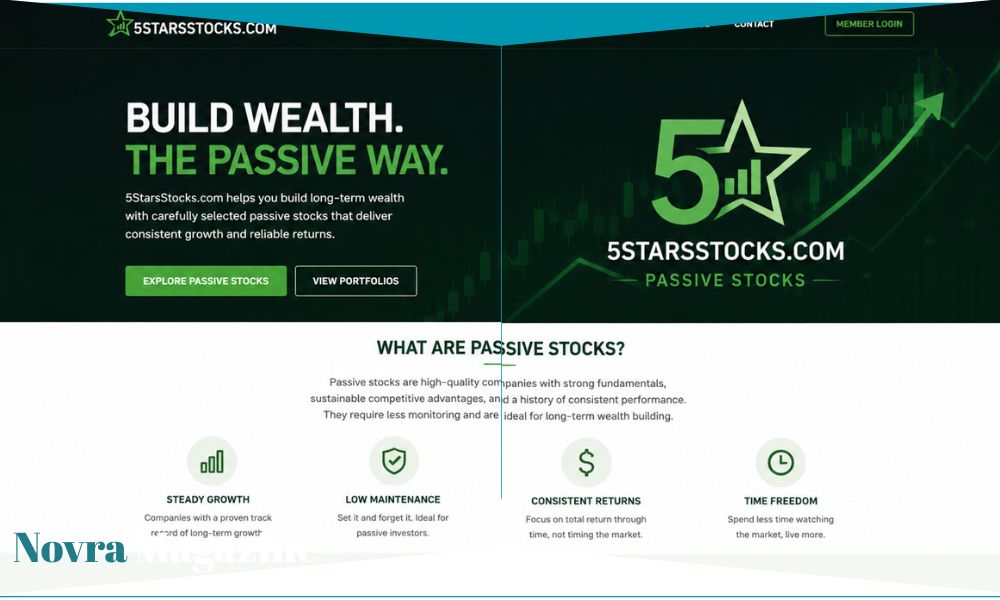
The idea sounds almost too easy: choose a few stocks, leave them alone, and watch your money grow. That simple promise makes 5starsstocks.com passive stocks interesting to new investors. The website presents passive investing as a calm, long-term way to build wealth. However, “passive stocks” are not a special type of risk-free investment. Readers must understand what the term means before using any online stock idea with real money.
What Is 5StarsStocks.com?
5StarsStocks.com is a financial content website.
It publishes articles about the stock market, investment styles, industries, and individual companies. Its main categories include growth stocks, value stocks, dividend stocks, income stocks, blue-chip stocks, penny stocks, and passive stocks.
The site also covers areas such as technology, artificial intelligence, healthcare, energy, finance, cannabis, utilities, and defence.
Readers can use the website to learn basic ideas or discover companies for further research.
However, the website clearly warns that investing carries risk and that its content does not count as personal financial advice.
What Does 5StarsStocks.com Passive Stocks Mean?
The phrase refers to the website’s section about low-maintenance, long-term investing.
Its passive investing content talks about holding investments over time instead of buying and selling every day. The site also discusses regular deposits, dividend reinvestment, long-term growth, and reducing emotional trading.
However, “passive stocks” is not a formal investment class.
A stock does not become passive by itself. The investor’s strategy makes the approach passive.
For example, one person may buy a company and hold it for ten years. Another person may trade the same company several times in one week.
The first person follows a passive approach. The second follows a more active approach.
What Is Passive Investing?
Passive investing usually means buying investments and holding them for a long time.
The investor does not try to guess every daily market move. Instead, the goal is often to follow the market’s long-term growth.
FINRA explains that passive investing is also called a “buy-and-hold” strategy. Passive investors often use index funds, although a person can also take a passive approach with individual shares by making very few trades.
Think about it like this.
An active investor keeps moving plants around the garden, hoping to find the perfect place each day.
A passive investor chooses a sensible place, waters the plants regularly, and gives them time to grow.
Neither method guarantees success. Both still carry risk.
Are Passive Stocks the Same as Index Funds?
No. The two ideas connect, but they are not exactly the same.
An individual stock represents ownership in one company.
An index fund normally holds shares in many companies. It tries to follow a market index rather than choosing only a few possible winners.
Many passive investors prefer index funds because one fund can spread money across a large group of businesses.
FINRA says passive investors often rely on index funds because they can help with diversification.
A person can hold one stock for years and call the strategy passive. However, that portfolio may still carry high risk because one company controls most or all of the result.
Passive does not always mean diversified.
Does Passive Investing Mean Doing Nothing?
No.
A passive investor usually trades less often, but the person still needs a plan.
Investors should check whether their goals have changed. They should also review risk, fees, account security, and the mix of investments they own.
Some passive investors rebalance their portfolios once or twice a year.
Rebalancing means bringing the portfolio back to its planned mix. For example, a person may want 70% in stocks and 30% in bonds. Market changes can move those numbers away from the original plan.
FINRA explains that periodic rebalancing can help investors return to their chosen asset mix.
Passive investing means fewer reactions, not zero responsibility.
What Does the 5StarsStocks Website Publish About Passive Investing?
The website has a category called Passive Stocks.
Its visible articles discuss long-term wealth building, regular investing, dividend reinvestment, and ways to create income with less daily work.
One guide presents passive investing as a strategy that may offer lower costs and less emotional decision-making. Another article explains how beginners can make automatic deposits and reinvest dividends.
These ideas match some common passive-investing principles.
Still, readers should separate education from a personal recommendation.
An article cannot know a reader’s income, debt, age, emergency savings, tax position, goals, or ability to handle losses.
Who Writes for 5StarsStocks.com?
The name Anthony Walker appears on many of the website’s articles.
His author page describes him as a staff writer who focuses on equities and financial analysis. It also provides a website email address.
The public profile remains short.
It does not clearly list professional licences, university qualifications, past employers, or a long record of audited investment results.
That does not prove that the articles are wrong.
It means readers should judge each claim by its evidence, calculations, company filings, and outside confirmation.
A confident writing style cannot replace proof.
Does 5StarsStocks.com Have Contact Information?
Yes. Its contact page lists an email address and a New York mailing address.
The address shown is 101 Avenue of the Americas, ninth floor, New York, New York.
Contact information is a useful trust sign.
However, an address and email do not prove that every investment idea will perform well.
Readers should still look for clear ownership, writer qualifications, research methods, possible payments, and performance records.
Is 5StarsStocks.com a Broker?
The website appears to provide articles and investment information rather than brokerage services.
Its public pages do not present a normal trading system where users deposit money and directly buy shares. The site also states that its content is not financial advice.
Investors should never assume that a research website has the same duties as a regulated broker or adviser.
The SEC advises people to check the registration and background of any person or company recommending investments.
Investors can use FINRA’s BrokerCheck for brokers and the SEC’s adviser database for investment advisers.
Is 5StarsStocks.com a Registered Financial Adviser?
The website’s disclaimer says its information does not count as financial advice.
Public search results reviewed for this article did not clearly confirm that 5StarsStocks.com operates as a registered investment adviser.
That does not automatically make the site illegal or fraudulent.
Many publishers provide general market commentary without acting as personal advisers.
Still, the difference matters.
A general article speaks to everyone. A registered adviser may consider a client’s personal needs, risk level, goals, finances, and legal duties.
Before trusting any company with money or personal advice, check its registration yourself.
How Does 5StarsStocks.com Choose Passive Stocks?
The public passive-stock pages explain broad ideas, but they do not show a full and independently tested selection formula.
Several outside reviews describe the website as using ratings, data tools, or artificial intelligence. However, the exact calculation, data weighting, and testing method remain unclear in the public information reviewed.
This makes independent checking important.
Readers should ask basic questions:
What facts support the rating?
Which financial records did the writer use?
What price did the recommendation begin at?
How long should the investor hold it?
What risks could damage the company?
How does the result compare with a broad market index?
Without those details, a star rating may look simpler than the real decision.
Does the Website Show an Audited Performance Record?
No independently audited long-term record was clearly visible in the public pages reviewed for this article.
An audited record should show every recommendation, including losing picks. It should include starting prices, ending prices, dates, dividends, fees, and a fair market comparison.
Showing only successful ideas can create a false picture.
The SEC warns that investment newsletters may misrepresent their performance or make false track-record claims. It advises investors to investigate every opportunity independently.
Until a platform publishes complete and independently checked results, readers should treat claims about accuracy with care.
What Are the Possible Benefits of Passive Investing?
Passive investing can offer several useful benefits.
Can It Reduce Trading Costs?
Fewer trades may mean fewer transaction costs.
Modern brokers sometimes advertise free commissions, but trading can still involve other costs. These may include bid-and-ask differences, fund fees, taxes, markups, or currency charges.
FINRA says passive strategies can have lower costs because they normally need less active management.
Can It Reduce Emotional Decisions?
Markets move up and down.
Fear may push people to sell after prices fall. Excitement may make them buy after prices have already risen sharply.
A planned passive strategy can reduce these quick emotional reactions.
FINRA notes that passive investing may help people avoid panic, fear of missing out, and impulsive trades.
Can It Save Time?
A passive investor does not need to watch every price movement.
The person can follow a set plan, make regular deposits, and review the portfolio on a reasonable schedule.
This may suit people who have jobs, businesses, families, or little interest in daily trading.
Can It Support Long-Term Compounding?
Compounding happens when returns begin earning more returns.
Dividend reinvestment can buy additional shares. Those new shares may later produce more dividends.
Regular investing can also build a larger position over time.
However, the market can fall, companies can cut dividends, and past growth may not continue.
What Risks Come With Passive Stocks?
Passive investing still carries real danger.
Can a Passive Stock Lose Money?
Yes.
A company can lose customers, take on too much debt, face new competition, cut its dividend, or fail completely.
Holding a poor company for ten years does not turn it into a good company.
A long holding period gives a strong business time to grow. It can also give a weak business time to lose more value.
Is One Stock Enough?
Usually, one stock creates concentration risk.
If most of your money sits in one company, one bad event may damage the whole portfolio.
FINRA explains that diversification means spreading investments across different asset types, companies, and industries. This can help manage risk, though it cannot remove all losses.
Are Dividend Stocks Always Safe?
No.
A dividend is a payment that some companies make to shareholders. A company can reduce or stop that payment.
A very high dividend yield may even signal trouble.
The share price may have fallen because investors expect weak earnings, heavy debt, or a future dividend cut.
Income should never become the only reason for buying a company.
Can Passive Investors Miss Important Changes?
Yes.
“Buy and hold” does not mean “buy and forget forever.”
A company’s business can change. Management may make poor decisions. Debt may rise. A useful product can become outdated.
Investors should review whether the original reason for owning an investment still makes sense.
Is 5StarsStocks.com Passive Stocks Safe?
Reading the website does not carry the same risk as giving someone control of your money.
The financial risk begins when a reader buys an investment based on an article without enough research.
The website includes a warning that stock investing can cause losses and that its material does not count as personal advice.
No stock website can make investing fully safe.
Even famous companies, index funds, government bonds, and professionally managed portfolios carry some form of risk.
The better question is not, “Is this completely safe?”
Ask, “Do I understand the investment, its risks, its fees, and the evidence behind the claim?”
Is 5StarsStocks.com a Scam?
There is not enough reliable evidence to fairly call the whole website a scam.
It operates as an active financial-content site. It publishes articles, lists an author, provides contact details, and displays a risk disclaimer.
However, readers should not treat this as proof that every stock idea is accurate.
The public information reviewed does not clearly show a full ownership profile, detailed research formula, or independently audited recommendation history.
A fair conclusion is simple:
Use the website for education and possible research ideas. Do not use it as your only reason to invest.
What Warning Signs Should Investors Watch For?
The SEC warns that some online newsletters may promote stocks without clearly explaining payments or conflicts.
Problems can include paid promotion, pump-and-dump activity, hidden ownership, false performance claims, and biased research.
Watch for language such as:
- “Guaranteed profit”
- “Almost no risk”
- “Buy before midnight”
- “This stock cannot lose”
- “Secret inside information”
- “The next 1,000% winner”
- “Everyone is buying now”
Real investing always involves uncertainty.
A responsible writer should explain both the possible reward and the possible loss.
Why Do Payment Disclosures Matter?
A website may receive money to discuss a company.
Paid content does not automatically mean the company is bad. The problem starts when readers cannot see the payment clearly.
The SEC says a paid stock promoter should explain who paid, how much they paid, and what form the payment took.
Vague statements such as “we may receive compensation” may not give investors enough information.
Before acting on any stock article, look for a clear disclosure near the article itself.
Do not assume that every review is independent.
How Should You Check a Stock Idea From 5StarsStocks.com?
Treat the article as the start of your research, not the end.
What Does the Company Sell?
Make sure you understand the business.
A company should not remain a mystery after ten minutes of reading.
Ask who its customers are, why they buy, and what could make them leave.
Is Revenue Growing?
Revenue shows how much money the business brings in before expenses.
Look at several years, not only one quarter.
Growth may look exciting, but it should come from a healthy business rather than constant borrowing or one short-term event.
Does the Company Make a Profit?
Some growing companies lose money while building their businesses.
That can work for a time, but losses create risk.
Check profit margins, cash flow, and whether the company needs to sell more shares or borrow money to continue.
How Much Debt Does It Have?
Debt can help a company expand.
Too much debt can become dangerous when sales fall or interest rates rise.
Compare debt with cash, profit, and yearly cash flow.
Is the Stock Price Reasonable?
A great company can still become a poor investment when its share price becomes too high.
Investors should compare price with earnings, sales, cash flow, growth, debt, and similar companies.
Do not buy only because the price recently rose.
Are Company Leaders Buying or Selling?
Management decisions can provide useful information, though they never tell the full story.
Check official filings rather than social media rumours.
What Do SEC Filings Say?
Public American companies file financial reports with the SEC.
These reports include business risks, financial results, debt, legal problems, and management discussion.
The SEC advises investors to investigate companies independently rather than trusting stock messages or newsletters alone.
Is a Broad Index Fund Simpler Than Choosing Passive Stocks?
For many beginners, a broad index fund may offer a simpler path than selecting several individual companies.
A broad fund can hold hundreds or thousands of stocks.
This spreads the result across many businesses rather than depending on one or two names.
FINRA says some exchange-traded products can provide a convenient and cost-effective way to diversify. However, investors still need to understand fees, structure, and risk.
Mutual funds may also provide built-in diversification and professional management, but they can still lose money.
No fund fits every person. Goals, age, taxes, country, income, and risk level all matter.
Can Beginners Use 5StarsStocks.com?
Beginners may find some of the site’s simple explanations useful.
The categories can introduce ideas such as dividends, growth, value, income, and passive investing.
However, a new investor may struggle to separate confident marketing from strong analysis.
Beginners should use several independent sources.
They should also learn basic ideas such as diversification, fees, risk tolerance, financial statements, fraud warnings, and account security before buying individual shares.
FINRA advises new investors to know what they own, understand fees, diversify, and avoid hot tips or guesses.
Who May Find the Passive Stocks Section Useful?
The section may interest readers who:
- Want to learn about buy-and-hold investing
- Prefer long-term plans over daily trading
- Want ideas for further research
- Are learning about dividends
- Want to reduce emotional decisions
- Understand that every stock can fall
- Plan to verify information independently
It may not suit someone looking for guaranteed returns or a perfect list of companies that never lose money.
That list does not exist.
What Should You Never Do Based on One Article?
Never invest your emergency savings because one page sounds confident.
Do not borrow money to buy a stock that a stranger calls a sure winner.
Never place your full portfolio in one company.
Avoid sharing brokerage passwords, card numbers, identity documents, or security codes with an unknown person.
Do not rush because of fear that an opportunity will disappear.
The SEC lists high-return promises, urgent pressure, fake testimonials, fear of missing out, and suspicious payment methods among common fraud warning signs.
How Can 5StarsStocks.com Build More Trust?
The website could improve trust by publishing more detail about its work.
A full team page could list each writer’s experience and qualifications.
The site could also explain its stock-rating method in simple words.
A complete public record of every past recommendation would help readers check real results.
Clear paid-content notices would make possible conflicts easier to understand.
Independent audits could confirm performance claims.
These changes would not guarantee future success, but they would help readers judge the research more fairly.
Final Thoughts
5StarsStocks.com passive stocks is a website category built around long-term, low-maintenance investing.
The main idea is easy to understand.
Instead of chasing every price move, an investor chooses a plan, invests regularly, and gives the portfolio time.
This approach may reduce trading costs and emotional decisions. It may also help investors focus on long-term goals.
However, the keyword can create confusion.
There is no special group of stocks that becomes safe simply because someone calls them passive. Individual companies can still lose money, cut dividends, take on heavy debt, or fail.
The website publishes educational content and clearly warns that investing carries risk. It also lists an author and contact information.
Still, readers should look for more than a polished article.
The public information reviewed does not clearly show a complete rating formula or an independently audited performance record.
Use 5StarsStocks.com as one research starting point.
Check company filings. Compare several trusted sources. Study debt, cash flow, profit, valuation, and business risks.
For many beginners, a broad and low-cost diversified fund may offer a simpler passive strategy than choosing individual stocks.
Most importantly, remember this simple rule:
Passive investing can reduce how often you trade. It cannot remove the chance of losing money.
Frequently Asked Questions
What is 5StarsStocks.com passive stocks?
It is a website section that discusses long-term, lower-maintenance stock investing and related strategies.
Are passive stocks a real type of stock?
Not exactly. “Passive” normally describes how an investor manages a portfolio, not a special legal class of shares.
What is passive investing?
Passive investing usually means buying investments and holding them for a long period instead of trading often.
Is passive investing the same as doing nothing?
No. Investors still need a plan, diversification, occasional reviews, and periodic rebalancing.
Does 5StarsStocks.com sell stocks?
Its public pages mainly provide financial articles and research ideas. They do not appear to operate as a normal stockbroker.
Is 5StarsStocks.com financial advice?
The website says its content is educational and does not count as financial advice.
Who writes for 5StarsStocks.com?
Anthony Walker appears as a staff writer on many articles. His public author page gives only a short professional description.
Is 5StarsStocks.com regulated?
Public search results reviewed for this article did not clearly confirm registration as a broker or investment adviser. Users should check official regulatory databases themselves.
Is 5StarsStocks.com safe to use?
Readers can use it for education, but they should independently check every investment idea before risking money.
Is 5StarsStocks.com a scam?
There is not enough reliable evidence to call the whole website a scam. However, investors should not rely on it as their only research source.
Does 5StarsStocks.com show audited results?
No clear independently audited long-term performance record was found in the public pages reviewed.
Can passive stocks lose money?
Yes. Every stock can fall, and some companies can fail completely.
Are dividend stocks passive stocks?
They can form part of a passive portfolio, but dividends are not guaranteed. Companies may reduce or stop them.
Are passive stocks better than index funds?
Not always. Individual stocks may create more concentration risk. Broad index funds can spread money across many companies.
What is the main benefit of passive investing?
It may lower costs, save time, and reduce emotional trading.
What is the biggest risk of choosing individual passive stocks?
A single company may perform badly and cause a large portfolio loss.
How often should a passive investor review a portfolio?
The right schedule depends on the person, but many investors review and rebalance on a planned basis rather than reacting every day.
Should beginners buy stocks from an online list?
Beginners should never buy only because a website recommends a company. They should check official filings and independent research first.
Where can investors check a company’s financial reports?
Investors can review official company filings through the SEC’s EDGAR system when the company files in the United States.
What should I check before buying a passive stock?
Review the business, revenue, profits, cash flow, debt, valuation, competition, dividend safety, and major risks.
Can passive investing guarantee wealth?
No. Passive investing may support a long-term plan, but it cannot promise profit or prevent losses.
For more info, visit novra magazine