Introduction
With product development, time is the biggest differentiating factor. However, even when adopting digital technologies, numerous teams face numerous roadblocks on the journey from conceptual designs to the final part.
Gap 1: Confusing Cost Estimation vs. Strategic Process Planning
The first significant gap is that between an ambiguous pricing quote and a rich data-driven manufacturing analysis. As we know, a regular online CNC Machining Quote tends to look like a simple numerical cost estimate, without any information about the strategic decision-making processes involved: which machine will produce the part – 3, 3+2, or 5-axis? It makes engineers make risky decisions based on ambiguous estimates without knowing what exactly they are dealing with.
l Price Quote vs. Manufacturing Strategy Report: A more sophisticated price quotation must contain the information about manufacturing process flows, reasons to select a certain machine tool type, etc.
l Interpreting Tolerances into Process Complexity: The relationship between the tolerance indicated and the cost incurred by manufacture is not always clear. Indication of a particular geometry tolerance according to industry standards such as ASME Y14.5 mandates the machine process, the setups required, and the instrumentation used to ensure compliance.
Gap 2: Post-fact DFM versus Concurrent Design Collaboration
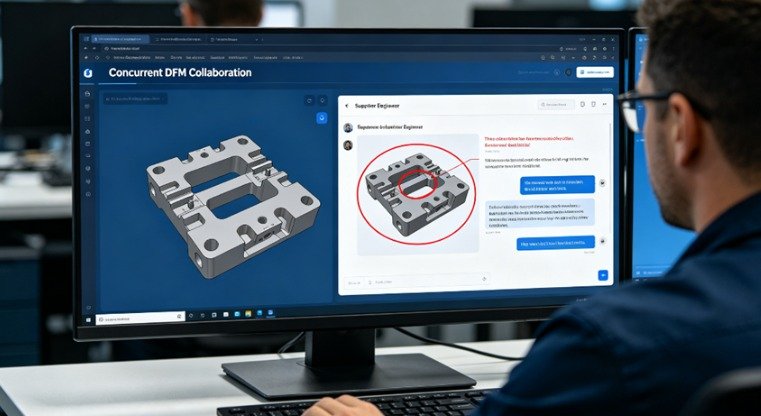
The second gap concerns the difference between reactive post-fact DFM and proactive concurrent design collaboration. In a traditional scenario, DFM comments are provided at the stage when the quote has already been accepted, usually uncovering design mistakes that might have been prevented at an early stage, which consumes unnecessary resources. The best approach would be to integrate DFM analysis at the very beginning of working with the supplier.
1. From Reference Manuals to Interactive Design
Although DFM guidelines are valuable sources, their analysis still cannot replace dynamic part-specific review. The platform must conduct automatic analysis on its own after the user uploads his/her design. For example, it can immediately detect potentially problematic elements such as thin walls, deep holes, or sharp inner edges. This will turn DFM review into immediate interactive discussion.
2. Allowing Real Time Collaboration for Engineering
The best DFM is a dialogue and not an exposition. In modern software, the engineer and the manufacturer’s representative must have the ability to see the same model together, add annotations, and discuss changes in real time. This function of online engineering assessment is similar to how information sharing takes place in collaborative groups such as the GrabCAD Blog. What took a week of emails before can now happen within minutes of real-time discussion.
Gap 3: The Production Black Box vs. End-to-End Digital Thread
The period after handing over a part for production is characterized by nervousness and uncertainty on the part of some teams. The third gap is the problem of a “production black box.” It occurs when the customer has no information about how the production takes place except for the promise of delivering it on the promised ship date. To fill the gap, it is necessary to implement an end-to-end digital thread from the factory to the customer’s office.
1. Real-Time Insight into the Production Process
To break the black box, the first step is providing a real-time dashboard showing production status information. This is not just whether the workpiece is in production but more detailed information such as what particular machine is performing the operation, which stage of manufacturing the machine is currently at (e.g., roughing, finishing, inspection), and what time frame is expected relative to the plan. More sophisticated systems also provide regular photo or video updates that demonstrate the part being worked on the machine.
2. Establishing Trust through Radical Transparency
The level of transparency mentioned above is the key to establishing trust. This kind of approach turns the collaboration into teamwork. In regard to complicated and costly projects, this integration of the R&D supply chain is crucial. It enables the customer to track the development process, foresee any delays, and make appropriate decisions without having to call on the phone all the time. To have control over such complicated parts, it becomes necessary for managers to resort to monitoring tools provided via custom CNC machining services online.
Gap 4: Prototype-to-Production Disconnect and the Knowledge Transfer Issue
The Fourth Gap: Separating prototypes from production with different suppliers wastes valuable knowledge (toolpaths, fixtures, measuring tools).
- Risk of Re-Qualification: New suppliers require costly re-qualification, redeveloping processes from scratch, risking errors and inconsistent part performance.
- Solution-One Digital Thread: A digital manufacturing platform records all programs, tools, inspection requirements, and quality measures from prototyping. Production then replicates the exact process, ensuring consistency from first article to mass production.
Gap 5: Transactional Versus Partnership-Based Supplier Relationship
Gap number five, which represents the biggest and broadest gap between you and a supplier, is the type of relationship you choose to have. A relationship that is entirely transactional will only focus on trading an order for a part, and thus cannot realize the complete benefits that can be derived from a manufacturing partnership. To close this gap, you need to engage a CNC machining supplier that acts as a partner.
1. Digital Maturity of the Supplier
Before selecting a supplier as a partner, there is one criterion that should be taken into consideration – evaluating the digital maturity of the potential partner. First of all, does the supplier have any software allowing for collaboration in real time? Secondly, does the supplier offer digital production visibility as a regular service rather than an additional paid feature? Finally, can the software generate a full CNC machining instant quote which will include both the cost and a manufacturing strategy?
2. Going from Order-Taker to Innovator
The right partner will function as an extension of your engineering team. This means providing you with early feedback on DFM concerns and alternative designs that will help you avoid future problems. Partnership-based execution turns a partner from an order-taker to someone who helps your product be successful. While vetting a potential partner, look for signs of deep insights based on robust data and a collaborative platform.
Conclusion
Fixing the critical gaps in your digital manufacturing process is not about using yet another software product; it is about integrating information and cooperation to turn your manufacturing from a burden into a powerful innovation force that will accelerate itself predictably. The systematic fixing of the five crucial gaps of cost ambiguity, DFM reactiveness, production black boxes, prototypes vs. production, and the transactional relationship will turn your CNC machining services into an indispensable partner in reaching faster time-to-market.
FAQs
Q: What is the turnaround time for getting an accurate quote for an intricate CNC part?
A: The state-of-the-art digital platform will be able to offer an instant intelligent assessment of the feasibility of manufacture within minutes. The accurate quotation will definitely be delivered within 1-2 hours after discussion as it is powered by automated DFM algorithms and process know-how bases.
Q: Is my Intellectual Property (IP) protected when I share designs on an online manufacturing platform?
A: Firstly, reliable platforms will offer full security with banking-grade encryption of all data transmissions. They will also easily execute Mutual NDAs. Some even provide for adding a digital watermark to the drawing.
Q: Will the processes which have been established during prototyping easily transfer into production, with the same online supplier?
A: Absolutely. It will be one of the biggest advantages of the integrated platform as all documentation relating to your prototype will be stored within it and can be used for the actual run of production.
Author Bio
The author has vast experience in precision manufacturing and digital manufacturing; his company LS Manufacturing is a professional outfit focused on overcoming complex engineering and manufacturing problems by embracing technological processes. Interested readers who wish to go through the whole digital manufacturing process discussed in the paper can simply upload their 3D files now and have an analysis and comparison of various options through a smart manufacturing strategy report.