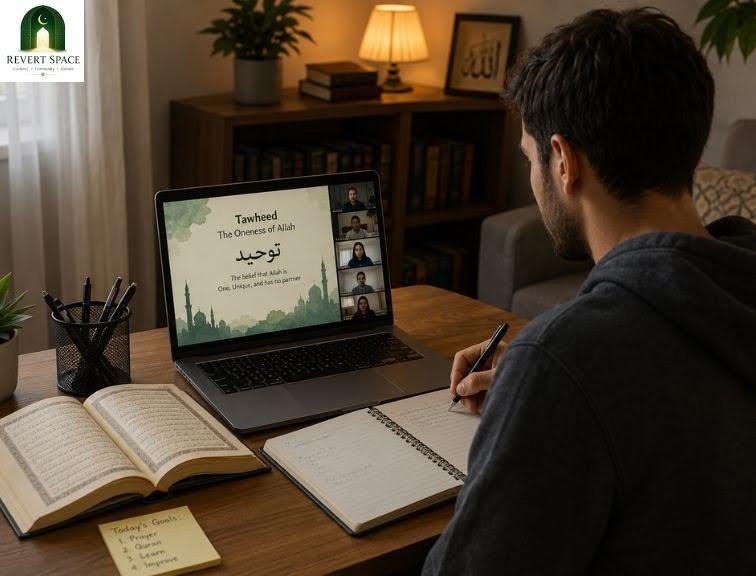
Finding the best online Islamic course should not feel harder than accepting Islam itself. Yet for many new Muslims, that is exactly what happens. Search results are crowded with generic Arabic apps, university style theology courses built for lifelong Muslims, and paid programs that never mention the word revert once. None of that answers the real question a new Muslim is asking: where do I actually start.
Why Reverts Need a Different Kind of Islamic Course
A revert’s starting point is fundamentally different from someone raised in a Muslim household. Born Muslims absorb the basics gradually, through family, childhood Quran classes, and years of cultural exposure. A revert often learns the five daily prayers, the meaning of tawheed, and basic Arabic recitation all within the same few months, sometimes while facing pushback from family or friends who do not understand the decision.
This is why the best online Islamic course for revert cannot simply be the most popular course overall. It needs to be built around a beginner’s mind, structured mentorship, and a community that understands the specific emotional weight of starting fresh.
What Makes an Online Islamic Course Actually Good
Quality in an Islamic course is not measured by production value or how polished the video editing looks. A handful of factors matter far more.
- Sequencing. A good course teaches concepts in the order a new Muslim actually needs them, starting with prayer and core belief before moving into deeper fiqh.
- Accessibility. Free or low cost access matters, since many reverts are already adjusting financially and socially during this period of their life.
- Mentorship, not just video lectures. One way content cannot answer the personal questions that come up at 11pm when doubt creeps in.
- Community. Learning alongside other reverts reduces the isolation that often accompanies conversion.
Did You Know? Surveys of new Muslims consistently show that isolation, not lack of religious knowledge, is the leading cause of reverts drifting away from practice within the first two years. A course that only teaches content without building connection is solving half the problem.
Common Gaps in Generic Islamic Courses
Most Islamic education platforms were not designed with reverts in mind. That creates predictable gaps.
- Assumed prior knowledge. Courses jump straight into advanced topics without explaining basics like wudu or the structure of a prayer.
- No revert specific FAQs. Questions like “how do I tell my family” or “what do I do if I don’t know any Arabic yet” rarely get addressed.
- No mentorship layer. Pre recorded content alone leaves new Muslims without anyone to ask when something feels confusing or overwhelming.
- High cost barriers. Some of the most polished courses charge fees that put them out of reach for someone still adjusting to a completely new way of living.
How to Evaluate the Best Online Islamic Course for Your Stage
Before committing to any program, run it through a short checklist.
- Does it start from true zero, assuming no prior Islamic knowledge or Arabic ability?
- Is there a mentor or teacher you can actually message, not just a video library?
- Does it address the revert experience specifically, including family dynamics and identity questions?
- Is it financially accessible, ideally with a free tier or free entry point?
- Does the community feel active, with other learners at a similar stage?
Pro Tip: Before enrolling anywhere, look for a free introductory class or session. A single class reveals more about teaching style and community feel than any course description ever will.
Mistakes New Muslims Make When Choosing a Course
- Choosing based on follower count or production quality alone, rather than actual teaching structure.
- Trying to consume multiple unrelated courses at once, which fragments learning instead of building it step by step.
- Skipping the mentorship option because self paced video feels easier, even though it often leads to stalled progress.
- Ignoring the community aspect, then feeling isolated a few months in when questions pile up with no one to ask.
Expert Insight: After working closely with new Muslims navigating their first year, the pattern is consistent. The people who stay consistent in their practice are rarely the ones who found the most information. They are the ones who found a mentor and a small community early, then built knowledge on top of that foundation.
What Sets Revert Space Apart
Revert Space was built specifically around the gaps described above. Rather than repackaging general Islamic education for a revert audience, the platform starts from the revert experience itself: free classes designed for zero prior knowledge, one on one mentorship for the questions that do not fit neatly into a lecture, and a community of people who are living through the same adjustment at the same time.
This structure means a new Muslim is never just handed a syllabus and left alone. Every stage, from learning the first prayer to reading early Quranic Arabic, comes with support attached. For someone searching for the best online Islamic course as a revert, that combination of free access, mentorship, and community is the actual difference between a course that gets started and one that gets finished.
If you are looking for a starting point built around exactly where you are right now, Revert Space’s free classes and mentorship programs were created for this stage of the journey.