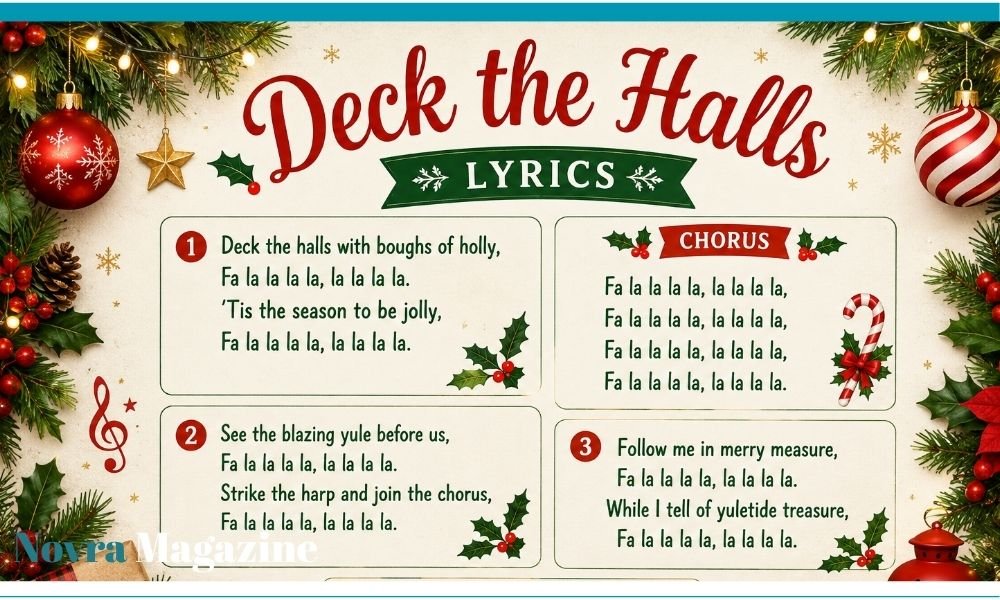
The search for deck the halls lyrics usually starts with a simple Christmas song, but the story behind it goes back hundreds of years. The familiar traditional Christmas carol “Deck the Halls” grew from an old Welsh tune connected with New Year celebrations. Its melody is much older than the English words most people know today, which makes this cheerful holiday song more interesting than it first seems.
What Is Deck the Halls?
“Deck the Halls” is one of the most famous songs heard during the Christmas season.
People sing it at family gatherings, school programs, Christmas parties, concerts, and holiday events.
Its music sounds happy and lively.
That is one reason children and adults can remember it so easily.
The song is also famous for its repeated “fa-la-la” sounds. These sounds help make the tune playful even for people who do not know every word.
Where Did Deck the Halls Come From?
The story starts in Wales.
The melody is connected with an old Welsh song called Nos Galan.
Nos Galan means New Year’s Eve.
The tune is very old. Sources trace its roots back several centuries, while surviving musical records show it was known in Wales long before the English Christmas words appeared.
This means something surprising.
“Deck the Halls” did not begin as the exact English Christmas song that people sing today.
The melody came first.
English words were added much later.
Who Wrote the Deck the Halls Lyrics?
The familiar English words are connected with Thomas Oliphant.
Oliphant was a Scottish musician and writer.
His English version appeared in 1862 in Welsh Melodies, a collection associated with Welsh musician John Thomas. The publication also included Welsh words by John Jones, who was known by the name Talhaiarn.
The important date is 1862.
That is when the English version that helped shape the modern Christmas song entered print.
Were the English Lyrics Translated From Welsh?
Not exactly.
This is a common misunderstanding.
The English words by Thomas Oliphant were not a simple word-for-word translation of the Welsh lyrics.
Instead, he created English words that worked with the old Welsh melody.
The Welsh material was connected more strongly with New Year celebrations.
Oliphant’s English version moved the song toward the Christmas traditions that English-speaking listeners recognize today.
Think about it like this.
Someone already had a beautiful old tune.
Then another writer created new words that matched the tune.
That is closer to what happened with “Deck the Halls.”
What Do the Deck the Halls Lyrics Mean?
The basic meaning is very simple.
The song is about enjoying the holiday season.
It talks about decorating.
It talks about wearing festive clothes.
It talks about singing together.
It also celebrates the end of the old year and the arrival of a new one.
The famous opening, “Deck the halls with boughs of holly,” is basically an invitation to decorate a home or gathering place with holly branches.
The whole song carries a happy message.
Celebrate.
Sing.
Decorate.
Spend time together.
Welcome the new year.
What Does “Deck the Halls” Actually Mean?
Today, many people hear the word “deck” and think about a wooden area outside a house.
That is not what it means here.
In this song, “deck” means to decorate or make something look festive.
So the title is telling people to decorate their halls.
Holly was often used as a winter decoration.
Its green leaves and bright berries made it a natural choice during a season when many other plants had lost their leaves.
The title therefore creates a very clear holiday picture.
Imagine a home filled with greenery, music, family, and winter celebrations.
That is the feeling behind the song.
Why Does the Song Mention Holly?
Holly has been connected with winter celebrations for a very long time.
Its leaves stay green through winter.
That made evergreen plants especially noticeable during the coldest months.
Over time, holly became strongly connected with Christmas decoration in many places.
So when the song talks about decorating with holly, it is describing something listeners in the 1800s could easily understand.
People today may use Christmas lights, artificial trees, wreaths, ribbons, and ornaments.
The old song uses holly to create that same festive feeling.
What Does “Don” Mean in Deck the Halls?
One word sometimes confuses younger listeners.
That word is “don.”
To don something means to put it on, especially clothing.
Merriam-Webster defines the verb as putting on an article of clothing.
So when the song uses this old-fashioned word, it is simply talking about getting dressed for the celebration.
The language sounds unusual today because people do not normally tell their children, “Go don your coat.”
They are more likely to say, “Put your coat on.”
The meaning, however, is very simple.
Why Does the Song Use the Word “Gay”?
Another word in older versions can confuse modern listeners.
The word had a common historical meaning of happy, cheerful, bright, or festive.
Words can change meaning over time.
A word that meant one thing in a song from the 1800s may be used differently in everyday conversation today.
In the context of this carol, the phrase is connected with cheerful holiday clothing.
Understanding the time when a song was written makes older language much easier to understand.
What Does Yuletide Mean?
“Yuletide” is another old word that appears in versions of the song.
It simply refers to the Christmas season.
Merriam-Webster defines Yuletide as the Christmas season or Christmastide.
Today, people might simply say:
Christmas time.
The holiday season.
The Christmas season.
Yuletide gives the song an older, traditional feeling.
What Does the Fa-La-La Part Mean?
This is one of the most memorable parts of “Deck the Halls.”
Children can often sing the fa-la-la section even when they forget the other words.
But does it have a secret meaning?
Not really.
It works mainly as a musical refrain.
Instead of adding another sentence, singers use repeated sounds that fit the melody.
This style also connects the English carol with the older musical tradition behind the Welsh tune. Versions of the melody included similar sung or instrumental passages before the modern English song became popular.
That simple refrain may also explain why the song is so easy to sing in groups.
You do not need to remember a difficult story.
Once the melody starts, almost everyone can join in.
Was Deck the Halls Originally a Christmas Song?
Not in exactly the form we know today.
The tune was linked to the Welsh New Year’s song Nos Galan.
The English version later turned it into a song strongly connected with Christmas and winter celebrations.
This is one of the most interesting facts about the carol.
Many people think it has always been a Christmas song.
Its history is actually a mix of Welsh New Year tradition and later English Christmas words.
Over time, those two parts came together.
Today, most listeners simply think of Christmas when they hear the melody.
Was the Original Title Deck the Hall?
Yes.
The early English publication used the singular form “Deck the Hall.”
The plural title “Deck the Halls” became common later.
Historical summaries say the singular title continued to appear until around the end of the 19th century.
This is a small change.
But it shows how traditional songs can slowly change as people keep singing them.
A word changes.
A line changes.
A melody is slightly adjusted.
Then one version becomes the one most people recognize.
Did the Deck the Halls Lyrics Change Over Time?
Yes.
Several versions have appeared.
This is normal for very old traditional songs.
Songs that are passed through schools, churches, families, songbooks, and performances often develop small differences.
An 1877 version published in the Pennsylvania School Journal, for example, included changes from the earlier wording. Later collections helped shape versions that became familiar to modern singers.
Some differences involve individual words.
Other versions change entire lines.
That is why two people may remember slightly different Deck the Halls lyrics even though they know the same tune.
Why Were Some Older Lines Changed?
Some early English wording was more connected with drinking and older holiday customs.
Later versions changed parts of the text.
This made the carol easier to use in schools, family settings, and other Christmas gatherings.
The changes also helped the song fit changing ideas about what a family Christmas song should sound like.
This is another reason there is no single simple story of the lyrics.
The song developed over time.
Why Are There Different Deck the Halls Lyrics Online?
If you search the internet, you may see slightly different versions.
That does not always mean one website is completely wrong.
Traditional songs can exist in several forms.
One version may use older wording.
Another may use words taught in schools.
A recording artist may make another small change.
Even punctuation can vary.
The safest way to understand the differences is to look at the date and source of each version.
The 1862 printed form is historically important because it shows Thomas Oliphant’s early English wording.
Modern performances often use later wording.
Why Is Deck the Halls So Easy to Remember?
The melody is short and lively.
The rhythm moves quickly.
Then there is the famous repeating refrain.
All of these things make the song easy to remember.
It also does not tell a long complicated story.
Instead, it creates quick pictures.
Decorations.
Music.
Winter.
Celebration.
A new year.
Those simple ideas work well for children and adults.
That may be one reason the song has survived for so many generations.
Is Deck the Halls a Religious Christmas Carol?
“Deck the Halls” is commonly called a Christmas carol.
However, its familiar lyrics focus mainly on seasonal celebration rather than telling the biblical story of the birth of Jesus.
There are no central lyrics about Bethlehem, the shepherds, Mary, Joseph, or the manger.
Instead, the song focuses on decorating, singing, celebrating, winter weather, and welcoming a new year.
This makes it different from strongly religious Christmas hymns.
People can sing it at churches, but it also works easily at schools, shops, family parties, and public holiday events.
Is Deck the Halls About Christmas or New Year?
The answer is really both.
The English song became strongly connected with Christmas.
But the melody came from a Welsh New Year tradition.
The song’s later sections also look toward the passing of the old year and the arrival of the new year.
So the song sits comfortably between Christmas and New Year’s celebrations.
That makes sense when you remember that these holidays come only days apart.
Who Was Thomas Oliphant?
Thomas Oliphant was born in 1799 and became involved in music and writing.
Today, his name is especially remembered because of the English words associated with “Deck the Halls.”
He died in 1873.
That means he did not live to see every later version of the song that spread around the English-speaking world.
His work, however, helped turn an old Welsh melody into one of the most recognizable Christmas songs today.
The 1862 Welsh Melodies publication remains an important part of that history.
Who Was John Thomas?
John Thomas was an important Welsh harpist and composer.
He worked on Welsh Melodies, the collection in which Oliphant’s English words appeared.
The project brought Welsh music together with Welsh and English poetry.
WorldCat records the 1862 publication with John Thomas, Talhaiarn, and Thomas Oliphant connected to the work.
Without this collection, the modern history of “Deck the Halls” may have looked very different.
It helped carry an old Welsh melody into a wider musical world.
What Does Nos Galan Mean?
Nos Galan means New Year’s Eve in Welsh.
This name gives us an important clue about the song’s early history.
Before English-speaking families knew the tune as a Christmas carol, the melody had strong links with New Year celebration in Wales.
That is why references to the passing year feel so natural in later versions.
The song carries pieces of both traditions.
How Old Is Deck the Halls?
There are two answers.
The melody is several centuries old.
The familiar English words date from the 19th century.
Oliphant’s English version appeared in 1862, which means those words are now more than 160 years old.
The Welsh musical roots go back much further.
So when families sing the song today, they are joining a musical tradition that has survived for generations.
Is Deck the Halls in the Public Domain?
The original song is old enough that the historical composition and Oliphant’s 1862 words are in the public domain.
A scan of the original printed version is identified as public domain by Wikimedia Commons.
However, there is an important difference.
A modern singer’s recording can still have its own copyright.
Think about it like this.
The old song itself may be free to perform.
But a recording made by a modern artist belongs to the people who created that recording.
The song and the recording are not exactly the same legal thing.
Why Do Children Like Deck the Halls?
It is easy to sing.
It sounds cheerful.
The repeated refrain gives children a part they can remember quickly.
The song also creates bright Christmas pictures without telling a difficult story.
A child can imagine decorating a room.
They can imagine everyone dressed for a holiday party.
They can imagine family and friends singing together.
That makes the carol easy to use in school performances and family celebrations.
Why Is Deck the Halls Still Popular Today?
Christmas traditions often survive because families repeat them.
A grandparent sings a song.
A parent remembers it.
A child learns it.
Years later, that child may teach it to another generation.
“Deck the Halls” also appears in holiday movies, television shows, advertising, school concerts, albums, and Christmas playlists.
Famous performers have recorded their own versions over the years.
Each new performance introduces the old Welsh melody to another group of listeners.
The song feels traditional, but it never completely disappears.
Are All Modern Recordings the Same?
No.
Some recordings are slow.
Others are very fast.
Some use a choir.
Others use pop music, jazz, orchestras, children’s voices, or a cappella singing.
Artists may also repeat parts, shorten sections, or use slightly different wording.
That does not change the basic history of the song.
It simply shows how flexible an old melody can be.
Why Do People Search for Deck the Halls Lyrics Every Christmas?
There are several simple reasons.
Some people forget a line.
Parents may need the song for a family Christmas activity.
Teachers may be planning a school concert.
Choir members may want to understand the words.
Others simply hear the song in a movie or shop and want to know its history.
The keyword deck the halls lyrics therefore becomes especially useful during the holiday season.
But understanding the song can be more interesting than simply reading the words.
Once you know its Welsh beginning, the old-fashioned vocabulary makes much more sense.
What Is the Main Message of Deck the Halls?
The message is joy.
Celebrate the season.
Decorate your surroundings.
Dress for the occasion.
Make music.
Sing with other people.
Enjoy the moment.
Then welcome the new year.
There is no complicated lesson hidden inside the song.
Its power comes from being simple.
That may be exactly why it has lasted so long.
FAQs About Deck the Halls Lyrics
Who wrote the Deck the Halls lyrics?
Thomas Oliphant wrote the well-known English words associated with the carol. They appeared in print in 1862.
Where did Deck the Halls come from?
Its melody comes from Wales and is connected with the traditional song Nos Galan, meaning New Year’s Eve.
When were the English Deck the Halls lyrics written?
The familiar English version was published in 1862.
Is Deck the Halls a Welsh song?
Its melody is Welsh. The familiar English words were written later by Scottish musician Thomas Oliphant.
What does Deck the Halls mean?
It means to decorate rooms or gathering places for a celebration.
What does don mean in Deck the Halls?
“Don” means to put on clothing.
What does Yuletide mean?
Yuletide means the Christmas season.
Why does Deck the Halls say fa-la-la?
The repeated sounds work as a musical refrain. They help create the cheerful rhythm that makes the song easy to sing.
Was Deck the Halls originally about Christmas?
The melody came from a Welsh New Year’s tradition. The later English words helped turn it into the Christmas carol people recognize today.
Was the song originally called Deck the Hall?
Yes. The early title used the singular “Hall.” “Deck the Halls” became the more familiar title later.
Are there different versions of Deck the Halls lyrics?
Yes. Different versions have appeared over the years because some words and lines changed as the song was republished and performed.
Is Deck the Halls religious?
It is considered a Christmas carol, but its familiar words focus mainly on seasonal celebration, decoration, music, and the new year rather than a specific biblical story.
Is Deck the Halls public domain?
The historic composition and the 1862 English version are old enough to be in the public domain, although modern recordings can still have their own copyright.
What language was the original Deck the Halls song?
The melody comes from Welsh tradition. The famous English words were created much later.
How old is Deck the Halls?
The English words are more than 160 years old, while the Welsh melody has much older roots.
Final Thoughts
The story behind deck the halls lyrics is much bigger than a short Christmas sing-along.
The melody began in Wales.
It was connected with New Year’s Eve.
Then Thomas Oliphant created English words that appeared in 1862.
Over time, some lines changed.
The title changed from singular to plural.
New singers recorded it.
Schools taught it to children.
Families sang it at Christmas.
Yet the cheerful heart of the song stayed almost the same.
It is about decorating, singing, celebrating together, and welcoming a new season.
That simple feeling has helped “Deck the Halls” survive for generations.
The next time you hear its familiar melody during Christmas, you will know that you are listening to a tune with centuries of history behind it.
For more info, visit Novra Magazine.