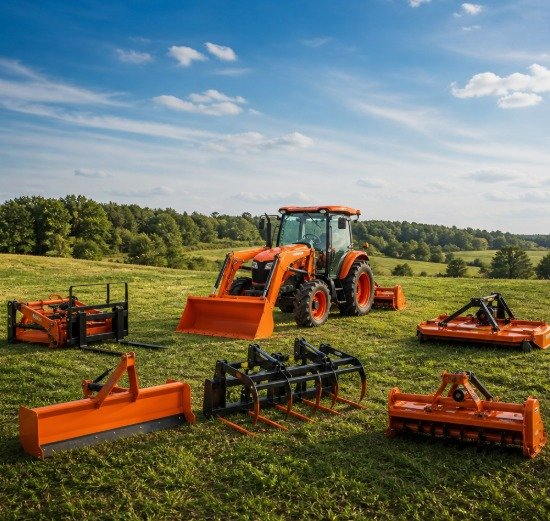
Farming has always demanded versatility. Whether you are managing a small family holding or operating a large-scale agricultural enterprise, the machinery you choose — and how you equip it — can define the difference between a productive season and a frustrating one. Kubota tractors have long held a respected place in the agricultural world, known for their reliability, fuel efficiency, and adaptability across a wide range of tasks. But the tractor itself is only part of the story. The attachments you pair with it are what truly unlock its potential.
Why Attachments Matter More Than Ever
Modern farming is not a single-task operation. On any given day, a farmer might need to move soil, lift bales, clear brush, grade a track, or prepare a seedbed. Purchasing a separate machine for each of these jobs is neither practical nor economical. This is precisely where tractor attachments earn their value — they transform a single piece of equipment into a multi-functional workhorse capable of adapting to the season’s demands.
The agricultural machinery market has evolved significantly over the past decade. Manufacturers have invested heavily in engineering attachments that are not only more durable but also smarter in their design, reducing operator fatigue and improving output per hour. For Kubota owners specifically, the range of compatible attachments has expanded considerably, giving farmers more options than ever before to customise their setup.
Matching the Right Attachment to the Right Task
One of the most common mistakes farmers make is purchasing attachments based on price alone rather than compatibility and intended use. A front loader bucket that is too large for the tractor’s hydraulic capacity will underperform and potentially cause mechanical strain. Similarly, a rotary tiller that exceeds the power take-off rating of the machine will wear out prematurely. Understanding the specifications of your Kubota model before investing in attachments is not just advisable — it is essential.
Soil type, terrain, crop variety, and farm size all play a role in determining which attachments will deliver the best return on investment. A farmer working on heavy clay soil will have very different needs from one managing sandy loam. Consulting with experienced dealers and reading detailed equipment guides can save considerable time and money in the long run.
The Most Valuable Attachments for Kubota Operators
Across the farming community, certain attachments consistently prove their worth season after season. Front loaders remain among the most popular, offering unmatched utility for moving materials, loading trailers, and handling bales. Box blades are another staple, particularly useful for grading driveways, levelling paddocks, and backfilling trenches. Post hole diggers, rotary cutters, and landscape rakes each serve specific but frequently needed purposes on working farms.
For those involved in livestock management, bale spears and pallet forks are indispensable. They reduce manual handling, speed up feeding routines, and allow a single operator to accomplish tasks that would otherwise require additional labour. In arable operations, subsoilers and disc harrows help prepare ground efficiently, breaking up compaction and improving drainage ahead of planting.
Forage and Harvesting Considerations
For farmers involved in grass and forage management, equipment innovation continues to move at pace. Manufacturers are developing increasingly sophisticated solutions to improve throughput and reduce crop losses during harvest. A recent example worth noting is the development of advanced grass pickup systems for forage harvesters — innovations that are reshaping how efficiently farms can process large volumes of material. You can read more about one such advancement in this detailed report on the new UltraFeed grass pickup for New Holland FR forage harvesters, which highlights how targeted engineering improvements can have a meaningful impact on farm productivity.
While Kubota attachments are primarily associated with compact and utility tractors, the broader principle applies across all machinery categories: the right accessory, properly matched to the base machine, dramatically improves operational efficiency. Farmers who invest time in understanding their equipment options consistently outperform those who rely on a one-size-fits-all approach.
Making Informed Decisions as a Farmer
The agricultural sector has always rewarded those who combine practical experience with a willingness to learn. Farming knowledge is not static — it evolves alongside technology, market conditions, and environmental pressures. Staying informed through trusted sources, whether that is trade publications, machinery expos, or peer networks, is part of what separates consistently productive farms from those that struggle to adapt.
There is also a cultural dimension to farming that is often overlooked in purely technical discussions. The values, traditions, and creative thinking that shape rural communities have a profound influence on how farmers approach problem-solving. Exploring broader perspectives — including those found in thought-provoking editorial content like that featured in Novra Magazine — can offer unexpected insights that translate into more thoughtful, innovative approaches to land management and resource use.
Budgeting for Attachments Without Compromising Quality
Cost is always a consideration, but it should never be the only one. Cheap attachments that fail after a single season cost far more in the long run than quality equipment purchased at a higher initial price. When budgeting for attachments, farmers should factor in not just the purchase price but also maintenance requirements, parts availability, and the manufacturer’s warranty terms. Kubota’s own branded attachments are engineered to integrate seamlessly with their tractors, but there are also reputable third-party manufacturers whose products offer excellent value when chosen carefully.
Leasing and hire purchase options have also become more accessible in recent years, allowing smaller operations to access high-quality equipment without the burden of full upfront costs. Speaking with agricultural finance specialists can open up options that many farmers are not aware of.
About HR Agri Power
HR Agri Power is a trusted name in agricultural machinery, offering farmers expert guidance and a comprehensive range of equipment solutions. With deep knowledge of the Kubota product range and a commitment to helping customers make informed purchasing decisions, the team at HR Agri Power provides the kind of practical, experience-backed advice that makes a real difference on working farms. Their resources are designed to help both new and established farmers navigate the often complex world of tractor attachments and agricultural equipment with confidence.
Getting Started with the Right Resources
For farmers who are new to Kubota machinery or looking to expand their current attachment setup, having access to reliable, well-structured information is the first step. The Kubota Attachments Guide from HR Agri Power offers a clear, practical breakdown of the top five attachments that deliver the most value across a range of farming operations. It covers compatibility considerations, use cases, and key features to look for — making it an excellent starting point for anyone looking to get more from their Kubota tractor.
Conclusion
Choosing the right attachments for your Kubota tractor is one of the most impactful decisions you can make as a farmer. It affects your daily efficiency, your operational costs, and ultimately your farm’s profitability. By taking the time to understand your specific needs, consulting reliable sources, and investing in quality equipment that is properly matched to your machine, you position your operation for long-term success. The tools are available — the key is knowing which ones are right for you.