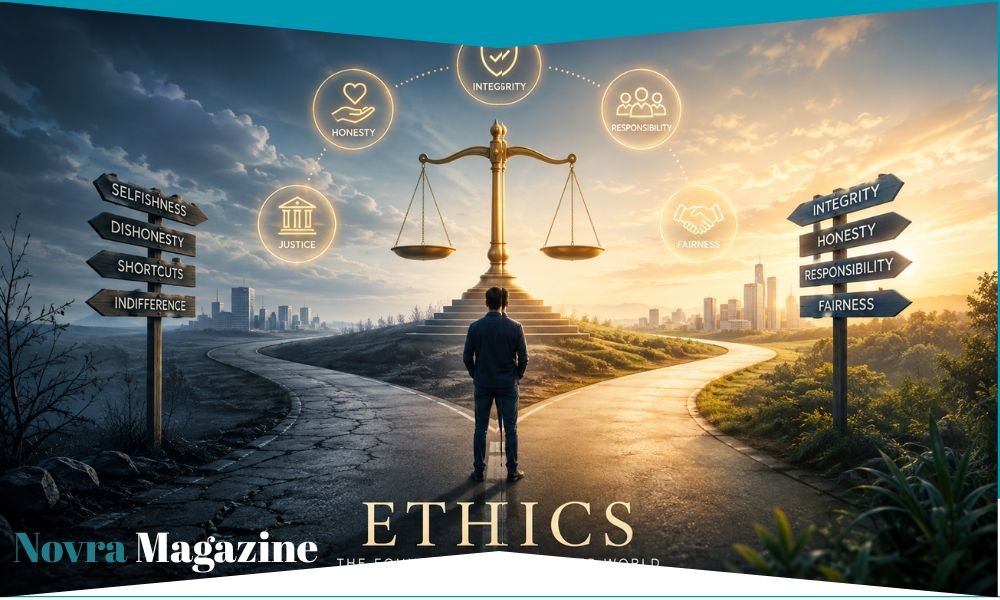
A cashier gives you too much change. Nobody notices. You could quietly keep the money, but something inside you asks, “What is the right thing to do?” That small question takes us straight into ethics, the study of right and wrong, good and bad, fairness, duty, character, and the choices people should make. Ethics may sound like a difficult school subject, but it appears in normal life every day—from telling the truth to protecting a patient, running a company fairly, reporting news honestly, or deciding how artificial intelligence should treat people.
What Is Ethics in Simple Words?
Ethics is the study of how people should behave.
It asks questions such as:
What is right?
What is wrong?
What is fair?
What do we owe other people?
What kind of person should we try to become?
Philosophers often call ethics moral philosophy. It studies moral rules, values, choices, duties and character.
Let’s understand this simply.
Ethics does not only ask, “What can I do?”
It also asks, “What should I do?”
That one word—should—is very important.
Why Does Ethics Matter in Everyday Life?
Imagine your best friend tells you a secret.
Later, another person offers you money to reveal it.
There may be no police officer standing beside you.
There may be no written contract.
But you still have an ethical decision.
Should you protect your friend’s trust?
Should you tell the truth if the secret could hurt someone?
What if keeping the secret creates danger?
Ethics helps us think carefully when the answer is not obvious.
It becomes especially important when two good values clash.
For example, honesty is good.
Privacy is also good.
But sometimes telling the truth can break someone’s privacy.
Ethical thinking helps people decide what matters most in a difficult situation.
Is Ethics the Same as Morality?
People often use ethics and morality as if they mean exactly the same thing.
There is a lot of overlap.
Morality usually refers to ideas, rules or standards about right and wrong behaviour.
Ethics can refer to the philosophical study of those moral ideas.
Think about it like this.
Morality may say:
“Lying is wrong.”
Ethics then asks:
Why is lying wrong?
Is lying always wrong?
What if a lie saves someone’s life?
Where does the rule come from?
That is where ethical thinking begins.
Is Ethics the Same as Law?
No.
Something can be legal but still raise ethical concerns.
Something can also be illegal while people argue that it is morally justified.
Law tells people what a government formally allows or forbids.
Ethics asks what is right or responsible.
The two often support each other, but they are not identical.
For example, a business may technically follow the law while treating customers in a way many people consider unfair.
Ethics asks whether “legal” is enough.
Often, it is not.
Is Ethics the Same as Religion?
Not exactly.
Religions have important moral teachings, and religious beliefs strongly shape ethical thinking for many people.
But ethics is also studied outside religion.
Philosophers can ask questions about right and wrong using reason, human experience, consequences, duties or ideas about good character.
The Stanford Encyclopedia of Philosophy notes that morality can be discussed separately from both law and religion, even though the areas often influence one another.
So a person can study ethics whether they are religious, non-religious or unsure.
What Are the Three Main Branches of Ethics?
A common modern way to divide ethics is into three large areas:
Normative ethics
Applied ethics
Metaethics.
These names sound difficult.
The ideas are easier than the words.
Let’s take them one at a time.
What Is Normative Ethics?
Normative ethics asks:
How should people act?
It tries to find principles that can help us judge whether an action is right or wrong.
Suppose you find a wallet.
Normative ethics asks what rule should guide your choice.
Should you return it because returning property is your duty?
Should you return it because it creates the best result?
Should you return it because an honest person would do that?
Those different answers lead us to some of the biggest ethical theories.
What Is Applied Ethics?
Applied ethics takes ethical ideas and uses them on real problems.
Examples include:
Medical ethics.
Business ethics.
AI ethics.
Environmental ethics.
Journalism ethics.
Research ethics.
Animal ethics.
Questions about war.
Questions about technology.
Questions about privacy.
The Internet Encyclopedia of Philosophy describes applied ethics as the part of ethics that deals with practical moral issues.
This is often the part of ethics ordinary people notice most.
It deals with decisions happening right now.
What Is Metaethics?
Metaethics asks a stranger and deeper question:
What does “right” even mean?
Instead of asking whether stealing is wrong, metaethics may ask what people mean when they call something “wrong.”
Are moral truths real?
Do moral values exist independently of human opinion?
Can a moral statement be true or false?
The Stanford Encyclopedia of Philosophy describes metaethics as the study of the deeper assumptions behind moral thought, language and practice.
It sounds abstract because it is.
But it matters.
Before arguing about which moral rule is correct, philosophers sometimes want to know what a moral rule actually is.
What Is Virtue Ethics?
Virtue ethics focuses on character.
Instead of only asking, “What rule should I follow?” it asks:
“What kind of person should I become?”
Important virtues can include:
Honesty.
Courage.
Kindness.
Patience.
Fairness.
Generosity.
Wisdom.
Virtue ethics is one of the major approaches in modern normative ethics, and its historical roots are strongly connected with Aristotle.
Aristotle believed ethics was connected with learning how to live well and developing good character over time.
Think about a child learning honesty.
One truthful answer does not automatically make the child an honest person.
Honesty becomes part of character through repeated choices.
That is the heart of virtue ethics.
What Is Duty-Based Ethics?
Duty-based ethics is often called deontology.
The basic idea is that some actions are right or wrong because of duties, rules or principles—not only because of what happens afterward.
German philosopher Immanuel Kant became one of the most famous thinkers connected with this approach.
Kant argued that morality should be based on rational principles that apply regardless of our personal desires.
Let’s make that easier.
Imagine cheating would help you win.
A duty-based approach might say cheating is still wrong because honesty and fair rules should apply to everyone.
The good result for you does not erase the dishonest action.
What Is Consequence-Based Ethics?
Another major way to think about ethics focuses on results.
The idea is simple:
When choosing what to do, think carefully about what will happen afterward.
One famous form of consequence-based ethics is utilitarianism.
It generally asks which choice will produce the greatest overall good or well-being.
This can become difficult very quickly.
Imagine a decision helps 100 people but badly harms one innocent person.
Is it still right?
That question shows why ethical philosophy remains debated.
Different theories can point toward different answers.
Which Ethical Theory Is Correct?
There is no single theory that every philosopher accepts.
That is important.
Ethics is not like asking:
“What is 2 + 2?”
Many ethical questions involve disagreement about values, duties and consequences.
One person may focus on fairness.
Another may focus on freedom.
Another may focus on reducing harm.
Another may focus on loyalty or responsibility.
Ethical reasoning does not make disagreements disappear.
It helps people explain why they believe one choice is better than another.
What Is a Moral Dilemma?
A moral dilemma happens when important ethical duties or values seem to pull in different directions.
For example:
Your friend asks you to keep a secret.
But the secret reveals that another person may be in serious danger.
You have two important values:
Loyalty.
Safety.
Keeping the secret protects one.
Breaking the secret may protect the other.
There may be no perfect answer.
Ethical dilemmas are difficult because choosing one value can mean giving up another.
What Is Personal Ethics?
Personal ethics are the principles a person tries to follow in private life.
They may include:
Tell the truth.
Keep promises.
Do not steal.
Treat people fairly.
Help people in need.
Take responsibility for mistakes.
Respect other people’s boundaries.
Personal ethics can be shaped by family, culture, religion, education, experience and personal reflection.
They can also change as someone grows and learns.
A teenager may understand responsibility very differently at age 18 than at age 10.
What Is Professional Ethics?
Professional ethics are standards connected with a particular job.
Different professions have different responsibilities.
Doctors handle people’s health.
Lawyers handle legal rights.
Journalists publish information that can affect reputations.
Psychologists work with private and deeply personal information.
Scientists conduct research that may involve human participants.
Because these jobs carry special power, professional organisations often create ethical codes.
The American Psychological Association, for example, maintains an ethics code for psychologists’ professional activities.
What Is Medical Ethics?
Medical ethics deals with difficult questions in healthcare.
A doctor may need to ask:
Does the patient understand the treatment?
Did the patient freely agree?
Will this treatment help?
Could it cause harm?
Are limited medical resources being distributed fairly?
WHO identifies issues such as respect for patient choice, protection of vulnerable people and fair distribution of resources as important health-ethics concerns.
Health ethics often uses principles such as respect for persons, beneficence, justice and solidarity.
What Is Bioethics?
Bioethics looks at ethical questions involving medicine, biology, public health and life sciences.
It may examine:
Organ donation.
Genetic testing.
Human research.
End-of-life care.
Reproductive technology.
Gene editing.
Medical AI.
Public-health decisions.
Johns Hopkins describes bioethics as a field that studies moral questions arising in healthcare, life sciences, research and public policy.
UNESCO’s Bioethics and Human Rights framework connects these questions with human dignity and fundamental rights.
Why Is Consent an Ethical Issue?
Consent means a person agrees to something with enough understanding and freedom to make a real choice.
This is especially important in healthcare and research.
A patient should normally understand what a treatment involves.
A research participant should understand what researchers plan to do.
WHO says research involving human beings should receive ethical review designed to protect participants’ dignity, rights and welfare.
Without proper consent, a person can be treated like an object rather than a human being with choices of their own.
That is why consent is both practical and ethical.
What Is Research Ethics?
Research ethics guides scientists when their work can affect people, animals, communities or the environment.
Researchers may have exciting ideas.
But scientific progress does not mean “anything goes.”
Research involving humans must consider safety, privacy, fairness and informed participation.
WHO says research ethics exists to protect the dignity, rights and welfare of human participants.
This matters because history has shown that research can cause serious harm when human beings are treated as tools instead of people.
What Is Business Ethics?
Business ethics asks how companies should behave.
Making money is an important part of business.
But ethics asks what limits should exist while making that money.
Should a company hide a dangerous product problem?
Should workers receive safe conditions?
Should customer information be protected?
Should a company pay bribes?
What responsibility does it have toward the environment?
The OECD’s responsible-business guidelines cover areas including human rights, labour, environmental impacts, bribery, consumers, disclosure, technology, competition and taxation.
Ethical business therefore means more than following one rule.
It involves thinking about how a company’s choices affect many different people.
Can a Company Be Legal but Unethical?
Yes.
Law usually sets a minimum requirement.
Ethics can demand more.
Imagine a company discovers that its product has a small problem.
The law may not require an immediate public warning.
But company leaders may still believe customers deserve to know.
That becomes an ethical choice.
The OECD encourages companies to look for and address harmful impacts involving workers, human rights, the environment, consumers and business relationships.
A responsible company asks not only:
“Can we legally do this?”
It also asks:
“Should we?”
What Is Journalism Ethics?
Journalism ethics deals with the responsibility of people who report news.
Journalists can affect elections.
They can damage reputations.
They can expose wrongdoing.
They can also spread false information if they are careless.
The Society of Professional Journalists’ long-standing ethical framework centres on four broad ideas:
Seek truth and report it.
Minimize harm.
Act independently.
Be accountable and transparent.
Those ideas sound simple.
Living by them can be difficult.
Why Can Truth and Harm Conflict in Journalism?
Imagine a journalist discovers a fact that is true but extremely private.
Should it be published?
The answer depends partly on whether the information serves a real public interest.
Truth matters.
But harm matters too.
SPJ’s ethics guidance specifically tells journalists to seek truth while also treating sources, subjects and members of the public as people deserving respect.
Good journalism therefore involves more than asking:
“Is this true?”
It also asks:
“Why does the public need to know?”
What Is AI Ethics?
AI ethics has become one of the biggest modern areas of applied ethics.
Artificial intelligence can help people write, learn, diagnose disease, analyse data and perform many other tasks.
But it can also create difficult questions.
Can an AI system discriminate unfairly?
Who is responsible when it makes a harmful decision?
Should people know when AI is being used?
How should private data be protected?
Should AI replace human decisions in important areas?
UNESCO adopted a global Recommendation on the Ethics of Artificial Intelligence in 2021. Its framework puts human rights and human dignity at the centre and highlights ideas such as fairness, transparency, accountability and environmental responsibility.
Why Is AI Ethics So Important in 2026?
AI systems are now being used in more areas of everyday life.
That means ethical questions are no longer only theoretical.
Schools must decide how students can use AI.
Employers may use automated tools when hiring.
Doctors can use AI-assisted systems.
Governments may use automated technology.
Newsrooms are deciding how AI fits into journalism.
The more power technology gains over people’s lives, the more important questions of fairness, accountability and human responsibility become.
UNESCO’s AI ethics framework was created specifically because AI can affect societies, human rights, human dignity and the environment.
Can AI Be Ethical by Itself?
AI does not solve ethical responsibility for humans.
People design systems.
People choose training data.
People decide where technology will be used.
People decide which risks are acceptable.
That means companies, governments, developers and users still have responsibilities.
An AI system may help make a decision.
But an important ethical question remains:
Who answers when the decision harms someone?
That is why accountability is a central idea in modern AI ethics.
What Is Environmental Ethics?
Environmental ethics asks what humans owe to nature, animals, ecosystems and future generations.
Suppose cutting down a forest creates jobs today.
But it also destroys wildlife habitat and damages the environment for people who will live there decades from now.
How should those interests be balanced?
Environmental ethics asks whether nature matters only because humans use it or whether animals and ecosystems have value of their own.
Climate change has made questions like these increasingly important in public policy and business.
What Is Digital Ethics?
Digital ethics concerns responsible behaviour in technology and online spaces.
Important questions include:
Privacy.
Cybersecurity.
Tracking.
Data collection.
Online harassment.
Deepfakes.
Misinformation.
Children’s online safety.
Algorithmic bias.
Companies can collect enormous amounts of information about people.
The ethical question is not simply whether the technology can collect it.
The question is whether it should.
Why Is Privacy an Ethical Issue?
Privacy gives people some control over information about themselves.
Imagine someone secretly reads every message on your phone.
Even if they never steal money, most people would feel something important had been violated.
That feeling is connected with privacy.
In healthcare and public-health work, privacy and confidentiality are treated as important ethical values, although they sometimes must be balanced with wider public interests.
Technology has made this issue harder because personal data can now be copied, analysed and shared extremely quickly.
What Is an Ethical Code?
A code of ethics is a written set of standards that helps members of an organisation or profession understand expected behaviour.
WHO, for example, has a Code of Ethics setting standards expected of its personnel.
Journalists have ethical codes.
Psychologists have ethical codes.
Companies may create ethics policies.
A code cannot make every person ethical.
Someone can break a rule.
But a clear code tells people what standards the organisation claims to expect.
It can also provide a basis for accountability.
What Are Common Ethical Values?
Different cultures and philosophies may rank values differently.
Still, several ideas appear again and again in ethical systems and professional codes.
They include:
Honesty.
Fairness.
Respect.
Responsibility.
Justice.
Compassion.
Trust.
Integrity.
Avoiding unnecessary harm.
Respect for human dignity.
Accountability.
WHO, UNESCO, OECD and professional organisations use many of these ideas when discussing ethics in health, science, business and technology.
What Is Integrity?
Integrity means trying to act consistently with your principles, including when nobody is watching.
Imagine two students take the same exam.
The teacher leaves the room.
One student sees the answer sheet sitting nearby.
There is now very little chance of being caught.
Integrity asks:
Does the student still choose not to cheat?
Ethics often becomes most revealing when a person could benefit from doing something wrong without being punished.
Is an Ethical Person Always a Good Person?
People are complicated.
Someone can make a good decision today and a bad decision tomorrow.
Ethics is not a magic label dividing humanity into “good people” and “bad people.”
It is better understood as a way of examining choices and character.
A person can make a mistake.
They can admit it.
Repair harm.
Learn.
And make a better choice next time.
Ethical responsibility includes accountability, not perfection.
Can Two Ethical People Disagree?
Absolutely.
Two people can care deeply about doing what is right and still reach different conclusions.
One person may value individual freedom most.
Another may focus on protecting the wider community.
One may emphasise consequences.
Another may emphasise duties.
One may think fairness means treating everyone exactly the same.
Another may think fairness means giving extra help to people starting from a worse position.
Ethics helps people explain these differences clearly rather than simply shouting that the other person is evil.
Does Culture Affect Ethics?
Yes.
Ideas about family, duty, privacy, justice, respect and responsibility can differ across societies and periods of history.
But this creates another ethical question.
Should every cultural practice automatically be accepted?
UNESCO’s bioethics framework supports respect for cultural diversity while also grounding ethical principles in human dignity and fundamental rights.
So respect for culture does not necessarily mean that every practice is beyond moral criticism.
Are Ethics Always Subjective?
This is one of the oldest questions in philosophy.
Some people believe moral truth exists independently of what individuals think.
Others believe morality depends heavily on human attitudes, cultures or agreements.
Metaethics studies questions like these.
There is no short answer accepted by everyone.
That is why ethical philosophy continues.
People have argued about the foundations of right and wrong for thousands of years.
How Can You Make a More Ethical Decision?
You do not need a philosophy degree.
A simple process can help.
Ask:
What are the facts?
Who could be harmed?
Who could benefit?
What promises or duties do I have?
Am I treating people fairly?
Would I be comfortable if my choice became public?
Am I hiding something because I know it feels wrong?
Would I accept the same behaviour if someone did it to me?
Is there another choice that causes less harm?
These questions do not guarantee a perfect answer.
They slow us down.
That is often exactly what an ethical decision needs.
Why Is Ethics Important for Children?
Children begin dealing with ethical questions very early.
Is it okay to take someone else’s toy?
Should you admit breaking something?
Should you include a lonely classmate?
Should you copy another student’s homework?
Should you tell an adult when someone is being bullied?
These are ethics questions.
Teaching ethics does not mean giving children a list of complicated philosophy words.
It means helping them think about fairness, honesty, kindness, responsibility and consequences.
Why Is Ethics Important at Work?
A workplace depends heavily on trust.
Employees trust employers to pay them fairly.
Employers trust workers not to steal.
Customers trust businesses not to lie.
Colleagues trust each other to behave respectfully.
When ethical standards collapse, that trust disappears.
The OECD describes responsible business conduct as aligning business activity with the needs of society and addressing harmful effects involving people and the environment.
Ethics can therefore affect reputation, employee loyalty and long-term business relationships.
Why Does Ethics Matter More When Someone Has Power?
Power changes the size of a decision.
If one person lies to a friend, two people may be affected.
If a government official lies about a major public danger, millions may be affected.
If a doctor behaves irresponsibly, a patient’s health can suffer.
If a technology company designs an unfair system, millions of users may experience the result.
The more power someone has, the greater the possible consequences of unethical choices.
That is why professions with major responsibilities often create special ethical standards.
Can Ethics Change Over Time?
Yes.
Societies reconsider ethical questions as knowledge and social conditions change.
New technologies also create questions older philosophers never faced.
Aristotle did not have to think about facial-recognition databases.
Kant did not have to decide whether an AI chatbot should disclose that it is artificial.
Doctors centuries ago did not have modern genetic editing tools.
The basic questions may remain familiar:
What is fair?
Who can be harmed?
Who is responsible?
But the situations keep changing.
That is one reason ethics never becomes an “finished” subject.
Why Is Ethics More Important Than Ever?
Modern technology gives individuals, companies and governments enormous power.
A piece of software can influence millions of people.
A false story can travel around the world in minutes.
Medical technology can change human biology.
Companies can hold huge amounts of personal data.
AI can make or influence decisions at extraordinary speed.
This does not mean modern life is less ethical than the past.
It means some choices now have much larger effects.
UNESCO’s work on AI and bioethics, WHO’s health-ethics programmes and OECD guidance for responsible business all show how ethical questions now sit at the centre of technology, health and global business.
FAQs About Ethics
What is ethics in simple words?
Ethics is the study of right and wrong and of how people should behave. Philosophers also call it moral philosophy.
What are the three main branches of ethics?
A common division is normative ethics, applied ethics and metaethics.
What is normative ethics?
Normative ethics tries to work out principles for deciding which actions or ways of living are morally right or wrong.
What is applied ethics?
Applied ethics uses moral ideas to examine real issues such as medicine, business, technology and the environment.
What is metaethics?
Metaethics studies deeper questions about morality itself, including what moral words and claims mean.
What is the difference between ethics and morals?
Morals usually refer to standards about right and wrong, while ethics can refer to the study and examination of those standards. In normal conversation, the two words are often used interchangeably.
Is ethics the same as law?
No. Law tells people what is legally required or forbidden. Ethics asks what is morally right or responsible. The two can overlap without being identical.
What is virtue ethics?
Virtue ethics focuses on good character and virtues such as courage, honesty and wisdom. Aristotle is strongly associated with this approach.
What is medical ethics?
Medical ethics examines questions about patient rights, treatment, fairness, harm, consent and other healthcare responsibilities.
What is business ethics?
Business ethics examines how companies should treat workers, customers, communities and the environment while conducting business.
What is AI ethics?
AI ethics studies how artificial-intelligence systems should be designed and used responsibly, including questions about fairness, transparency, human rights and accountability.
What is journalism ethics?
Journalism ethics sets standards for responsible reporting. SPJ’s framework focuses on truth, minimizing harm, independence and accountability.
Why are ethics important?
Ethics helps people make responsible decisions, protect others from harm, build trust and think carefully about fairness, rights and duties.
Can ethics change?
Ethical debates can change as societies, knowledge and technology change. New areas such as AI ethics and modern bioethics show how old moral questions can appear in new forms.
Can two people disagree ethically?
Yes. Ethical theories and values can lead thoughtful people to different answers, especially when duties, consequences, rights and fairness conflict.
Final Thoughts
Ethics may sound like a subject that belongs in a philosophy classroom.
It does not.
It belongs in a supermarket when you receive too much change.
It belongs in a hospital when a patient must choose treatment.
It belongs in a newsroom deciding whether private information should be published.
It belongs in a company deciding whether profit matters more than worker safety.
And now it belongs inside laboratories and technology companies building artificial intelligence.
At its heart, ethics asks a very human question:
What should we do?
Sometimes the answer is easy.
Do not steal.
Do not deliberately hurt someone.
Keep an honest promise.
But real life quickly becomes harder.
What happens when telling the truth causes harm?
What happens when helping many people hurts one person?
What happens when a new technology brings great benefits but also creates serious risks?
That is why ethics has survived as a field of study for thousands of years.
Aristotle connected ethical life with character and human well-being. Kant focused strongly on duty and rational moral rules. Modern applied ethics now examines everything from medical research to artificial intelligence.
The tools change.
The questions remain.
Who could be harmed?
What is fair?
What do we owe each other?
What kind of person—or society—do we want to become?
In 2026, these questions may matter even more because individual decisions can now affect people at enormous scale.
AI can influence millions.
Businesses can collect huge amounts of personal information.
Medical science can change lives in ways earlier generations could barely imagine.
Global organisations such as UNESCO, WHO and the OECD are therefore continuing to build ethical frameworks around technology, healthcare, human dignity and responsible business.
Ethics cannot promise an easy answer to every difficult choice.
What it can do is make us stop, think, question our reasons and remember that our choices affect other people.
Sometimes, that short moment of thinking is the difference between simply doing what we can do and choosing what we believe we should do.
For more info, visit novra magazine