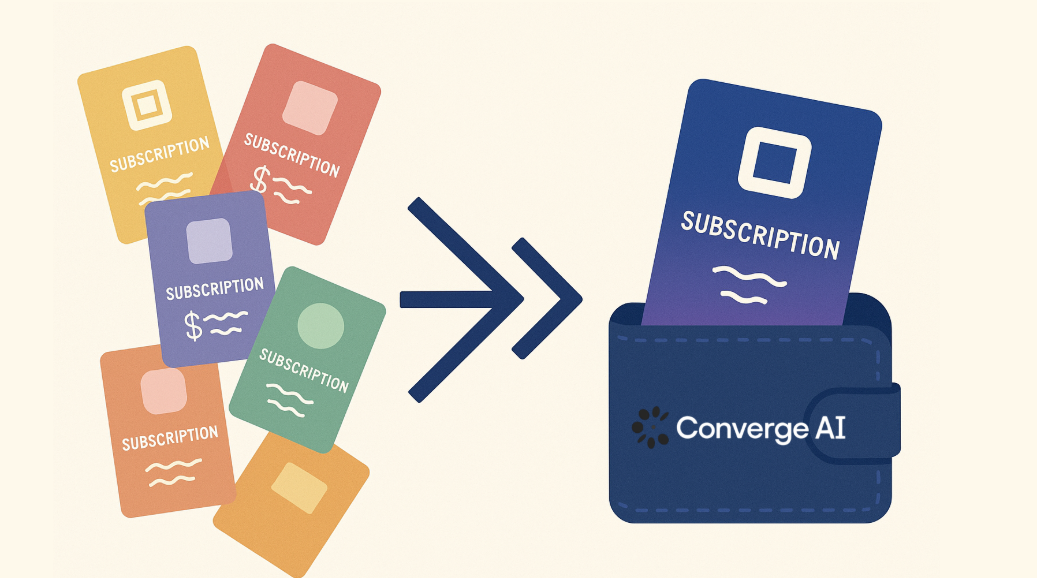
The multiple AI subscriptions can introduce unnecessary complexity to growing organizations. Multiple platforms add software expenses, diminish workflow consistency and disperse valuable business knowledge between platforms. Having a centralized AI system makes operations more streamlined and enhances collaboration and productivity. An integrated ecosystem enables organizations to develop, automate and manage projects via shared intelligence, rather than stand-alone applications.
The Challenges of Using Separate AI Platforms
The need to switch between AI platforms hinders productivity and breaks the flow of daily tasks. Teams often spend a lot of time searching for files, prompts, and updates on projects between disconnected systems. The information in the fragments also contributes to communication gaps, as departments don’t necessarily have the same working context. Duplicate subscriptions result in unwanted financial obligations and additional licensing, billing and administrative burden. Different security settings, user permissions, and software updates add to the complexity of operations. Different work processes between creative teams, developers, marketers and managers often do not work well together. This siloed world makes it slower to make decisions, as information is distributed across the various services. When conversations, assets, and project histories are stored in different platforms, it becomes challenging to retain business knowledge. It’s challenging to maintain consistent collaboration when each department relies on their own interface and disjointed workflows. Over time, organizations end up spending more time managing software than providing real business value.
Why an All-in-One AI Platform Changes Everything
By leveraging an integrated AI ecosystem that combines development, creative production, collaboration, and automation under a single umbrella, many operational hurdles are eliminated. With shared team context, various specialists can view the same project information without having to re-explain the situation or recreate workflows. One central workspace eliminates confusion as all departments are operating off the same knowledge base and reusable assets. Access to multiple sophisticated AI models offers flexibility to meet various business needs without the need for multiple subscriptions. Converge AI brings together the expertise of AI, intelligent agents, development tools, creative production, collaboration, and infrastructure all within a single workspace. This consolidated structure allows for better collaboration between technical and creative teams, and facilitates uniform processes across business functions. Project history is preserved throughout the entire business lifecycle, resulting in better knowledge retention. Administrative functions are also simplified because licensing, collaboration and workflow management are centralized rather than distributed across unrelated platforms.
Replacing Individual Creative Tools with Framia Pro
Several applications are needed for design, editing, animation, branding and video creation during the production process. Embedding all those activities in one intelligent environment makes creative workflows easier and production consistency better. Enter Pro, which helps support integrated development in tandem with connected creative operations. Image generation, editing and enhancement become more efficient thanks to revisions within an intelligent editing environment. Marketing can produce branded visuals and ensure consistent design across marketing campaigns.

Additionally, video production is streamlined with automated script generation, storyboard creation, scene generation, voiceover preparation, background music selection, and editing support. With AI to refine, enhancements can be made to layouts, visual balance, typography, and branding without switching software. Creative professionals have more control as images, videos, text, and design elements remain linked within a single production workflow. There are also reusable resources that make marketing easier, which helps organizations maintain a consistent brand.
Consolidating Development with Enter Pro
The connected planning, coding, testing, deployment and infrastructure management of modern application development is an alternative to isolated development environments. Development tools with AI capabilities facilitate the creation of functional applications from project ideas and minimize repetitive development work. Integrated coding workflows are beneficial for collaboration, as planning, editing, and deployment are all linked together during the development process. Built-in deployment capabilities remove the need for various stand-alone infrastructure services during project delivery. The developers save time in tuning business logic rather than setting up deployment environments over and over again. A shared project context facilitates communication between technical teams and business stakeholders in the software development process. With infrastructure managed within a single platform, operational overhead is also minimized as backend services, deployment procedures, analytics, and key integrations are all centrally managed. This linked workflow enables rapid software delivery while ensuring a uniform quality in a range of development projects.
Capabilities Available from One Workspace
A unified workspace supports several business functions without requiring multiple disconnected platforms. The following capabilities demonstrate how integrated operations improve consistency across departments while reducing administrative effort. Combos also supports connected game development workflows through reusable assets and intelligent automation.

-
Application Development: Build software without maintaining separate development platforms and deploy projects from one environment.
-
Creative Design: Produce branded graphics efficiently while refining visuals inside an intelligent editing canvas.
-
Video Production: Generate scripts, storyboards, marketing videos, and production assets through connected creative workflows.
-
Business Collaboration: Share project context across departments while strengthening organizational knowledge retention.
-
Workflow Automation: Connect repetitive business processes to improve operational consistency and reduce manual effort.
-
AI Model Access: Choose different AI models whenever appropriate without managing several independent AI subscriptions.
Improving Operational Efficiency Through Centralization
This centralization also contributes to simplifying administrative duties, as managing software becomes much more streamlined. From one environment, user permissions, billing, project access and collaboration settings are still easier to manage. New hires become productive more quickly when they learn one workspace, rather than multiple apps. Centralized asset management enhances content discovery as documents, creative files, workflows and reusable resources are all kept within the shared organizational knowledge. Departments naturally collaborate faster as they are sharing the same project information, rather than having separate versions. Communication also gets better as all discussions are linked to relevant assets and current activities. Existing workflows, templates, and reusable resources are easily accessible across future projects, reducing duplicated efforts for organizations. Consistent operational practices also add to governance and lessen confusion during day-to-day operational activities.
Scaling Business Operations Without Additional Complexity
As companies grow, their operations are likely to become more complex, unless supporting systems are flexible and connected. Organizations can handle more workload with intelligent AI agents without increasing the administrative load. Automated workflows help minimize repetitive tasks and enable employees to handle strategic roles that demand their expertise and human decision-making. Successful processes can be repeated and thus speed up future projects with reusable workflows. Standardized business practices help improve quality by minimizing unnecessary variations among departments and project teams. Valuable expertise is also not lost in individual employees or departments through connected knowledge sharing. Consistency in operations helps to ensure predictability in project delivery and better coordination across growing organizations. Information and data seamlessly flow through development, marketing, operations and business management activities, further enhancing productivity with centralized automation. Thus, organizations grow sustainably without growing software size and the number of employees in a continuous manner.
Choosing an Integrated AI Ecosystem for Long-Term Growth
Creating a successful business over the long haul is increasingly reliant on connected digital operations, not just software collections. AI-native workflows foster better creative, dev, marketing, and operational team coordination with shared information and reusable knowledge. Technology management is simplified, software maintenance is reduced, and consistent governance is achieved across business functions. Centralized infrastructure also promotes operational resilience, keeping key resources in a single environment rather than across a variety of systems. A common project history facilitates organizational learning and helps to retain business knowledge for future projects. Consistent workflows enhance execution quality by ensuring that departments operate in the same way from one project to the next. Integrated AI features also offer flexibility for organizations as they implement other technologies without having to start from scratch with their operations. Connected intelligence can enable efficient collaboration across all key business functions, making sustainable productivity gains possible.
Conclusion
A single operational environment eliminates the need for multiple AI integrations and cuts down on complexity, fostering enhanced collaboration and productivity. Centralized development, creative production, workflow automation and knowledge sharing lead to a more seamless business across departments. There are also the advantages of simplified software management, consistent operations, reusable workflows and long-term scalability for organizations. An integrated AI ecosystem helps to support efficient digital transformation, minimize unnecessary administrative overhead, and eliminate disjointed technology management.