Every operations lead has read the same case study: a company deploys an AI agent, handles hundreds of requests a day, and reassigns three people to higher-value work. Every operations lead has also noticed that the case study company had four engineers.
The premise of this playbook is that you have none. No backend developer, no DevOps, no budget for an integration consultancy. You have a process that is eating your team’s hours, some subject-matter knowledge, and an afternoon.
That is now enough — but only for a specific class of process, and only if you scope it correctly. Getting the scoping wrong is the main reason these projects fail, and it fails in a way that makes the technology look worse than it is.
What an agent is, and what it is not
Terminology has been stretched to breaking point by marketing, so be precise.
A chatbot answers when spoken to. It has no memory between conversations and no ability to act on anything.
An agent persists. It remembers prior context, follows standing instructions, and can take actions — searching, reading a document, updating a record, sending a message. It runs in a place your team or customers already are, rather than in a browser tab someone has to remember to open.
That distinction determines what is worth building. A chatbot is a better search box. An agent replaces a repeated human loop. Only the second one changes your staffing maths.
The qualification test: which processes are worth automating
Not everything should be an agent. Run every candidate process through five questions. It needs a yes on at least four.
- Does it repeat at least twenty times a week? Below that, the setup and maintenance cost exceeds the saving. Automate the boring frequent thing, not the interesting rare thing.
- Is the input arriving as text? Messages, tickets, emails, form submissions. Text-in is where this technology is strongest. Processes that begin with a phone call or a scanned document add a failure-prone conversion step before you start.
- Is there a documented right answer? An agent grounded in your actual policy, pricing, or procedure is reliable. An agent asked to exercise judgement it has no basis for will produce confident, plausible, wrong output. If you cannot write down the rule, do not automate the decision.
- Is the cost of being wrong recoverable? Drafting a reply a human sends is recoverable. Issuing a refund is not. Start where mistakes are cheap and visible.
- Can you tell whether it worked? If you have no measurement, you will not know whether to expand or roll back. Define the number before you start.
Processes that pass all five are usually unglamorous: first-line support triage, internal policy lookups, appointment scheduling, order status, routing enquiries to the right person, drafting standard responses. That is fine. Unglamorous and frequent is exactly the profile you want.
The four-step deployment
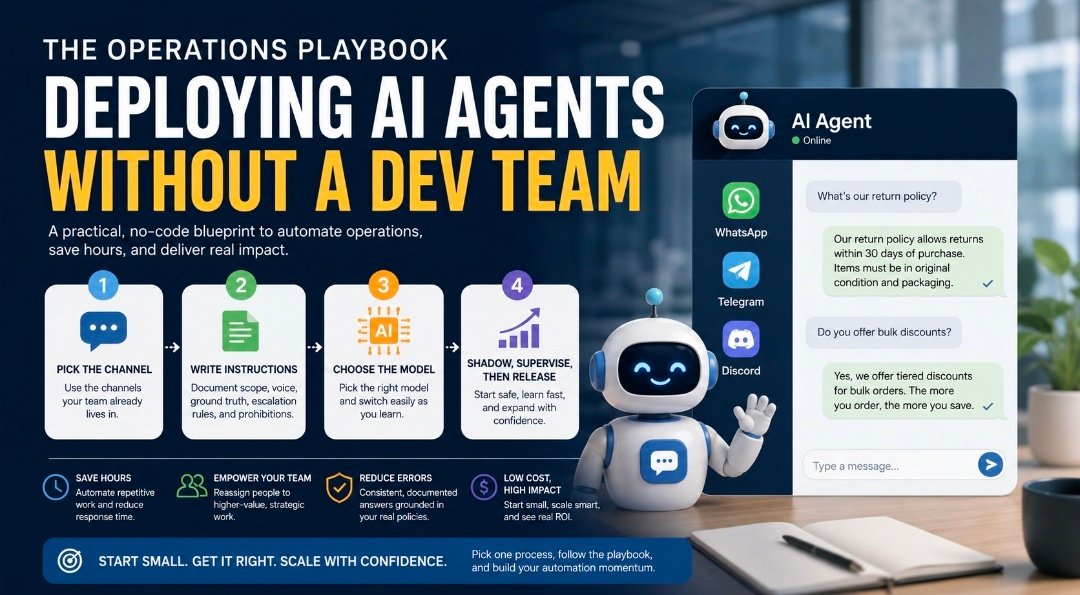
Step one: pick the channel your people already use
The single biggest predictor of adoption is not agent quality — it is whether anyone has to install something.
An agent living in WhatsApp, Telegram, or Discord gets used because those apps are already open. An agent living behind a login on an internal portal gets used for two weeks and then forgotten, no matter how good it is.
Managed agent-hosting platforms have made this part genuinely trivial. Services such as OpenClaw connect an agent to WhatsApp, Telegram, or Discord without servers or deployment work — you choose the underlying model, connect the channel, and the agent is live. Whatever you use, the requirement is the same: no servers to maintain, because you have nobody to maintain them.
Step two: write the instructions like an onboarding document
This is where the actual work sits, and it is writing work rather than technical work — which is why an operations person outperforms an engineer here.
Cover five things:
- Scope. What it handles, and explicitly what it does not.
- Voice. Formal or casual, short or thorough, with two example responses.
- Escalation. The exact conditions under which it stops and hands to a human. Be generous with these at the start.
- Ground truth. The documents, policies, and pricing it should answer from — and an instruction to say “I don’t know” rather than infer when the answer is not there.
- Prohibitions. What it must never do: promise a refund, quote a price not in the document, share internal information, speculate about timelines.
Write it as though onboarding a capable new hire on their first day. That framing produces better instructions than any prompt-engineering template, because it is the same problem. For a practical checklist on briefing AI teammates, define the job, connected tools, knowledge sources and escalation rules before giving the agent more autonomy.
Step three: choose the model deliberately
The instruction set matters most, but model choice is not nothing. Different models have genuinely different strengths — long-document handling, instruction-following consistency, refusal behaviour, cost per interaction.
Prefer a setup where the model is a configuration setting rather than a rebuild. Multi-model platforms such as Perspective AI let an agent run on models from different labs and switch between them without reconfiguring the agent itself. That matters more than it sounds: your first model choice will probably be wrong, and the cost of being wrong should be a dropdown, not a migration.
Start with a strong general model. Optimise for cost later, once you know the real volume.
Step four: shadow, then supervise, then release
Never go straight to autonomous.
Week one — shadow. The agent drafts, a human sends. You see exactly what it would have done, with zero risk. Log every case where the human edits the draft; those edits are your instruction backlog.
Week two — supervise. The agent handles the clearly in-scope cases directly. Everything ambiguous escalates. Tighten the escalation rules based on week one.
Week three — release, narrowly. Autonomous handling for the categories that performed cleanly. Everything else still escalates. Expand category by category, never all at once.
Teams that skip to week three on day one generate an incident, lose organisational trust, and shelve the project. The three-week ramp costs almost nothing and protects the entire initiative.
The failure modes nobody warns you about
Confident wrong answers. The default failure of language models is fluent fabrication, not obvious error. Mitigate by grounding responses in named documents and instructing explicit uncertainty. Test by asking things your documentation genuinely does not cover and checking that it declines.
Scope creep by request. Once it works, everyone wants their process added. Each addition dilutes the instructions and degrades the cases that already worked. Add one process at a time and re-test the existing ones after each.
Silent drift. Your pricing changes, your policy updates, and the agent keeps confidently citing the old version. Assign an owner and a monthly review of the source documents. This is the most common cause of a six-month-old agent becoming a liability.
Nobody owns it. The pilot succeeds, the champion moves teams, and eighteen months later nobody knows how to update it. Name the owner on day one and document where the instructions live.
What to measure
Four numbers, tracked from week one:
- Containment rate — share handled without human involvement
- Escalation accuracy — of escalated cases, how many genuinely needed a human
- Time to first response — usually the metric that improves most dramatically
- Correction rate — how often a human had to fix an answer that went out
Correction rate is the one to watch. Rising containment with rising corrections is not a success, it is a slow-motion incident.
Frequently asked questions
Can you deploy an AI agent with no technical skills at all? Yes, for messaging-channel agents on managed platforms. The work is writing instructions and defining escalation rules, which is operations work. Deep integration with internal systems still needs technical help.
How long does a first deployment take? The technical setup is minutes on a managed platform. Writing good instructions takes a few hours. The three-week supervised ramp is where the calendar time goes, and skipping it is the most expensive shortcut available.
What does it cost to run an AI agent? Managed platforms typically bundle agents into a subscription with a credit or message allowance, starting in the region of $15/month for a single agent and rising with volume and agent count. Model choice affects consumption significantly — check the rate before committing to a high-volume process.
What should the first agent handle? Something frequent, text-based, documented, and low-stakes. Internal policy lookups and first-line triage are the two most reliable starting points because errors are visible immediately and cost almost nothing.
Start smaller than you want to
The instinct is to automate the biggest, most painful process first. Resist it. That process is painful precisely because it is complex, and complexity is what breaks first deployments.
Pick the boring one. Get it working properly, with a real containment number and a real correction rate. Then expand. The credibility you build on a small success is what funds the ambitious one.