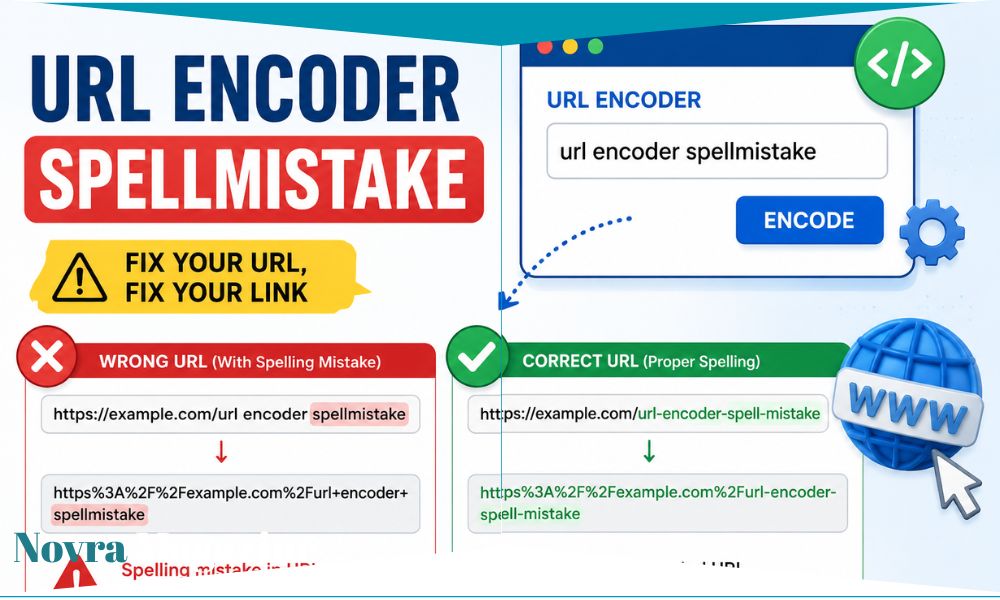
Best one for Yoast + CTR:
URL Encoder SpellMistake: How the Free Tool Works and Fixes Broken URL Characters
A strange web address filled with signs such as %20, %26, or %3F may look broken, but these codes often help the link work correctly. The URL Encoder SpellMistake tool converts spaces, symbols, and other characters into a URL-safe format. It can also reverse encoded text and make it readable again. The tool is useful for website owners, developers, SEO specialists, students, and anyone trying to fix a difficult link. (Spell Mistake)
Quick Overview
| Detail | Information |
|---|---|
| Tool name | SpellMistake URL Encoder/Decoder |
| Main purpose | Encode or decode URLs and text |
| Encoding type | Percent-encoding |
| Example | Space becomes %20 |
| Main users | Developers, SEO workers, marketers and students |
| Cost | Presented as a free online tool |
| Installation | Not required for normal online use |
| Can it fix spelling? | No |
| Can it decode URLs? | Yes |
| Official technical term | URL encoding or percent-encoding |
What Is URL Encoder SpellMistake?
The phrase URL encoder spellmistake usually refers to the URL Encoder/Decoder tool offered on the SpellMistake website.
The tool has a simple purpose.
You enter a URL, query, word, or piece of text. You then choose whether you want to encode or decode it. The result appears in an output field and can be copied for later use. (Spell Mistake)
The phrase itself can be confusing.
“SpellMistake” is the website or brand name. It does not mean that URL encoding is a spelling-correction system.
URL encoding changes characters into a web-safe form. It does not check whether a word, domain, page name, or query has been typed correctly.
For example:
blue shoes
can become:
blue%20shoes
However, if you type:
bule shoes
the encoder may produce:
bule%20shoes
The space is encoded, but the spelling mistake remains.
Is “URL Encoder SpellMistake” an Official Technical Term?
No. It is better understood as a branded search phrase connected with the SpellMistake tool.
Official web standards normally use terms such as:
- URL encoding
- Percent-encoding
- URI encoding
- Percent-encoded characters
RFC 3986 explains percent-encoding as a method for representing a data byte with a percent sign followed by two hexadecimal digits. The WHATWG URL Standard also defines how modern browsers and applications should handle URLs. Neither standard uses “spellmistake” as the name of an encoding method. (URL Standard)
So, the simple explanation is:
SpellMistake is the tool name. Percent-encoding is the technical process.
What Is URL Encoding?
URL encoding changes characters that may be unsafe, confusing, or unavailable inside a normal web address.
The encoded character usually appears as:
% followed by two hexadecimal characters.
For example:
| Original character | Encoded form |
|---|---|
| Space | %20 |
| Double quotation mark | %22 |
| Number sign | %23 |
| Percent sign | %25 |
| Ampersand | %26 |
| Less-than sign | %3C |
| Greater-than sign | %3E |
| Question mark | %3F |
| At sign | %40 |
| Vertical bar | %7C |
Google’s developer documentation explains that spaces and many special characters need encoding because they cannot always be safely used in their original form. It also recommends using normal URL-building tools or platform libraries when links are created through code. (Google for Developers)
Why Do URLs Need Encoding?
Some characters already have a special job inside a URL.
Look at this example:
https://example.com/search?q=blue shoes&sort=price
Different symbols control different parts of the address:
:separates the scheme./separates sections of the path.?starts the query string.=connects a parameter name with its value.&separates one parameter from another.#normally begins a page fragment.
A problem appears when one of these symbols is meant to be normal text rather than a control character.
For example, imagine the search phrase:
fish & chips
If the ampersand is placed directly inside a query value, a server may think a new parameter is beginning.
Encoding the phrase produces:
fish%20%26%20chips
Now the ampersand is treated as part of the search phrase instead of a separator.
Percent-encoding is therefore not random decoration. It helps browsers and servers understand which characters are instructions and which characters are ordinary data. (IETF Datatracker)
How Does the SpellMistake URL Encoder Work?
The SpellMistake page provides both encoding and decoding options.
Its instructions describe a basic process:
- Open the URL Encoder/Decoder page.
- Enter text or a URL in the input area.
- Select Encode or Decode.
- View the converted result.
- Copy the output for use elsewhere. (Spell Mistake)
The tool is designed to make the process easier for users who do not want to calculate encoded character values manually.
For example, you could enter:
https://example.com/search?q=red shoes
The encoded form of the search value would use %20 for the space:
https://example.com/search?q=red%20shoes
The important point is to encode the correct section of the URL.
Encoding every character in a complete address may also convert important separators such as /, :, ?, and =. That can make the address harder to use.
What Is the Difference Between Encoding and Decoding?
Encoding changes normal characters into a safe format.
Example:
summer sale
becomes:
summer%20sale
Decoding performs the opposite action.
Example:
summer%20sale
becomes:
summer sale
The SpellMistake page provides both functions inside the same tool. (Spell Mistake)
Decoding is useful when you receive a long link and want to understand what its query parameters contain.
For example:
name%3Djohn%26city%3Dlondon
may decode into:
name=john&city=london
This makes the information easier for a person to read.
Can URL Encoder SpellMistake Correct Misspelled Words?
No.
A URL encoder is not a spelling checker.
It changes how characters are represented, but it does not understand whether the words are correct.
Suppose you enter:
best resturant in london
The encoder may return:
best%20resturant%20in%20london
The word “restaurant” is still misspelled.
The tool correctly processed the spaces, but it did not correct the language.
The best order is:
- Check the spelling.
- Confirm the domain and page path.
- Confirm the query values.
- Encode the necessary characters.
- Test the final link.
This prevents a spelling mistake from being hidden inside a properly encoded URL.
Common URL Encoder SpellMistakes
Several different errors are often placed under the phrase “URL encoder spellmistake.”
Typing the Wrong Domain
A URL encoder cannot repair a wrong domain.
For example:
gooogle.com
will not become:
google.com
Encoding protects characters. It does not confirm that the website name is correct.
Encoding an Already Encoded Value
This is called double encoding.
A space may already appear as:
%20
If the same value is encoded again, the percent sign may become %25.
The result becomes:
%2520
A server decoding it once may see %20 rather than the intended space.
Decoding More Than Once
Repeated decoding can also create problems.
A value may be designed to remain encoded during one stage of a request. Decoding it too early can cause reserved characters to become active separators.
Encoding a Complete URL as One Text Block
A complete URL contains structural characters.
Consider:
https://example.com/page?id=10
If every reserved character is encoded without understanding its role, the scheme, path, and query structure may be changed.
Developers normally encode individual values or components rather than blindly encoding the entire finished address.
Forgetting Special Characters
Characters such as &, #, %, +, and ? can change the meaning of a URL.
When one of them is part of a search term or user-provided value, it may need encoding.
Editing Percent Codes Manually
Every percent code must use valid hexadecimal digits.
A code such as %2G is invalid because G is not a hexadecimal character.
Using a tool or a programming library reduces this type of manual error.
Should a Space Use %20 or +?
Both forms may appear, but they are not always used in exactly the same way.
A normal encoded URL component commonly represents a space as:
%20
HTML form data and some query-string systems may represent a space with:
+
Google’s URL documentation notes that spaces may appear as either %20 or a plus sign in certain contexts. (Google for Developers)
Example:
blue shoes
may appear as:
blue%20shoes
or:
blue+shoes
The correct form depends on the system receiving the URL.
This is another reason developers should use the URL tools provided by their programming language instead of manually replacing characters.
What Is the Difference Between encodeURI and encodeURIComponent?
JavaScript provides different functions for different jobs.
encodeURI() is designed for an entire URI. It keeps many structural characters unchanged, including /, ?, :, and &. (MDN Web Docs)
encodeURIComponent() is intended for one part of a URL, such as a search term, username, product name, or parameter value. It encodes more reserved characters because those symbols may be ordinary data inside that component. (MDN Web Docs)
Think about this example:
Search value: red & blue
Encoding the value as a component gives:
red%20%26%20blue
This is normally safer than placing the raw ampersand directly inside a query value.
Developers can also use URLSearchParams, which provides standard methods for creating and managing query strings. (MDN Web Docs)
How Can URL Encoding Affect SEO?
A correctly encoded URL helps browsers, servers, analytics systems, and search engines understand the same address.
Incorrect encoding may lead to:
- Broken internal links
- Failed redirects
- Missing tracking data
- Incorrect query parameters
- Pages returning an error
- Several inconsistent forms of the same URL
- Search engines crawling unnecessary URL variations
Google recommends using a common parameter structure, with = between a parameter name and value and & between separate parameters. (Google for Developers)
For example:
?category=shoes&sort=low-to-high
is clearer than using unusual brackets or separators.
Encoding does not automatically improve rankings.
It simply helps create technically valid links. Good SEO still depends on useful content, crawlable pages, clear site structure, correct canonical tags, and strong internal linking.
Can Incorrect Encoding Create a 404 Error?
Yes, in some situations.
A server may treat these as different paths:
/blue shoes/
/blue%20shoes/
/blue+shoes/
/blue%2520shoes/
The correct result depends on how the website and server are configured.
If an internal link points to an encoded path that does not match the page’s real path, the visitor may receive a 404 error.
That is why encoded links should always be tested before they are added to menus, articles, advertisements, sitemaps, or email campaigns.
Is URL Encoding the Same as Encryption?
No.
Encoding changes the representation of characters.
Encryption hides information so that it cannot be read without a key or another decoding method.
Anyone who understands percent-encoding can read an encoded URL.
For example:
password%3Dhello123
can easily be decoded into:
password=hello123
The information is not protected.
Never place passwords, private keys, access tokens, or sensitive personal information in a URL simply because the characters have been encoded.
Is URL Encoding the Same as URL Shortening?
No.
URL encoding converts characters into a safe format.
URL shortening replaces a long address with a shorter redirect link.
Example of encoding:
red shoes → red%20shoes
Example of shortening:
A long product URL → a small redirect address
The two processes solve different problems.
An encoded URL may actually become longer because one character can be replaced by three or more characters.
Who Can Use the SpellMistake URL Encoder?
The tool can help many different users.
Website Owners
They can encode search values, page parameters, and special characters before placing links on their websites.
SEO Specialists
They can inspect difficult URLs and identify whether a symbol, space, or double-encoded value is causing a problem.
Developers
They can quickly test how a string looks after encoding or decoding.
For permanent application code, standard programming libraries are normally safer than depending on manual online processing. Google’s documentation recommends using platform URL-building libraries where possible. (Google for Developers)
Digital Marketers
Tracking links often contain campaign names, source values, and UTM parameters. Encoding prevents spaces or symbols in those values from breaking the URL.
Students
The tool provides a simple way to understand how spaces, punctuation, and international characters are changed.
Content Writers
Writers may use it when a source URL contains unusual query values or symbols that do not copy correctly into a content-management system.
What Should You Avoid Pasting Into an Online Encoder?
Do not paste confidential data into a third-party website.
Avoid entering:
- Passwords
- Private API keys
- Login tokens
- Confidential customer information
- Private document links
- Payment details
- Medical or financial information
An encoder only needs the text that must be converted.
For sensitive application data, use trusted tools inside your own device, browser code, server, or programming environment.
How Can You Test an Encoded URL?
After encoding, follow a simple checking process.
First, paste the finished URL into a browser.
Confirm that the correct page opens.
Next, check whether the query value reached the website correctly.
For example, a search for “red & blue” should not become two different parameters.
You should also confirm that:
- The domain name is unchanged.
- The
https://section still works. - Path separators remain correct.
- Query parameters begin with
?. - Additional parameters use
&. - The URL does not contain unexpected
%25patterns. - The page does not redirect to an incorrect address.
For important SEO pages, test the URL through your website crawler and Google Search Console as well.
Is the SpellMistake Tool Enough for Every Project?
It is useful for quick conversions and learning.
However, a website or application should not depend on people manually copying every URL into an online tool.
Large systems should build URLs through trusted programming libraries.
These libraries understand which part is a path, parameter, fragment, domain, or complete URL.
The SpellMistake encoder is most useful for:
- Quick checks
- Simple conversions
- Troubleshooting
- Learning
- Decoding a difficult link
- Testing an example before adding it to code
For automated systems, use the URL and encoding methods supported by the chosen programming language or framework.
Final Thoughts
The URL Encoder SpellMistake tool makes a technical process much easier to understand.
It changes spaces and special characters into percent-encoded values so they can travel safely inside a web address. It also decodes those values and returns them to a readable form.
The tool can help developers, marketers, SEO specialists, website owners, students, and ordinary users.
However, it is important to understand what it cannot do.
It does not correct spelling, repair an incorrect domain, encrypt private information, shorten links, or automatically decide which part of a complex URL should be encoded.
Always check the text before encoding it.
Encode only the correct component, avoid double encoding, and test the finished URL in a browser.
Used carefully, the tool can prevent broken links and make complicated web addresses much easier to manage.
Frequently Asked Questions
What is URL Encoder SpellMistake?
It is an online URL Encoder/Decoder tool offered by SpellMistake. It converts text into percent-encoded form and can decode encoded text.
Is “URL encoder spellmistake” a technical term?
No. URL encoding or percent-encoding is the technical term. SpellMistake is the name connected with the online tool.
Is the SpellMistake URL encoder free?
The website presents it as a free URL Encoder/Decoder tool.
What does %20 mean in a URL?
%20 represents a space.
What does %26 mean?
%26 represents an ampersand.
What does %3F mean?
%3F represents a question mark when it is being used as data rather than as a URL separator.
Can the tool fix spelling mistakes?
No. It encodes characters but does not correct misspelled words or domains.
Can it decode a URL?
Yes. The tool includes both encode and decode options.
Why does %20 sometimes become %2520?
This normally happens when an already encoded value is encoded a second time. The percent sign becomes %25.
Is URL encoding secure?
It helps create valid links, but it does not encrypt or hide information.
Should I encode a complete URL?
Sometimes an entire URI can be processed with a suitable function, but individual user values and query components should normally be encoded separately.
What is the difference between %20 and +?
Both can represent a space in certain contexts. %20 is common in percent-encoded URL components, while + is often used in form-style query data.
Does URL encoding help SEO?
Correct encoding can prevent broken links and malformed parameters, but it does not directly guarantee better rankings.
Can a URL encoding error cause a broken link?
Yes. Incorrect, missing, or double encoding can send users to the wrong path or produce an error.
Can I use the tool for API parameters?
Yes, it can help test encoded API values. Permanent application code should use standard URL-building libraries.
Should I paste an API key into the tool?
No. Avoid entering passwords, private tokens, API keys, or other confidential data into third-party tools.
For more info, visit Novra Magazine.