An ebike battery does not contain a fixed number of miles. A useful estimate starts with watt-hours, divides by the energy your route is likely to use, and then keeps a reserve for hills, wind, cold and battery ageing.
Quick answer: A nominal 48V 20Ah battery contains about 960Wh. Dividing that by 15 to 25Wh per mile gives roughly 38 to 64 miles before reserve and real-world losses. A useful buying estimate starts with the hardest normal return route, keeps a practical reserve, and then verifies voltage, continuous current, charger and frame fit. It does not promise one fixed mileage figure.
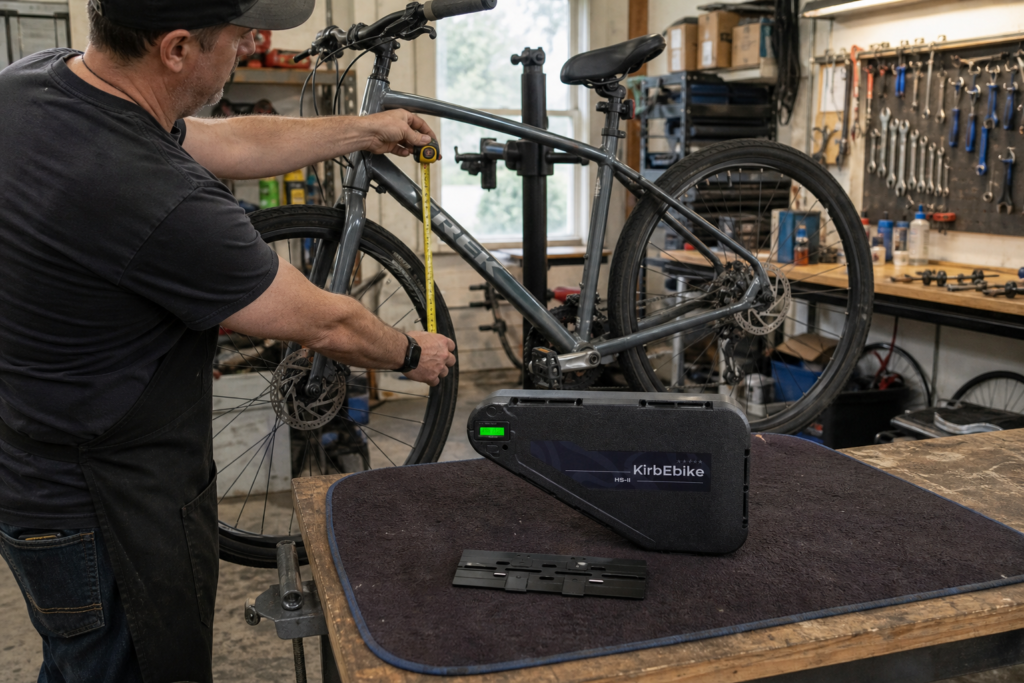
Measure the donor bicycle before installation, then compare the available frame space with the HS-II battery case and mounting rail.
A battery advertised at 48V 20Ah may carry a nominal 960 watt-hours, but that does not mean it will deliver the same mileage to every bicycle. A light rider pedalling on flat tarmac can use far less electrical energy per mile than a heavy, fast conversion climbing into a headwind. Tyres, temperature, stop-start traffic and controller settings can move the result again.
The honest answer to “how far can an ebike battery go?” is therefore a range of outcomes with stated assumptions. The arithmetic is simple; choosing realistic assumptions is the valuable part.
The quick calculation: watt-hours divided by route consumption
Battery energy is usually compared in watt-hours, written Wh. When the manufacturer does not publish Wh, a first estimate is nominal voltage multiplied by amp-hours:
Nominal voltage (V) x capacity (Ah) = nominal energy (Wh)
For example, 36V x 15Ah is 540Wh, 48V x 20Ah is 960Wh, and 52V x 20Ah is 1,040Wh. Use the maker’s published Wh figure when one is supplied, because a voltage family name can be rounded and usable output is affected by the pack design and protection limits.
The second half of the calculation is route consumption, expressed as watt-hours per mile or watt-hours per kilometre. Range is approximately usable battery energy divided by average consumption. For planning, do not treat the entire label capacity as guaranteed usable energy. Keep a reserve instead of aiming to arrive at the low-voltage cut-off.
| Battery label | Nominal arithmetic | At 10 Wh/mi | At 15 Wh/mi | At 25 Wh/mi |
|---|---|---|---|---|
| 36V 15Ah | 540 Wh | 54 mi | 36 mi | 22 mi |
| 48V 20Ah | 960 Wh | 96 mi | 64 mi | 38 mi |
| 52V 20Ah | 1,040 Wh | 104 mi | 69 mi | 42 mi |
| 52V 25Ah | 1,300 Wh | 130 mi | 87 mi | 52 mi |
| 52V 30Ah | 1,560 Wh | 156 mi | 104 mi | 62 mi |
Illustrative arithmetic before reserve, voltage sag, cut-off and real-world losses. These are not product mileage promises.
What does 10, 15 or 25 Wh per mile represent?
Those figures are planning scenarios, not universal performance classes. They let a buyer see how strongly the result changes when the route becomes harder. A useful way to set the first estimate is:
- Around 10 Wh/mi: efficient assistance, active pedalling, moderate speed, sound tyres and mostly flat paved riding.
- Around 15 Wh/mi: mixed commuting with normal assistance, starts, rolling terrain and ordinary luggage.
- Around 25 Wh/mi or more: high assistance, heavy load, strong wind, steep climbs, soft or wide tyres, cold conditions or a powerful fast system.
The same rider can move between these bands on different days. That is why a single maximum-range claim is weak purchase evidence unless the test speed, rider mass, elevation, wind, temperature, tyre and assistance settings are also stated.
Voltage and amp-hours answer different questions
Voltage describes the electrical system family. It must match the controller’s permitted input range and the rest of the drive system. A nominal 52V lithium-ion pack reaches about 58.8V when fully charged; a controller designed only for a 48V pack may not tolerate it. Higher voltage is not a free range upgrade.
Amp-hours describe charge capacity at that pack voltage. Comparing Ah across different voltages can be misleading: 36V 20Ah is about 720Wh, while 52V 20Ah is about 1,040Wh. Wh is the more useful energy comparison, but even Wh does not prove current capability.
A battery management system also limits how much current the pack may continuously supply. The controller’s maximum battery current must sit within the battery, BMS, connector and wiring limits. A large-energy battery with an underspecified BMS can be the wrong match for a high-current controller even if its predicted mileage looks attractive.
The eight variables that move real-world range
- Assistance and throttle use: the more work the motor supplies, the faster stored energy is consumed.
- Speed and air resistance: energy demand rises sharply as speed increases, especially into a headwind.
- Gradient and stop-start riding: climbing and repeated acceleration draw more energy than settled cruising.
- Total mass: rider, bicycle, battery, locks, luggage, child seat and trailer all count.
- Tyres and surfaces: pressure, width, tread and soft ground change rolling resistance.
- Temperature: cold conditions can reduce available performance and increase voltage sag.
- Motor and controller efficiency: a motor labouring slowly under heavy load can waste more energy as heat.
- Rider contribution: gearing and steady pedalling can materially reduce electrical consumption.
Build a route budget instead of believing a maximum
Start with the hardest normal journey, not the easiest ride you hope to complete. Include the return trip, the steepest section, usual cargo and the weather in which the bicycle must remain useful. Then follow this sequence:
- Measure the true round-trip distance and note elevation, exposed roads and stop-start sections.
- Choose a cautious Wh-per-mile scenario that reflects speed, assistance and loaded weight.
- Multiply distance by that consumption figure to estimate route energy.
- Divide by 0.75 to keep roughly a 25% planning reserve rather than designing around an empty pack.
- Check that the resulting battery also matches voltage, continuous current, connector, charger and frame space.
A 20-mile mixed commute budgeted at 15Wh/mi needs about 300Wh for the route. Dividing by 0.75 gives a target of roughly 400Wh. A 25-mile hilly ride budgeted at 20Wh/mi needs 500Wh; with the same reserve, the target becomes about 667Wh. These examples are planning arithmetic, not promises that ignore conditions.
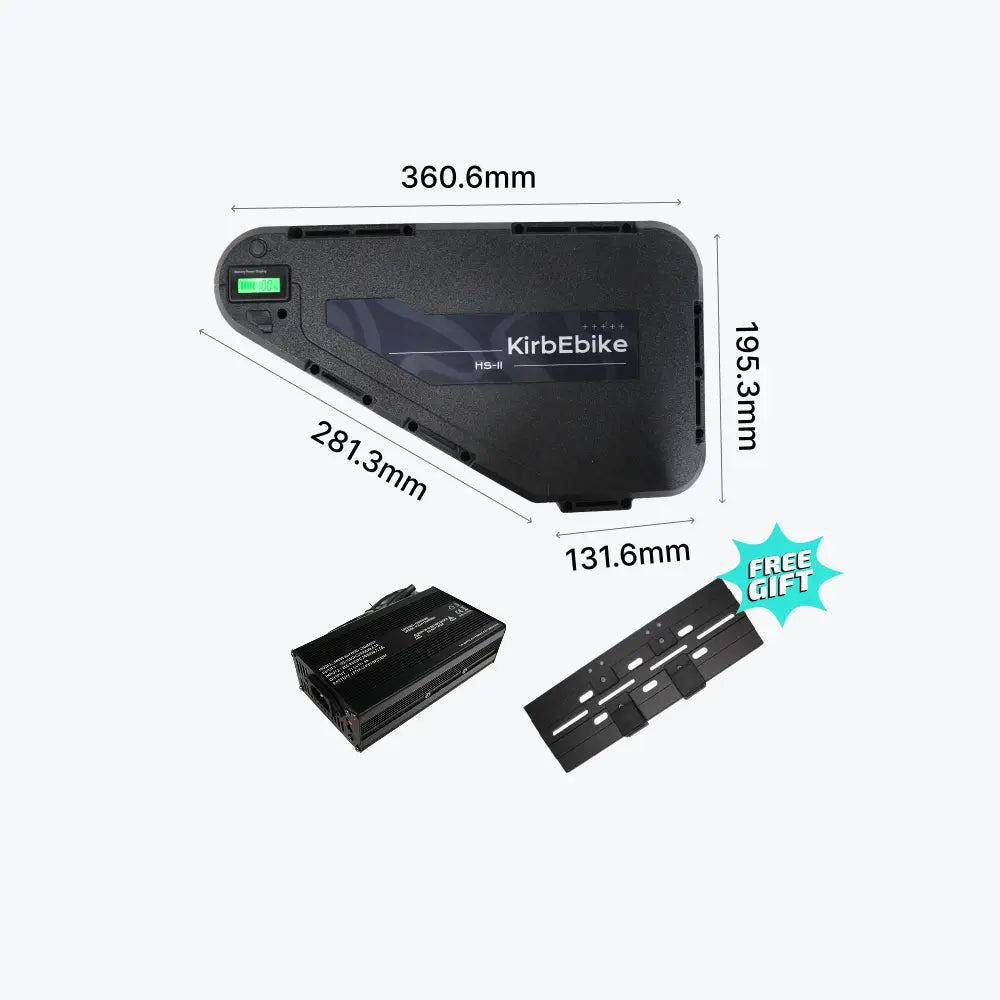
Official KirbEbike HS-II product image showing the battery case, charger and mounting rail.
A larger battery can create a smaller fit margin
More watt-hours normally mean more cells, mass and case volume. That can improve range while making mounting harder. A pack must fit with its rail, connector and cable exit, and it must have room to slide off the rail for charging or service. A paper dimension drawing and cardboard template are more useful than holding a ruler across the open triangle.
When comparing electric bike battery options, filter by controller voltage and continuous current first. Then compare Wh, case dimensions, weight, charger and mounting direction. This prevents a high-capacity pack from winning on paper while failing electrically or physically.
KirbEbike’s current range illustrates the trade-off. Its lower-voltage down-tube packs prioritise weight and simpler commuter builds, while Taishan and HS-II families offer more stored energy and higher published continuous-current capability in larger cases. The deeper case of the higher-capacity KirbEbike HS-II batteries needs more frame-triangle space, so the dimension drawing belongs in the purchase decision.
Turn the first three rides into a personal range model
A generic planning band is useful before purchase, but a rider’s own route data is stronger. After installation, use several ordinary journeys to replace assumptions with measured consumption. Do not choose only an easy Sunday ride; include the loaded commute, the hillier return leg and the assistance level normally used.
- Begin each test from a known charge state and record distance, weather, load, assistance and elevation.
- If the display reports Wh used, divide that figure by distance. If it does not, use a compatible energy meter or compare repeatable portions of the pack rather than guessing from one battery bar.
- Calculate separate figures for easy, normal and demanding rides instead of averaging away the worst conditions.
- Size the return-trip reserve from the demanding figure, then recheck it when winter, new tyres, luggage or controller settings change.
For example, if three normal commutes use 13, 15 and 16Wh/mi, planning at 16Wh/mi is more defensible than advertising the 13Wh/mi result. If a cold headwind journey records 21Wh/mi, that becomes the relevant figure whenever arriving with reserve matters more than achieving a maximum.
Battery bars are not a precise fuel gauge
Many displays estimate state of charge from pack voltage. Lithium-ion voltage does not fall in a perfectly linear relationship with remaining energy, and it can sag temporarily when the motor draws high current on a climb. A display may therefore lose a bar under load and recover after the bicycle stops.
Age, temperature, cell balance and BMS cut-off can also change how the last part of the indicated charge behaves. Treat the final bar as emergency margin, not a route plan. Where the system provides Wh consumed or reliable percentage data, combine it with distance and route conditions rather than trusting an icon by itself.
Fast charging is a compatibility feature, not a plug choice
A higher-amp charger can shorten charging time only when the cells, BMS, charge connector and pack documentation permit that current. Do not replace a 2A charger with a 5A unit because the plug appears to fit. Use the supplied or manufacturer-authorised charger for the exact battery model.
Simple Ah divided by charger amps gives only a rough baseline. Charging slows near full, and pack temperature and BMS behaviour matter. Charging time should therefore be presented as a supported range under stated conditions, not as a guaranteed division result.
Dual batteries require a designed method
Two batteries can extend range, but they should not be improvised in parallel. Packs need compatible voltage, connection logic, protection and switching or combining hardware approved for the system. Never join batteries with different state of charge, chemistry, condition or voltage through an unverified adapter. A supported dual-battery design is a system feature, not merely twice the nominal Ah.
A pre-order battery checklist
| Question | Why it changes the decision | Evidence to obtain |
|---|---|---|
| What voltage does the controller accept? | Wrong voltage can damage components or cause cut-outs. | Controller label/manual and battery full-charge voltage |
| How much route energy is needed? | Distance alone ignores hills, speed, load and reserve. | Round-trip miles, elevation and Wh/mi scenario |
| Can the BMS supply controller current? | Energy capacity does not prove discharge capability. | Continuous BMS rating and controller battery-current limit |
| Will the case and rail fit? | The pack must mount securely and remain removable. | Dimension drawing, template and slide-off clearance |
| Is the charger authorised? | Plug shape does not prove safe charging compatibility. | Exact model charger specification |
Frequently asked questions
How many miles can a 48V 20Ah ebike battery go?
Its nominal capacity is about 960Wh. The arithmetic changes with energy use before any reserve is applied:
- At 10Wh/mi: about 96 miles in a very efficient planning scenario.
- At 15Wh/mi: about 64 miles in a moderate mixed-use scenario.
- At 25Wh/mi: about 38 miles in a demanding scenario.
Real usable range will be lower when the route budget includes reserve, cut-off behaviour, weather, hills and losses.
Does a 52V battery always go farther than a 48V battery?
No. Compare total watt-hours, not voltage alone. A higher-capacity 48V pack can store more energy than a smaller 52V pack, and the controller must accept the chosen battery’s voltage including its full-charge level.
How can I estimate battery range before ordering?
Use four inputs that can be checked rather than a single advertised maximum:
- Calculate nominal Wh from voltage multiplied by amp-hours.
- Select a cautious Wh-per-mile scenario for the real route, load and assistance level.
- Divide Wh by Wh per mile, then keep a reserve instead of planning to reach cut-off.
- Confirm voltage, continuous BMS current, connector, charger, weight and physical fit.
Can I use a 5A charger on any ebike battery?
No. The cells, BMS, charge connector and manufacturer documentation must all support the charge current. A matching plug is not proof of compatibility; use the supplied or explicitly authorised charger for the exact battery model.
Bottom line: Size the battery from a Wh-per-mile route budget, keep a practical reserve, then verify voltage, current capability, charger and frame fit. No fixed mileage claim replaces those checks.