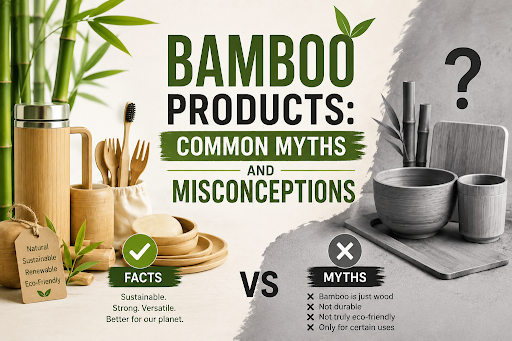
Does bamboo deserve all the praise it gets, or are people believing the wrong things?
Bamboo has become one of the most talked-about natural materials in recent years. It appears in everything from household paper to clothing and furniture. Because it has gained such a positive reputation, many people assume every product made from bamboo is automatically better than every other option.
The truth is more balanced. Bamboo offers many advantages, but it is also surrounded by myths that often confuse buyers. Some claims are based on facts, while others come from clever marketing or incomplete information.
Understanding these misunderstandings helps people make informed choices instead of relying on assumptions. Knowing what bamboo can do and where its limits begin is the best way to choose products with confidence.
Bamboo is not a tree
One of the most common misunderstandings starts with the plant itself. Many people believe bamboo is a type of tree because it grows tall and develops thick stems.
In reality, bamboo is a grass. It grows from an underground root system that continues producing new shoots after harvesting. This natural growth pattern allows it to recover much faster than traditional timber.
That is one reason Tree Free Paper Products have attracted attention in recent years. Fast-growing grasses provide another source of fibre without depending entirely on forests.
Every bamboo product is not identical
Another myth is that every bamboo product offers the same quality. This is far from the truth.
Manufacturing methods vary between companies. Some focus on premium fibres and careful production while others aim to reduce costs. The result is that two products made from bamboo can feel completely different.
Quality depends on processing standards as much as the raw material itself. Reading product information carefully helps you understand what you are buying.
Bamboo products are not always chemical-free
Many shoppers believe anything made from bamboo has never been processed. This is another misunderstanding.
Like other natural fibres, bamboo typically undergoes several manufacturing stages before becoming a finished product. Cleaning, softening, and shaping the fibres are necessary to produce items suitable for daily use.
Processing does not automatically make a product unsafe. What matters is how responsibly those processes are managed and whether manufacturers are open about them.
Softness depends on production, not only on the material
Some people expect every bamboo paper product to feel softer than ordinary paper. While bamboo fibres are naturally smooth, the final texture depends on how the product is manufactured.
High-quality processing can produce paper that feels gentle, while lower-quality production may create a completely different result.
For example, many households choose eco friendly toilet tissue because it combines comfort with reliable strength. However, that experience still depends on the standards followed during manufacturing.
Bamboo is renewable but not perfect
People sometimes assume bamboo has no environmental impact at all. That idea is too simple.
Although bamboo grows quickly it still needs land water transport and manufacturing. Every stage requires resources before the finished product reaches consumers.
This is why it is better to look at the complete production process rather than judging a product by its raw material alone.
Price does not always reflect value
Another misconception is that bamboo products are expensive only because they are fashionable.
Pricing depends on many factors including fibre quality production methods transport and packaging. A well-made bamboo product may cost slightly more because it has been produced to higher standards.
Looking only at the price without considering durability and quality often leads to the wrong conclusion.
Bamboo products are becoming part of everyday life
Years ago bamboo products were difficult to find outside specialist retailers. Today they are available in supermarkets online stores and household shops across the UK.
Many families now purchase bamboo toilet rolls because they provide familiar comfort while using fibres from a rapidly renewable plant. This shows how bamboo has moved from being a niche material to an everyday choice.
Greater availability has also encouraged manufacturers to improve quality and offer more competitive prices.
Marketing can create unrealistic expectations
Advertising often presents products in the best possible light. While there is nothing wrong with highlighting benefits, marketing sometimes leaves out important details.
Words such as natural or eco-friendly do not always explain how a product has been made. Consumers should read product descriptions carefully instead of relying only on attractive packaging.
This balanced approach helps people understand what they are actually buying.
Why Tree Free Paper Products continue to grow
Growing interest in renewable materials has encouraged manufacturers to explore alternatives to traditional wood pulp.
This is one reason Tree Free Paper Products are becoming more common in homes and businesses. They provide another option for people who want everyday paper products made from fast-growing plant fibres.
The aim is not to replace every conventional paper product overnight. Instead it is to create greater choice while supporting responsible use of natural resources.
Making informed buying decisions
Understanding facts is always more valuable than following trends. Before buying any bamboo product it helps to check the material source manufacturing information and product quality.
Simple research allows consumers to compare products fairly instead of making decisions based only on advertising claims.
Many households also choose bamboo kitchen rolls because they fit naturally into daily routines while supporting the use of renewable fibres.
Final thoughts
Bamboo has earned its popularity for many good reasons. It grows quickly and provides strong fibres and supports the development of practical alternatives to traditional materials. At the same time it is important to separate facts from assumptions.
Learning more about Tree Free Paper Products allows consumers to appreciate both the strengths and the limitations of bamboo based goods. No material is perfect but informed choices always lead to better decisions.
When people understand the real story behind bamboo they are more likely to buy products that match their needs instead of following common myths. That knowledge creates confidence and encourages more thoughtful choices in everyday life.