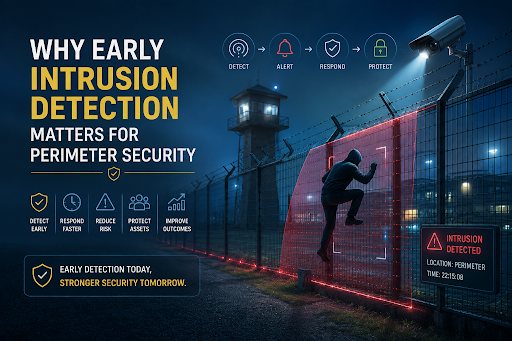
Quick answer: A fence or barrier alone only slows an intruder down – it doesn’t stop them, and it doesn’t tell anyone they’re there. Early intrusion detection is what turns a physical boundary into an active perimeter security system, giving response teams the time they need to act before an intruder reaches a building, an asset, or a control room. The earlier the detection, the more options a security team has, and the lower the cost of a breach when one happens.
The Problem With Detecting an Intrusion Too Late
Every perimeter security system exists to buy time. The question is: time for what? If an intrusion is only detected once someone is already inside the compound, close to a building, or already tampering with equipment, that window has effectively closed. The security team is now reacting to a breach already in progress, not preventing one.
This is the core weakness of older, reactive approaches to perimeter security – relying on CCTV review after the fact, infrequent manned patrols, or detection systems placed too far inside the site to give any real warning. By the time an alert reaches a human, the intruder may already have achieved what they came to do.
Early intrusion detection flips that timeline. By detecting activity at the outer boundary – the fence line, the approach path, or the moment of climbing or cutting – a perimeter security system gives responders minutes rather than seconds. Those minutes are often the difference between an intruder being intercepted and an intruder getting away.
What “Early” Actually Means in Perimeter Security
Early detection isn’t just about having sensors on the fence. It’s about where in the intrusion sequence detection happens. A well-designed perimeter security system is layered so that something is detected at each stage:
- Approach detection – identifying a person or vehicle nearing the boundary before contact is made, using volumetric sensors, thermal cameras, or radar
- Boundary contact detection – sensing climbing, cutting, or lifting the moment it starts, via fence-mounted vibration or fibre-optic sensors
- Breach confirmation – video analytics verifying that a genuine crossing has occurred, not just a disturbance
- Internal movement detection – a fallback layer in case the outer boundary is bypassed, so there’s no single point of failure
The earlier a genuine threat is picked up in this sequence, the more of these layers a security team still has in reserve. A system that only triggers at the last layer has already used up its safety margin.
Why Speed of Detection Affects the Cost of a Breach
For sites like data centres, energy infrastructure, and industrial facilities, the financial impact of an intrusion isn’t just about what’s stolen – it’s about downtime, damage, insurance implications, and, in the case of critical infrastructure, potential regulatory consequences. Early intrusion detection reduces all of these:
- Faster response, smaller loss window – the sooner security or police are alerted, the less time an intruder has to cause damage or remove equipment
- Lower false-negative risk – layered, early detection means a missed sensor at one stage doesn’t mean a missed intrusion overall
- Reduced reliance on manned guarding – early, automated detection means fewer patrols are needed to achieve the same level of assurance, which lowers long-term operating costs
- Stronger evidence and audit trail – detecting and recording an event from the moment it begins gives a clearer picture for any investigation or insurance claim afterwards
In short, a perimeter security system that detects early doesn’t just prevent incidents – it makes the incidents that do happen far less costly.
Early Detection Reduces Pressure on Security Teams
There’s also a human factor here. Security operators monitoring a perimeter security system are far more effective when they’re alerted early and given time to assess a situation calmly, rather than being thrown into a live, in-progress breach with seconds to decide. Early warning supports better decision-making, clearer communication with any responding personnel, and a lower risk of the situation escalating unnecessarily.
This is particularly important for remote or unmanned sites – battery energy storage facilities, substations, and rural infrastructure – where there may be no one physically present to intervene. In these cases, early detection isn’t a nice-to-have; it’s what makes automated, remote-monitored security viable at all.
Building Early Detection Into a Perimeter Security System
Achieving genuinely early detection isn’t about adding more sensors indiscriminately — it’s about designing the system around the site’s specific risk profile. A few principles matter most:
- Detect at the boundary, not beyond it. Sensors placed too far inside the site reduce the warning time to almost nothing.
- Layer multiple technologies. Combining fence-line sensors with open-ground detection closes the gaps a single technology would miss.
- Use analytics to verify, not just detect. Early detection is only useful if it’s trustworthy – AI-assisted verification means early alerts are also accurate ones, not just early false alarms.
- Match sensitivity to the site. A system tuned incorrectly for wind, wildlife, or terrain will either miss real intrusions or generate so many false alerts that early warnings get ignored.
- Integrate with response. Early detection only creates value if it triggers a fast, coordinated response – cameras, lighting, and alerts should all activate automatically the moment a threat is confirmed.
Final Thoughts
The strength of a perimeter security system isn’t measured by how tall the fence is or how many cameras are installed – it’s measured by how early a genuine threat is identified and how quickly that information reaches the people who can act on it. Early intrusion detection turns a passive boundary into an active layer of defence, giving security teams the time advantage they need to protect people, assets, and operations before a breach becomes a loss.
Want to know how early your current perimeter would actually detect an intrusion? Sysco Technical Solutions designs perimeter security systems for critical infrastructure, data centres, energy sites, and industrial facilities across the UK. Call 01772 621716 or email enquiries@syscotech.co.uk for a free site assessment.