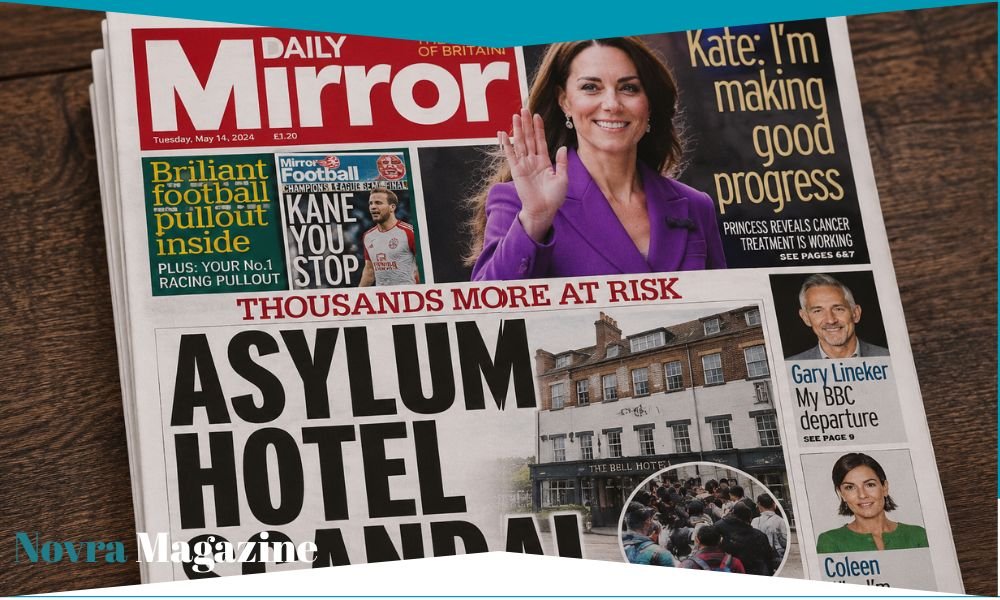
For more than 120 years, the daily mirror has been part of everyday British life. It began with an unusual idea in 1903, later became one of the biggest newspapers in the world, strongly connected itself with working-class readers and Labour politics, and survived huge changes in television, the internet and social media. The Daily Mirror is still published today, but the newspaper of 2026 looks very different from the paper that once sold more than five million copies a day. It is now owned by Reach plc, led editorially by Chloe Hubbard, connected closely with Mirror Online, and trying to build a future where digital readers matter just as much as people buying a printed paper.
What Is the Daily Mirror?
The Daily Mirror is a British national newspaper.
It is a tabloid, which means it uses a smaller newspaper format and usually presents stories in a quick, easy-to-read style.
Its coverage includes politics, breaking UK news, crime, football, television, celebrities, royal stories, money and everyday life.
The newspaper is especially known for large headlines, strong pictures and stories written for a broad audience.
That simple style has been part of the Mirror identity for generations.
However, the Daily Mirror of today is only one part of a much bigger news operation.
Mirror stories are also published online and distributed through phones, search engines and social media.
Is the Daily Mirror the Same as The Mirror?
They are part of the same news brand.
Daily Mirror is the traditional name of the printed newspaper.
The Mirror is commonly used for the wider digital brand.
Mirror Online covers many of the same subjects as the newspaper, but the website publishes news throughout the day rather than waiting for one printed edition.
The Mirror’s current About Us page lists Chloe Hubbard as Editor-in-Chief and says the publication is produced by MGN Ltd, part of Reach plc.
So if someone says:
“I read that in The Mirror,”
they may have seen the story online.
If someone says:
“I bought the Daily Mirror,”
they normally mean the physical newspaper.
When Was the Daily Mirror Founded?
The Daily Mirror launched on November 2, 1903.
Alfred Harmsworth, who later became Lord Northcliffe, created it.
But the first version was very different from today’s paper.
Harmsworth originally wanted the Daily Mirror to be a newspaper aimed at women.
Women also played a major role in producing it.
That was unusual for British newspapers at the beginning of the 20th century.
The idea sounds modern now.
But commercially, the original version struggled.
The Mirror soon had to change.
Was the Daily Mirror Really Created for Women?
Yes.
The first Daily Mirror was designed as a paper that would reflect women’s interests and lives.
Most of its early staff were women.
Mary Howarth was its first editor.
However, sales quickly fell after the first issue.
In 1904, Harmsworth changed the newspaper into a much more visual publication aimed at both men and women.
The paper briefly used the name The Daily Illustrated Mirror.
It then returned to the Daily Mirror name.
The new strategy worked much better.
Pictures became one of its biggest strengths.
Why Did Pictures Make the Daily Mirror Different?
Today, a newspaper filled with photographs feels normal.
In the early 1900s, it was much more exciting.
Printing technology was changing.
Newspapers could use photographs to show readers events instead of only describing them with words.
The Daily Mirror became strongly connected with visual storytelling.
Big photographs helped people quickly understand a story.
A royal event could fill a page.
A disaster could be shown directly.
A famous face could sell copies.
This approach helped turn the Mirror into a powerful mass-market newspaper.
Its influence even reached America, where London’s Daily Mirror helped inspire the development of the New York Daily News and the wider modern tabloid style.
How Did the Daily Mirror Become a Working-Class Newspaper?
Another huge change came during the 1930s and 1940s.
The Daily Mirror increasingly moved towards ordinary working people.
Its tone became more direct.
Its political position moved left.
The paper focused strongly on workers, soldiers and families.
During the Second World War, it became especially popular with British servicemen and ordinary civilians.
After the war, that identity became even stronger.
The Mirror was no longer simply a picture newspaper.
It had developed a clear voice.
It wanted readers to feel that the paper understood their worries.
Jobs.
Pay.
Housing.
Health.
War.
Pensions.
Government decisions.
Those subjects helped create a close connection with millions of readers.
Did the Daily Mirror Support Labour in 1945?
Yes.
The Daily Mirror supported Labour during the historic 1945 general election.
Labour, led by Clement Attlee, went on to win a huge victory.
From that period onward, the Mirror developed a very long connection with Labour politics.
That relationship became one of the newspaper’s most recognisable features.
However, it is important to explain this correctly.
The Daily Mirror is not owned by the Labour Party.
It can criticise Labour politicians.
Its journalists can report negative stories about Labour governments.
But its editorial tradition has usually been much more friendly to Labour than to the Conservative Party.
Is the Daily Mirror Left Wing?
It is commonly described as left-leaning or centre-left in British newspaper politics.
Perhaps the simplest description is:
The Daily Mirror is a Labour-supporting popular tabloid.
That does not mean every journalist working there has the same politics.
It also does not mean every article is political opinion.
News reporting and editorial endorsement are different things.
But when general elections arrive, the newspaper’s political preference has usually been clear.
For the 2024 UK general election, the Mirror explicitly urged readers to vote Labour.
So its historical Labour connection remained visible in the most recent UK general election.
Does the Daily Mirror Still Support Labour in 2026?
The Mirror’s broad historical identity remains Labour-friendly.
However, that does not mean it automatically praises everything Labour politicians do.
The newspaper continues reporting criticism, political arguments and difficult stories involving Labour figures.
That is important because “supports Labour” and “works for Labour” are not the same thing.
A newspaper may endorse a party at an election while still criticising its government later.
The clearest recent confirmed political fact is that the Mirror endorsed Labour in the July 2024 general election.
It is therefore safer to describe the paper as historically and editorially Labour-supporting rather than saying every current story follows a Labour position.
How Big Did the Daily Mirror Become?
Enormous.
The newspaper grew into one of Britain’s great mass-market success stories.
By the late 1940s, it was selling millions of copies.
Its circulation later reached more than five million copies a day during its peak period in the 1960s. Historical records put its record average daily sale at more than 5.2 million in 1967.
Think about what that meant.
Millions of households could see the same front page every morning.
There was no Twitter.
No Facebook.
No Google News.
No smartphones.
Television news existed, but newspapers still played a huge role in shaping the national conversation.
A powerful Daily Mirror front page could become something almost everybody had seen.
Why Were Newspapers So Powerful Then?
Information moved differently.
If something important happened overnight, most people could not simply unlock their phones and watch a video.
They waited for radio.
Television.
Or the morning newspaper.
That gave newspapers enormous influence.
The front page decided which story looked most important.
An editorial could tell millions of people what the paper thought.
A photograph could shape how a politician, royal or celebrity was remembered.
This helps explain why old British newspaper owners could become incredibly powerful public figures.
The Daily Mirror was not simply selling paper.
It was selling a shared national conversation.
Who Owns the Daily Mirror in 2026?
The Daily Mirror is owned by Reach plc.
ABC’s current Daily Mirror listing identifies Reach plc as the owner.
Reach describes itself as the UK’s largest commercial national and regional news publisher.
It owns more than 120 print and online brands.
The group includes major national newspapers and many regional news brands.
The Daily Mirror therefore sits inside a much bigger publishing company.
Its publishing company is Mirror Group Newspapers, often shortened to MGN.
What Other Newspapers Does Reach Own?
Reach owns a large collection of British and Irish news titles.
Its national portfolio includes brands such as the Mirror, Daily Express and Daily Star.
It also operates major regional news brands across the country.
Reach says its full network reaches about 66% of the UK online population and has around 115 million social followers worldwide.
Those are company-wide figures.
They should not be mistaken for Daily Mirror-only readership numbers.
Still, they show why Reach remains a major force in British media.
A company that began with newspapers now needs audiences on websites, apps, search, social platforms and many other places.
Who Is the Daily Mirror Editor in 2026?
Chloe Hubbard is the current Editor-in-Chief of the Mirror.
Reach announced her appointment on December 11, 2025.
She took over after Caroline Waterston left at the end of 2025.
Hubbard had previously worked as UK Editor at The Independent.
Her earlier career included roles at organisations including the BBC, Telegraph and MailOnline.
Her appointment matters because the newspaper industry is going through major change.
Leading the Mirror today is not simply about choosing tomorrow’s front page.
An editor must think about print, web stories, video, social media, search traffic and new technology at the same time.
What Did Chloe Hubbard Say About Taking Over?
When Reach announced her appointment, Hubbard spoke about the Mirror’s tradition of progressive politics, entertainment and holding powerful people to account.
That gives a useful picture of how the current leadership views the brand.
The Mirror still wants to be politically recognisable.
It still wants entertaining stories.
It still wants campaigns.
But the way readers find those stories is changing quickly.
The challenge for Hubbard is keeping the newspaper’s old identity while building something that works in the digital world.
Who Was the Editor Before Chloe Hubbard?
Caroline Waterston held the senior Mirror editorial role before Hubbard.
She left at the end of 2025.
So articles written before 2026 may still name Waterston as the editor.
Those pages are now out of date.
As of August 2026, the Mirror’s own current About Us information names Chloe Hubbard as Editor-in-Chief.
This is why current research matters.
Editorial leadership can change quickly.
Was Piers Morgan Editor of the Daily Mirror?
Yes.
Piers Morgan was editor of the Daily Mirror from 1995 until 2004.
He later became much more widely known as a television presenter and media personality.
His Mirror years remain important because they overlap with a period later examined during phone-hacking litigation.
A 2023 High Court judgment found evidence that senior Mirror editors knew phone hacking was being used. Reuters reported that the judge specifically found Morgan knew about phone hacking during his time at the paper. Morgan has repeatedly said he never hacked a phone or told anybody else to hack one.
That distinction should be presented carefully.
A court finding about knowledge is not the same claim as personally hacking a phone.
What Was the Daily Mirror Phone-Hacking Scandal?
Phone hacking became one of the darkest parts of modern British tabloid history.
Journalists or people working for newspapers gained unlawful access to voicemail messages or used other illegal methods to gather private information.
Mirror Group Newspapers faced many claims over historical unlawful information gathering.
In December 2023, a High Court judge found that Prince Harry had been a victim of phone hacking and other unlawful information gathering by Mirror Group Newspapers.
The court found unlawful activity in a number of the articles examined in his case.
Harry initially received £140,600 in damages.
His remaining Mirror claims were later settled.
Did the Daily Mirror Publisher Admit Historical Wrongdoing?
Mirror Group Newspapers has apologised for historical unlawful activity and has paid compensation in many cases.
Reuters reported in November 2024 that MGN was facing another 101 lawsuits involving public figures and that the publisher acknowledged historical wrongdoing had occurred in the early 2000s.
The issue is important to the Daily Mirror’s history.
But it should also be described in the correct time frame.
The litigation relates to historic newsroom conduct, mainly from years or decades ago.
It would be wrong to use those historical findings as evidence that today’s Daily Mirror journalists are carrying out the same practices.
Current reporting operates under a different newsroom and regulatory environment.
Is the Daily Mirror Regulated Today?
Yes.
The Daily Mirror is regulated by IPSO, the Independent Press Standards Organisation.
IPSO regulates participating British newspapers and magazines.
Its Editors’ Code includes rules covering areas such as accuracy, privacy, harassment and reporting involving children.
The latest Editors’ Code took effect on January 1, 2025.
The Daily Mirror is also part of IPSO’s compulsory arbitration scheme.
That means there is a formal system for dealing with certain disputes involving regulated publications.
Does the Daily Mirror Publish Corrections?
Yes.
The Mirror maintains a Corrections and Clarifications section and explains how readers can raise concerns about published material.
That does not mean mistakes never happen.
Newsrooms work quickly.
Breaking stories change.
Information from sources can later prove incomplete.
The important question is whether a publication has systems for correcting errors.
The Mirror’s participation in IPSO and its own complaints process provide ways for readers to challenge material they believe is inaccurate or unfair.
Is the Daily Mirror a Reliable Newspaper?
There is no useful answer that reduces a newspaper to simply “reliable” or “unreliable.”
The Daily Mirror is an established national news organisation with professional journalists, editorial leadership, correction procedures and IPSO regulation.
At the same time, it is a tabloid.
Tabloids often use dramatic headlines.
They may focus strongly on human emotion.
Political opinion can be clear.
Celebrity stories can receive large attention.
That does not automatically make the reporting false.
But readers should separate news from opinion and check especially important claims against primary sources or another strong news organisation.
That is a healthy habit with any newspaper.
Why Does the Daily Mirror Use Strong Headlines?
Because the newspaper has always competed for attention.
Long before internet clickbait existed, newspapers were sitting beside one another on shop shelves.
A headline had seconds to make somebody stop.
Large words helped.
Dramatic photographs helped.
Emotion helped.
That same competition now happens on phones.
The newspaper no longer only competes with The Sun, Daily Mail or Daily Express.
It competes with YouTube.
TikTok.
Google.
Facebook.
Television.
Podcasts.
Thousands of websites.
So the old tabloid battle for attention has become a digital battle for clicks, time and loyalty.
What Does the Daily Mirror Cover?
The content mix is broad.
Politics remains important.
But the Mirror is not a political newspaper only.
Football is huge.
Premier League stories, transfers, clubs and players can generate constant interest.
The paper also covers television, royal stories, celebrities, crime, consumer problems, money and human-interest stories.
This variety reflects how mass-market newspapers traditionally worked.
A reader could buy one paper and receive almost everything.
News.
Sport.
Entertainment.
Opinion.
Pictures.
That same idea now exists online, where a reader can move from a government story to Manchester United news in seconds.
Why Is Football So Important to the Daily Mirror?
Football gives newspapers something politics cannot always provide:
daily emotion.
A general election happens once every few years.
Football happens constantly.
Matches.
Transfers.
Injuries.
Managers.
Champions League games.
Premier League drama.
England matches.
Supporters want news every day.
That makes football perfect for a fast-moving publication.
It also reaches readers who may rarely open political articles.
For the modern Mirror, sport helps keep people returning to the website throughout the day.
Does the Daily Mirror Cover Royal News?
Yes.
The British royal family has been a major subject for popular newspapers for generations.
Weddings.
Births.
Funerals.
Tours.
Family disputes.
Public appearances.
All can become major Mirror stories.
Royal reporting also shows why privacy rules matter.
There is a difference between reporting public events and unnecessarily exposing private people.
Current IPSO standards include rules on privacy and the treatment of children.
That creates boundaries modern newspapers are expected to consider.
What Is the Sunday Mirror?
The Sunday Mirror is a sister newspaper to the Daily Mirror.
It appears on Sundays.
The Daily Mirror traditionally serves the Monday-to-Saturday market, while the Sunday Mirror provides the related Sunday publication.
Both belong to Mirror Group Newspapers and ultimately Reach plc.
The two titles share a long brand history but are separately recognised publications.
The Sunday Mirror also participates in IPSO’s compulsory arbitration scheme.
Is the Daily Mirror Still Printed in 2026?
Yes.
The Daily Mirror remains a printed national newspaper.
ABC continues to audit the publication.
Its latest certified period listed publicly is June 2026.
However, there is an important change.
The exact latest circulation number is now private.
ABC says the publication has chosen private reporting under National Newspaper Reporting Standards.
That means websites claiming to know an exact current August 2026 Daily Mirror print circulation should be checked carefully.
Older numbers may still appear in search results.
They are not necessarily current.
How Many Copies Does the Daily Mirror Sell in 2026?
The exact latest audited number is not publicly displayed by ABC.
ABC confirms that the Daily Mirror’s latest certified period is June 2026, but the certificate is private.
This is the most accurate answer.
It would be easy to find an older circulation number online and present it as current.
That would be misleading.
What we can say with confidence is that print circulation is dramatically lower than the millions of copies the Daily Mirror sold at its historic peak.
That decline is part of a much wider change affecting newspapers around the world.
Is Print Dying at the Daily Mirror?
Print is clearly shrinking.
Reach’s latest half-year results provide a useful picture of the pressure.
For the six months ending June 30, 2026, Reach reported £178 million in print revenue, down 8.3% from the first half of 2025.
The company also said print circulation volumes were down 22% year over year across the group.
Those numbers are for Reach as a whole, not the Daily Mirror alone.
That distinction matters.
Still, they clearly show the difficult direction facing printed newspapers.
Fewer people are buying physical papers.
Publishers must find new ways to make money.
Is Digital Saving the Daily Mirror?
Digital is essential, but it has problems too.
Reach reported £54.2 million in digital revenue for the first half of 2026.
That was down from £61.1 million in the first half of 2025.
The company said lower referral traffic, especially from Google, was an important reason.
On-platform page views fell 40% year over year across Reach’s business.
Again, these are company-wide numbers.
They are not Mirror-only figures.
But they reveal the challenge facing modern publishers.
Moving from print to digital does not magically solve everything.
The internet has its own risks.
Why Does Google Matter So Much to Newspapers?
Imagine a reader wants information about a celebrity.
They may not type the Mirror website directly.
They type the celebrity’s name into Google.
Google then decides which stories appear.
That makes search engines extremely powerful.
For years, publishers gained huge amounts of traffic from search and social platforms.
But algorithms can change.
AI summaries can change how many people click.
Social networks can reduce news distribution.
Reach’s 2026 results say lower referral volumes, mainly from Google, hurt its digital business.
This is why publishers increasingly want direct readers.
People who open the site.
Use the app.
Subscribe to newsletters.
Follow trusted accounts.
Or pay for a product.
Is Reach Using AI?
Yes.
Reach says it is embedding AI across its business to help teams work more efficiently.
Its business-model information also describes its AI-driven advertising platform, Mantis.
That does not mean AI simply replaces all Daily Mirror reporters.
Real journalism still requires people.
Reporters attend events.
Interview sources.
Check claims.
Understand local context.
Make legal and ethical decisions.
However, AI can help with tasks around technology, distribution, advertising and newsroom workflows.
Almost every large media company is now deciding how much of this technology to use.
Is the Daily Mirror Losing Readers?
Print readership has fallen dramatically compared with its historic peak.
That is true.
However, modern newspaper audiences are much harder to measure with one number.
A person may read one print copy.
Another may read Mirror stories through Google.
Another may follow Mirror football coverage on social media.
Another may see a story through an app.
Reach says its entire portfolio reaches about 66% of the UK online population, with 115 million social followers globally.
Those figures cover all Reach brands, not just the Mirror.
So it would be misleading to say all those people are Daily Mirror readers.
The broader lesson is that newspaper reach now goes far beyond physical sales.
Why Did Trinity Mirror Become Reach?
The Daily Mirror’s ownership history has changed several times.
Mirror Group later became part of Trinity Mirror after the merger of Trinity and Mirror Group in 1999.
Trinity Mirror expanded further over the years.
In 2018, after buying publishing assets from Northern & Shell, the company changed its name to Reach plc.
That is the company name used today.
So older articles may refer to:
Mirror Group.
Trinity Mirror.
Or Reach.
They describe different stages in the corporate history behind the newspaper.
What Happened During Robert Maxwell’s Ownership?
Robert Maxwell became closely connected with the Mirror during the 1980s.
His ownership later became one of the most controversial chapters in British business history.
After Maxwell died in 1991, major problems emerged involving money taken from company pension funds.
The consequences continued for decades.
Even in 2025, the UK’s Pensions Regulator was dealing with funding issues connected with the old Mirror pension scheme and required Reach to increase contributions.
The Maxwell period is therefore more than newspaper history.
It is also an important part of British corporate and pension history.
Has the Daily Mirror Changed Its Name?
At different times, the masthead has used variations.
The newspaper briefly became The Daily Illustrated Mirror during its early 1904 redesign before returning to the Daily Mirror name.
Modern branding often uses simply The Mirror online.
That explains why searches for “Daily Mirror,” “The Mirror,” and “Mirror Online” can all lead into the same broad news ecosystem.
The old printed name remains important.
The digital brand is simpler.
Why Is the Daily Mirror Red?
The Mirror is part of Britain’s tradition of popular red-top tabloids.
The phrase comes from newspapers that traditionally use a red masthead or strong red branding.
Red is visually powerful.
It can be seen quickly on a newspaper stand.
It also fits the bold, urgent style associated with popular tabloids.
Over time, these colours became part of newspaper identity.
A reader did not always need to carefully read the masthead.
They could recognise a familiar paper from its look.
That branding remains useful even when the “newspaper stand” has become a phone screen.
Does the Daily Mirror Have a Website?
Yes.
Mirror Online is now a major part of the operation.
The website publishes news continuously.
The current Mirror About Us page identifies MGN Ltd, part of Reach plc, as the publisher and lists the present editorial leadership.
This digital side allows the Mirror to do things print never could.
Live updates.
Video.
Breaking-news changes.
Instant football coverage.
Photo galleries.
Social sharing.
A printed Daily Mirror captures one moment in time.
The website never really stops.
Is Mirror Online Free?
Much of Mirror Online remains openly accessible rather than sitting completely behind a hard paywall.
However, news-publishing business models continue to change.
Reach says it has more than 40,000 digital subscribers across its wider portfolio.
That figure applies across Reach, not only the Mirror.
Digital subscriptions, reader registration and direct relationships are becoming increasingly important because advertising and platform traffic can be unpredictable.
That is a challenge facing the entire news industry.
Why Does the Daily Mirror Still Matter?
Because history matters.
For decades, the newspaper helped shape British political and popular culture.
Its front pages recorded wars.
Elections.
Royal events.
Sporting victories.
Scandals.
Celebrity stories.
Economic crises.
And everyday life.
But it also matters because the brand still publishes national journalism today.
The medium has changed.
The audience has changed.
The business has changed.
Yet the basic job remains familiar:
Find a story.
Explain it.
Show why people should care.
Is the Daily Mirror Going to Close?
There is no verified current announcement that the Daily Mirror is about to stop publishing.
What is confirmed is that Reach faces a difficult media market.
Its first-half 2026 revenue fell to £232.9 million, compared with £256 million during the same period in 2025.
Both print and digital revenue were lower.
That creates pressure.
But pressure is not the same thing as an announced closure.
The Daily Mirror remains active.
Its June 2026 print edition remained ABC-certified.
Its website remains active.
And it has a newly appointed Editor-in-Chief leading the brand.
Claims that the Daily Mirror has already shut down would therefore be incorrect.
What Is Changing at the Daily Mirror in 2026?
Several things are happening at once.
The first is new editorial leadership.
Chloe Hubbard is now running the Mirror.
The second is declining print consumption.
Reach’s overall print circulation volumes dropped sharply in the first half of 2026.
The third is digital disruption.
Google referrals and changing online behaviour have reduced website traffic across Reach.
And then there is AI.
News publishers must now work out how artificial intelligence changes search, content creation and advertising. Reach says it is already embedding AI into parts of its business.
That makes 2026 an important year.
The Daily Mirror has survived world wars, television and the first internet revolution.
Now it must adapt again.
FAQs About the Daily Mirror
What is the Daily Mirror?
The Daily Mirror is a British national tabloid newspaper founded in 1903. It covers news, politics, football, celebrities, royal stories, entertainment and everyday issues.
When was the Daily Mirror founded?
It launched on November 2, 1903.
Who founded the Daily Mirror?
Alfred Harmsworth, later known as Lord Northcliffe, founded it.
Was the Daily Mirror originally a newspaper for women?
Yes. It was originally created as a newspaper aimed at women and largely produced by women.
Who owns the Daily Mirror in 2026?
Reach plc owns the Daily Mirror.
Who publishes the Daily Mirror?
It is published through MGN Ltd, part of Reach plc.
Who is the Daily Mirror editor in 2026?
Chloe Hubbard is Editor-in-Chief of the Mirror.
When did Chloe Hubbard become Mirror editor?
Reach announced her appointment in December 2025, with her taking over following Caroline Waterston’s departure at the end of that year.
What political party does the Daily Mirror support?
The Daily Mirror has a long Labour-supporting tradition and explicitly endorsed Labour at the 2024 UK general election.
Is the Daily Mirror left wing?
It is generally regarded as a left-leaning or centre-left popular newspaper with a long history of supporting Labour.
Is the Daily Mirror owned by Labour?
No. It is owned by Reach plc, a commercial publishing company.
Is the Daily Mirror owned by Rupert Murdoch?
No. The Daily Mirror is owned by Reach plc.
Is the Daily Mirror the same as The Mirror?
The Daily Mirror is the traditional print newspaper, while The Mirror is commonly used for the wider online brand.
Is the Daily Mirror still printed?
Yes. ABC lists its latest certified period as June 2026.
What is the Daily Mirror circulation in 2026?
The exact latest number is not publicly available. ABC says the June 2026 Daily Mirror certificate is private.
How many copies did the Daily Mirror sell at its peak?
Historical figures show average daily sales passed five million during the 1960s, with a record of more than 5.2 million in 1967.
Is the Daily Mirror regulated?
Yes. It is regulated by IPSO.
Does the Daily Mirror have a corrections page?
Yes. Mirror Online publishes corrections and clarifications and provides a process for editorial complaints.
Was the Daily Mirror involved in phone hacking?
Mirror Group Newspapers faced major litigation over historic phone hacking and unlawful information gathering. A High Court judgment in Prince Harry’s case found that unlawful activity had occurred.
Did Prince Harry win against the Daily Mirror publisher?
Yes. In December 2023, the High Court awarded him £140,600 after finding unlawful information gathering in some of the articles examined. Remaining claims were later settled.
Was Piers Morgan editor of the Daily Mirror?
Yes. He edited the newspaper from 1995 until 2004.
Does the Daily Mirror have a Sunday edition?
The Sunday Mirror is its sister Sunday newspaper and is also part of the Reach/Mirror publishing group.
Is the Daily Mirror closing?
There is no confirmed announcement that the Daily Mirror is shutting down. Its print edition remains audited, its website remains active, and Chloe Hubbard currently leads the brand.
Is the Daily Mirror losing print readers?
The wider Reach group reported a 22% year-over-year decline in print circulation volumes for the first half of 2026. That figure covers Reach’s whole portfolio, not the Daily Mirror alone.
Does Reach use AI?
Yes. Reach says it is embedding AI across parts of its business and uses an AI-driven advertising platform called Mantis.
Final Thoughts
The daily mirror has survived because it has never stayed exactly the same.
It started in 1903 with an unusual mission.
A newspaper aimed at women.
Produced largely by women.
That first idea struggled commercially, so the Mirror changed direction and became a picture-led newspaper for a much wider audience.
That change worked.
Pictures became part of its identity.
Then the newspaper changed again.
During the 1930s and 1940s, it developed a much stronger working-class voice.
It began speaking more directly about the worries of ordinary people.
Then came politics.
The Mirror backed Labour in the landmark 1945 election and built one of the strongest political identities among British popular newspapers.
That connection continues to matter today.
The Mirror’s clearest recent election position came in July 2024, when it openly urged readers to vote Labour.
But politics was never its only story.
Football mattered.
Royal news mattered.
Crime mattered.
Television mattered.
Celebrities mattered.
Ordinary families mattered.
That broad mix helped the newspaper become enormous.
At its peak, more than five million copies could be sold in a day.
That old Daily Mirror belonged to a very different world.
Millions of people bought newspapers.
The front page could decide what Britain talked about over breakfast.
Today, that power has been broken into thousands of pieces.
People wake up to phone alerts.
They search Google.
They watch TikTok.
They open Facebook.
They stream television.
They read newsletters.
Some still buy the printed Daily Mirror.
But the newspaper no longer has anything close to its old physical circulation.
The exact June 2026 circulation is now private under ABC’s reporting system.
The wider financial picture also shows how hard the transition has become.
Reach reported print revenue of £178 million for the first half of 2026, down 8.3% year over year.
Digital revenue also fell, reaching £54.2 million.
The company said changing referral traffic, particularly from Google, had hurt online performance.
This creates a strange situation.
Print is shrinking.
Yet digital is not automatically easy.
A newspaper once controlled its relationship with readers.
It printed the product.
Shops sold it.
People bought it.
Now technology companies can decide whether a Mirror story appears near the top of search results or inside a social feed.
That makes the newspaper less powerful over its own distribution.
It also explains why Reach talks so much about direct audiences, data and new technology.
Then there is the Mirror’s difficult history.
The phone-hacking scandal cannot simply be removed from the story.
A High Court judge found that unlawful information gathering had occurred within Mirror Group Newspapers, and the publisher has paid compensation and apologised for historical wrongdoing.
Those events seriously damaged trust.
But they concern historic conduct.
The modern Daily Mirror operates with different leadership and under IPSO regulation.
Readers can also use formal correction and complaint processes.
Now another chapter has started.
Chloe Hubbard is Editor-in-Chief.
Reach chose her as the Mirror entered 2026, one of the most uncertain periods the newspaper industry has faced.
She inherited something unusual.
A 123-year-old newspaper brand.
A strong political identity.
A famous red tabloid style.
A huge historical archive.
A difficult legal past.
A shrinking print market.
And a digital world being changed again by AI.
The question is no longer whether the Daily Mirror can become exactly as powerful as it was in the 1960s.
That world is gone.
The real question is whether the Mirror can keep the parts that made people recognise it while changing everything else around them.
The newspaper has already done that several times.
It changed from a women’s newspaper into a picture paper.
Then into a mass working-class tabloid.
Then into a major Labour-supporting national newspaper.
Then into a print-and-digital news brand.
In 2026, another transformation is happening.
The physical newspaper still exists.
But the future of the daily mirror will probably depend much more on screens, direct digital readers, video, social platforms and whatever comes after today’s version of internet news.
That may sound like a completely different world from Fleet Street in 1903.
But the basic challenge is surprisingly similar.
A newspaper has to make people stop.
Look.
Read.
And believe the story matters.
More than a century later, the Daily Mirror is still trying to do exactly that.
For more info, visit novra magazine