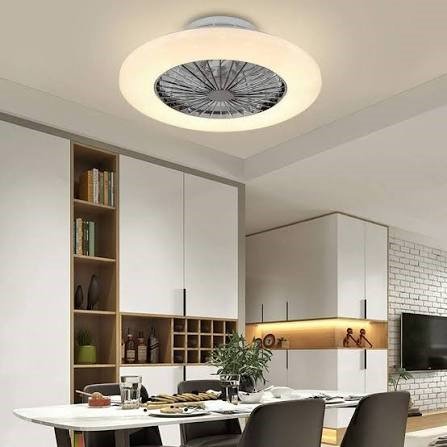
Rooms with low ceilings can be difficult to improve. A hanging pendant may reduce headroom, while a standard ceiling fan on a downrod can feel uncomfortably close. Even fixtures that appear compact in product photos may project farther into the room than expected once their canopy, motor housing, shade, and decorative details are included.
For many homeowners, the practical choice comes down to two options: a close-to-ceiling light or a flush mount ceiling fan. Both preserve more vertical space than traditional hanging fixtures, but they solve different problems. The right decision depends on how the room is used, how warm it becomes, and whether the ceiling fixture must provide the primary illumination.
Start With the Room’s Biggest Discomfort
Before comparing styles, identify what is actually making the room uncomfortable. Is it too dark, poorly ventilated, visually cramped, or noticeably warmer than nearby areas?
A hallway with limited headroom usually needs light but not airflow. A bedroom beneath a warm upper floor may benefit more from air circulation. A small home office could need both, particularly if computers and afternoon sun cause the temperature to rise.
List the room’s problems in order of importance. This prevents an attractive dual-purpose fixture from being selected when a simpler light would perform better—or a decorative ceiling light from replacing the only practical location for a fan.
Measure the Total Fixture Drop
Ceiling height alone does not tell you how much usable clearance will remain. Measure from the finished floor to the ceiling, then subtract the fixture’s complete installed height. For a fan, calculate the height of the canopy, housing, blades, light, and any decorative elements.
Mark the lowest point on a wall with removable tape. This helps you see whether the fixture will feel intrusive from the doorway, beside tall furniture, or above a bed. Also check the manufacturer’s required blade height and clearance instructions, along with applicable local building and electrical requirements.
Flush mount does not always mean completely flat. Some fixtures sit almost directly against the ceiling, while others extend several inches downward. Always use the listed product dimensions rather than relying on the category name.
When a Flush Mount Light Is the Better Choice
Choose a close-to-ceiling light when the room’s main problem is insufficient illumination. This option generally works well in hallways, closets, compact kitchens, entries, laundry rooms, and spaces that already receive adequate airflow from another source.
A broad diffuser can spread ambient light more evenly than a small exposed bulb. For a multipurpose room, dimming or adjustable color temperature can make the fixture more flexible. Bright, neutral light may be useful for cleaning or working, while a warmer setting feels more comfortable during the evening.
Modern flush mount lighting is available in simple geometric forms as well as glass, wood, metal, and decorative designs. This allows homeowners to preserve headroom without settling for a basic builder-style dome.
When a Flush Mount Ceiling Fan Makes More Sense
A fan becomes the stronger option when stagnant air or seasonal heat affects daily comfort. Bedrooms, living rooms, nurseries, and home offices can all benefit from gentle circulation, especially when opening a window is noisy, inconvenient, or ineffective.
Low-profile fans mount closer to the ceiling than conventional downrod models. Some have visible blades, while enclosed designs place smaller blades inside a protective housing. Many also include an integrated LED, allowing one electrical location to provide both circulation and general light.
Browse flush mount ceiling fans only after measuring the room and confirming that the proposed location provides sufficient blade and furniture clearance. A compact appearance does not remove the need for safe installation.
An enclosed low-profile fan can combine ambient lighting and air circulation without a long downrod.
Understand the Airflow Trade-Off
Because a flush mount fan sits closer to the ceiling, there is less space above the blades for air to enter. Its performance depends on the motor, blade design, pitch, diameter, and the distance between the blades and ceiling.
Do not select a fan based on diameter alone. Review its airflow information and recommended room size. A compact enclosed fan may be suitable for a bedroom or office but may not circulate air effectively through a large open living area.
Remember that a fan circulates air rather than lowering the actual room temperature. The moving air can make occupants feel more comfortable, but there is usually little benefit in leaving the fan running for long periods when the room is empty.
Match the Diameter to the Occupied Area
The largest fan that physically fits is not always the best-looking or most effective choice. Consider the usable area beneath it. In a bedroom, the fan may primarily serve the bed. In an open-plan room, it might only need to cover the seating zone rather than the entire combined floor area.
Use the manufacturer’s room-size recommendations as a starting point and check that blades remain clear of walls, cabinets, tall storage units, and open doors. For enclosed designs, confirm that the housing will not interfere with wardrobes or loft-bed frames.
Scale also affects the room visually. A very small fixture can look lost on a broad ceiling, while an oversized decorative fan may make a compact room feel more crowded despite its low-profile installation.
Evaluate the Light Separately From the Fan
When choosing a fan with an integrated LED, do not assume that the light will automatically be sufficient. Check the lumen output, beam spread, color temperature, dimming functions, and whether the LED module or driver can be replaced.
A bedroom may need bright general light for dressing and cleaning but softer illumination before sleep. Independent controls are important so the fan can operate with the light off and the light can remain on without running the fan.
If the integrated light creates a narrow pool directly below the fixture, additional bedside, desk, or wall lighting may still be necessary. A central fixture should support the room’s activities rather than being expected to solve every lighting need.
Consider Noise and Controls
A quiet motor is especially important in bedrooms, nurseries, and workspaces. Motor quality matters, but installation also affects noise. A loose mounting bracket, unsuitable electrical box, unbalanced blades, or vibrating decorative component can cause humming, clicking, or rattling.
Review the available speed settings and control method. A remote is convenient from a bed or sofa, while a wall control is more difficult to misplace. Some models include timers, reversible operation, dimming, or adjustable color temperature. Choose features that are easy to use rather than selecting the longest specification list.
Confirm compatibility before connecting a fan or integrated LED to an existing dimmer. Controls intended only for standard light bulbs may not be suitable for a fan motor or LED driver.
Check the Existing Electrical Box
Replacing a light with another flush mount light may be relatively straightforward when the wiring and box are in good condition. Installing a fan in the same location requires additional attention because a fan is heavier and produces movement.
The ceiling box and supporting structure must be rated for a fan. A standard light-fixture box should not be assumed strong enough. If the box rating, ceiling support, or wiring is uncertain, ask a qualified electrician to inspect the location before purchasing the fixture.
Also measure the old canopy or base. A smaller replacement may expose an unpainted ring, screw holes, or damaged ceiling surface that was hidden by the previous fixture.
Make the Decision Around Daily Use
Choose a flush mount light when illumination, simplicity, and maximum visual openness are the priorities. Choose a low-profile fan when air circulation would improve comfort and the room has enough clearance for safe operation. Select a fan with an integrated light when one ceiling location needs to perform both functions.
The best fixture is not necessarily the thinnest or most decorative option. It is the one that preserves headroom, provides the right amount of light or airflow, operates comfortably, and suits the way the room is used every day.