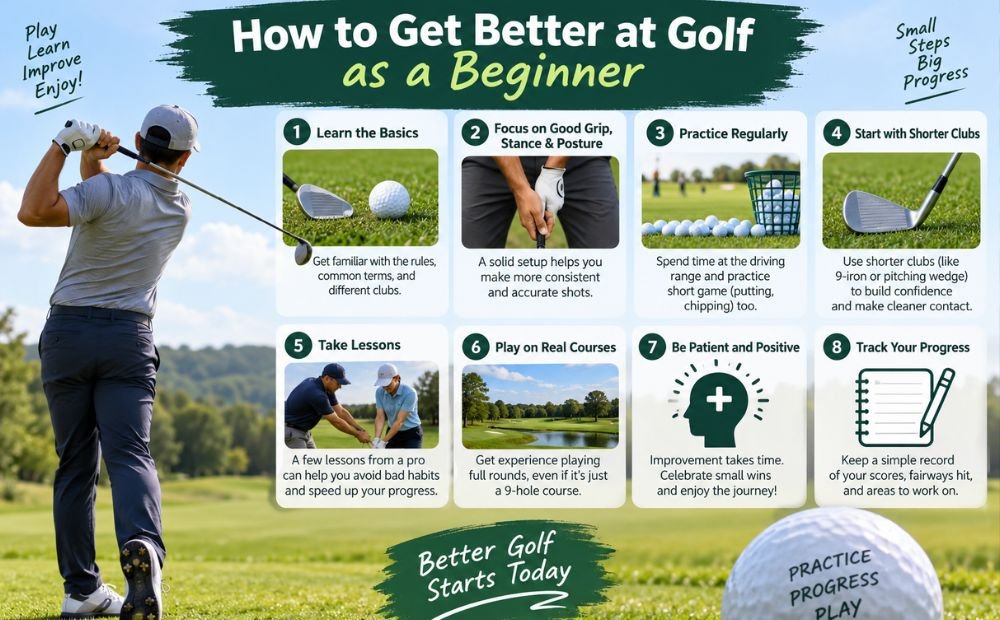
Golf presents a unique challenge for newcomers: the game combines physical technique, mental focus, and strategic thinking into one complex skill set. Many beginners feel overwhelmed by the rules, equipment, and sheer difficulty of hitting a small ball consistently well. The good news is that improvement comes faster when you understand which fundamentals matter most and how to practice them deliberately. This article covers the core areas where beginners can build a solid foundation and see measurable progress within weeks.
1. Master Your Grip and Stance
Your grip is the only connection you have with the club, making it arguably the most important fundamental in golf. A proper grip ensures that the clubface returns to the ball in a square position, which is essential for straight shots. Most beginners hold the club too tightly, which restricts their swing and creates tension in their shoulders and arms. Your grip should be firm enough to control the club but relaxed enough that someone could pull it from your hands with moderate effort. Your stance sets the foundation for your entire swing and balance: stand with your feet shoulder-width apart, ball positioned between your front heel and the center of your stance, knees slightly bent, and back maintaining a natural posture without excessive bending or hunching. Grip and stance require no special athleticism, yet correcting them unlocks better contact and consistency almost immediately.
2. Focus on Short Game Practice First
Many beginners spend all their practice time on the driving range, hitting full shots and watching the ball fly. However, chipping, pitching, and putting account for roughly half of your total score, so focused work within 100 yards of the green will improve your scorecard far faster than hitting driver after driver. For example, if you miss a green but chip close and convert the putt, you save strokes that a long drive simply cannot recover. Start by practicing chip shots from various distances and lies around the practice green, then work on pitching between 30 and 100 yards with an emphasis on rhythm and distance control rather than power. Dedicate significant time to putting as well, since it is the only stroke made from the green itself and directly impacts every hole you play. Beginners who develop short game competence early score better, enjoy the game more, and stay motivated to improve longer than those who chase distance off the tee.
3. Invest in Quality Instruction Early
Learning golf alone through videos and trial-and-error can ingrain bad habits that become difficult to correct later. A single lesson with a qualified instructor is worth dozens of hours of unguided practice, because a professional can identify and correct swing flaws before they become permanent. A good instructor meets you where you are, teaches fundamentals in the right order, and provides specific drills to practice between sessions. They also help you understand why certain techniques matter, not just what correct form looks like. Consider taking three to five lessons when you first start, covering grip, stance, posture, basic swing mechanics, and short game fundamentals. Many golf facilities offer group lessons for beginners at reasonable rates, making quality instruction accessible regardless of budget.
4. Play More Golf, Not Just Practice
There is a meaningful difference between practice and actual play, and both have a role in improvement. Practice allows you to repeat the same shot in a controlled environment and build muscle memory, while play forces you to execute under pressure and make strategic decisions. Beginners who spend weeks at the range without playing often struggle on the course because they have never dealt with slopes, course conditions, or the mental pressure of real scoring. Start on short par-3 courses or executive courses if full 18-hole rounds feel overwhelming, as these teach the same fundamentals in a less daunting environment. Women beginners stepping onto the course for the first time often find that wearing stylish ladies golf apparel helps them feel confident and comfortable during real rounds, which makes it easier to focus on the game itself. Playing also teaches course management and how to handle poor shots mentally, two skills that range sessions alone cannot develop.
5. Develop Consistency Through Deliberate Practice
Random practice feels productive because you are swinging clubs and hitting balls, but structured, deliberate practice produces real improvement. Instead of hitting 50 balls without a purpose, set specific targets for each session, such as landing shots consistently within a defined area at 75 yards or making putts from five feet repeatedly. Treat every range ball like a real shot: pick a target, commit to a club selection, execute a pre-shot routine, and evaluate the result. This mental discipline transfers directly to your on-course game and reduces the gap between how you practice and how you perform. Film yourself occasionally to compare what you feel with what actually happens, since many golfers carry an inaccurate perception of their own swing. Over time, deliberate practice with honest feedback creates the neural patterns needed for consistent, quality golf.
Conclusion
Becoming a better golfer as a beginner requires focus on fundamentals, quality instruction, and a balance between practice and play. Grip and stance form the foundation upon which all other skills build, while short game practice delivers faster score improvement than driving distance. Investing in a few professional lessons early prevents bad habits from taking root, and playing actual rounds accelerates learning in ways practice alone cannot replicate. By combining these approaches with deliberate practice and honest self-assessment, beginners can see significant improvement within months. Golf rewards those who commit to steady, patient improvement, and every accomplished golfer started exactly where you are now.