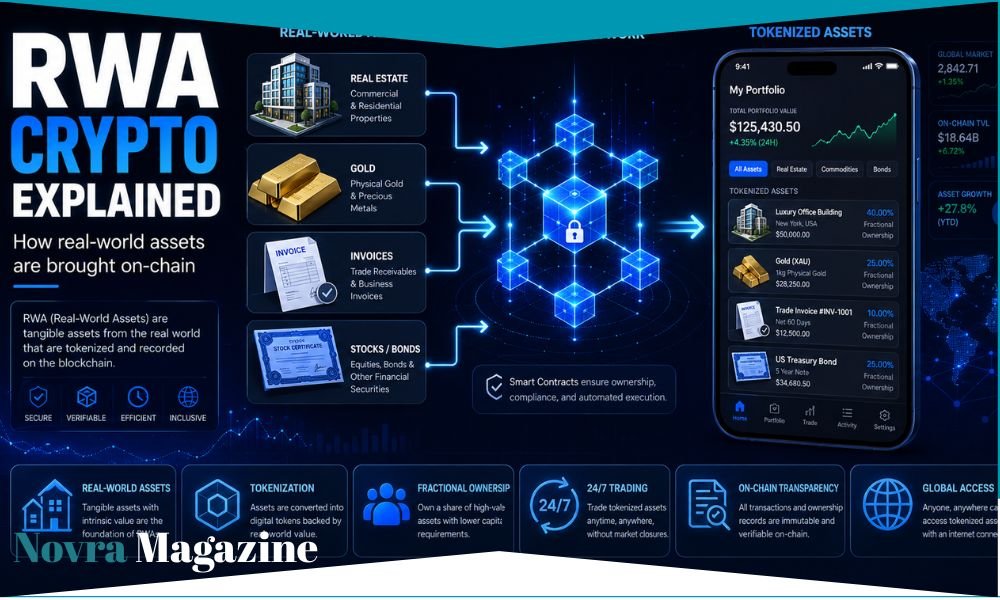
Imagine owning part of a U.S. Treasury fund, a gold bar, private credit, or another traditional investment through a token in a blockchain wallet. That is the basic idea behind RWA crypto explained in simple words. RWA means real-world asset, and the Bank for International Settlements describes tokenisation as creating digital representations of assets on programmable systems. The exciting part is that blockchain can make traditional assets easier to move, divide, track, and connect with digital finance. But there is one very important warning: the token is only as strong as the legal rights, custody, and real asset behind it.
What Does RWA Mean in Crypto?
In crypto, RWA usually means real-world asset.
These are assets that exist outside a blockchain or come from traditional finance but are represented in some way onchain.
Examples can include:
- U.S. Treasury securities
- Money-market funds
- Government bonds
- Private credit
- Company shares
- Gold
- Real estate
- Loans
- Investment funds
- Other financial claims
The basic idea is to connect something from traditional finance or the physical world with blockchain technology. The BIS describes tokenisation as creating and recording digital representations of traditional assets on programmable platforms.
So RWA crypto is not one particular cryptocurrency.
It is a much bigger idea.
Does RWA Ever Mean Something Else?
Yes, and this can confuse people.
In traditional banking, RWA can also mean “risk-weighted assets.”
Banks use risk-weighted assets when calculating how much regulatory capital they need to hold against different types of risk. The Basel framework uses RWA calculations for credit, market, and operational risks.
That is completely different from the crypto meaning.
When crypto users talk about an “RWA narrative,” “RWA token,” or “RWA crypto project,” they normally mean real-world assets.
When banking regulators discuss RWA calculations, they may mean risk-weighted assets.
The context tells you which one applies.
What Is Real-World Asset Tokenization?
Tokenization means creating a blockchain-based representation connected to an asset.
Imagine a traditional investment fund.
Normally, ownership is recorded inside databases operated by financial companies.
A tokenized fund can use blockchain technology as part of its ownership and transaction record.
The underlying investment may still be very traditional.
It could contain Treasury bills.
Government securities.
Cash.
Private loans.
Or shares.
What changes is how the investor’s interest is represented and moved.
The BIS says tokenisation can combine messaging, reconciliation, and settlement functions in programmable systems, potentially making some financial processes more efficient.
Can You Give a Very Simple RWA Example?
Yes.
Imagine a fund owns $10 million of short-term U.S. government securities.
Instead of investors only seeing their fund shares inside an old financial database, the fund’s shares are represented through blockchain tokens.
You buy an eligible token.
The token represents your interest in the fund.
The Treasury assets remain real financial securities.
The blockchain does not create the Treasury yield.
It simply helps represent or move the investment.
Franklin Templeton’s BENJI is a real example. One BENJI token represents one share of the Franklin OnChain U.S. Government Money Fund.
That is RWA tokenization in action.
Does an RWA Token Mean You Own the Real Asset?
Sometimes.
Not always.
This is probably the most important thing to understand about RWA crypto.
Different tokens create different legal relationships.
One token may represent a genuine share in a regulated investment fund.
Another may represent ownership rights connected with physical gold.
Another may be a debt instrument backed by assets.
Another may simply provide economic exposure without giving you ownership of the underlying asset.
The SEC’s January 2026 guidance on tokenized securities specifically explains that blockchain products can use several structures, including issuer-sponsored securities and third-party products that create different rights.
So never assume:
“There is a real asset behind this token, therefore I personally own that real asset.”
Read the legal structure.
How Does an RWA Get Put on a Blockchain?
The process depends on the asset, but the basic steps can look like this.
First, somebody identifies the asset.
Maybe it is a Treasury fund.
Maybe it is gold.
Maybe it is a private loan.
Then there needs to be a legal structure connecting that asset with investors.
A custodian may hold the real asset.
A fund may own it.
A trust or company may be created.
Next, tokens are issued on a blockchain.
Rules can be added to smart contracts covering transfers, investor eligibility, redemptions, and other actions.
Finally, the onchain token needs to stay connected with what is happening offchain.
That connection is critical because a blockchain cannot magically know whether a Treasury bill matured or a borrower missed a loan payment.
Why Are Custodians Important in RWA Crypto?
Because many RWAs still exist outside the blockchain.
Consider physical gold.
The blockchain can show a gold token moving from one wallet to another.
But the blockchain cannot physically hold a gold bar.
Someone must store it.
Paxos’ PAX Gold is a clear example. Paxos says each PAXG token represents one fine troy ounce of London Good Delivery gold kept in professional vaults, with holders having ownership rights to the underlying gold.
The blockchain deals with the digital token.
The custodian deals with the physical asset.
Both parts matter.
What Is PAX Gold?
PAX Gold, or PAXG, is one of the easiest physical RWA examples to understand.
Each PAXG token represents one fine troy ounce of qualifying gold.
Paxos says the physical gold is held in segregated custody for token holders.
So instead of buying a whole gold bar and finding somewhere safe to store it, eligible investors can gain ownership exposure through blockchain tokens.
PAXG can also be divided into smaller amounts.
That demonstrates one potential advantage of tokenization.
A large physical asset becomes easier to divide digitally.
In June 2026, Paxos also expanded PAXG to Solana in addition to its existing blockchain presence.
What Are Tokenized U.S. Treasuries?
Tokenized Treasury products are among the most important parts of the RWA market.
U.S. Treasury securities are debt issued by the U.S. government.
Traditional investors have used them for generations.
Tokenization brings exposure to Treasury-based investments onto blockchain infrastructure.
The important point is that the yield does not come from the blockchain.
The underlying Treasury assets or Treasury-focused investment products create the income.
The token is the digital layer.
Products such as BlackRock’s BUIDL, Franklin Templeton’s BENJI, and Ondo’s OUSG show different approaches to bringing U.S. dollar and Treasury-related investments onchain.
What Is BlackRock BUIDL?
BUIDL stands for the BlackRock USD Institutional Digital Liquidity Fund.
BlackRock launched the tokenized fund with Securitize in 2024.
It gives qualifying investors exposure to U.S. dollar yield through a fund that invests in assets including cash, U.S. Treasury bills, and repurchase agreements.
BlackRock now publishes official BUIDL token addresses to help users avoid fake tokens pretending to be the fund.
That detail also highlights an important RWA risk.
A scammer can create a token with a familiar name.
The name alone proves nothing.
Can BUIDL Be Used Inside Crypto Markets?
Increasingly, yes, for eligible participants.
In February 2026, Securitize and Uniswap Labs announced infrastructure allowing eligible, whitelisted BUIDL investors to access trading through UniswapX technology.
In April 2026, OKX, BlackRock, and Standard Chartered announced a framework allowing eligible institutional clients to use BUIDL as yield-bearing collateral while trading, with custody handled through Standard Chartered in that arrangement.
This shows where the RWA idea becomes more interesting.
The tokenized fund is not only something to hold.
It can potentially become financial infrastructure.
An institution might earn income on Treasury exposure while also using the token as collateral elsewhere.
What Is BENJI?
BENJI is connected with Franklin Templeton’s Franklin OnChain U.S. Government Money Fund.
The fund launched in 2021.
Franklin Templeton says it was the first U.S.-registered money-market fund to use a public blockchain as its system of record.
The fund invests at least 99.5% of its assets in U.S. government securities, cash, and fully collateralized repurchase agreements involving government securities or cash.
One BENJI token represents one share of the fund.
This is very different from buying an unknown RWA meme coin.
BENJI represents an interest in an actual registered investment fund.
Why Is BENJI Important?
Because it shows how blockchain can change the infrastructure without necessarily changing the investment.
The investment itself is very traditional.
Government securities.
Cash.
Repurchase agreements.
Those assets existed long before crypto.
Blockchain changes how shares can be recorded, transferred, and serviced.
Franklin Templeton says its Benji system supports blockchain-integrated mutual-fund recordkeeping, while the fund has added features such as peer-to-peer share transferability for eligible participants and intraday yield functionality.
This is an important way to think about RWA crypto.
Sometimes the innovation is not the asset.
The innovation is the financial plumbing around the asset.
What Is Ondo OUSG?
OUSG is Ondo Finance’s Short-Term U.S. Treasuries product.
Ondo describes it as providing exposure to lower-risk, liquid U.S. Treasury bills while allowing holders to accrue income from the underlying portfolio.
The product has also expanded onto several blockchain systems.
For example, Ondo brought OUSG to the XRP Ledger in 2025 with minting and redemption supported through Ripple’s RLUSD stablecoin for eligible institutional users.
In May 2026, Ondo, J.P. Morgan’s Kinexys, Mastercard, and Ripple announced a pilot involving near-real-time cross-border redemption of a tokenized U.S. Treasury fund.
That gives us another clue about where RWAs may be heading.
Not only investing.
Settlement too.
What Is USDY?
USDY is another Ondo product, but it should not simply be described as a U.S. Treasury token.
Ondo describes USDY as a tokenized note that can be backed by assets including short-term U.S. Treasuries, shares of a short-duration Treasury ETF, or bank demand deposits depending on the issuance structure.
Ondo also clearly warns that USDY provides economic exposure related to those assets but is not itself a U.S. Treasury security and does not give holders a right to receive individual Treasury securities.
That distinction is exactly why RWA investors must read carefully.
“Backed by Treasuries” and “I own Treasury bills directly” can be two different things.
Where Does RWA Yield Come From?
Not from the token.
Not from Ethereum.
Not from Solana.
Not from blockchain magic.
The yield normally comes from whatever economic activity sits behind the token.
For Treasury products, income can come from interest earned by government securities and related cash-management investments.
For private credit, yield can come from borrowers paying interest.
For real estate, returns might come from rent or property income.
For bonds, they can come from coupon payments.
Gold is different because physical gold itself does not pay interest simply for existing.
This is an extremely useful rule:
Always ask what generates the yield.
If nobody can explain it simply, be careful.
Is High RWA Yield Automatically Better?
No.
Higher yield often comes with higher risk.
A short-term government-security fund is very different from lending money to a risky private business.
Both can be called RWA products.
They should not be treated as equally safe.
Private-credit products can face borrower defaults.
Real estate can lose value.
Property can remain empty.
Companies can fail.
Fund managers can make mistakes.
Tokenization does not erase any of those old risks.
It may simply make the investment easier to represent or move digitally.
What Is Private Credit in RWA Crypto?
Private credit means lending money outside normal publicly traded bond markets.
A company or borrower receives financing.
Investors receive interest in return for taking credit risk.
Tokenization can represent interests in those loans or credit funds onchain.
Centrifuge is one platform building infrastructure around tokenized funds, Treasuries, and private credit. It says its systems can bring institutional investment products into blockchain-based markets and connect them with DeFi liquidity.
Private credit can provide attractive yields.
But those yields come from borrowers.
If borrowers cannot repay, investors can lose money.
The blockchain cannot force an insolvent company to suddenly find cash.
Can Real Estate Become an RWA Token?
Yes.
Property is one of the most common examples used when people explain asset tokenization.
Imagine an apartment building worth $10 million.
Instead of one person buying the whole building, a legal structure could create investment interests connected with it.
Those interests could then potentially be represented through blockchain tokens.
Investors might receive exposure to rental income or changes in property value.
But real estate tokenization is more complicated than creating a token and writing “house” beside it.
Property ownership is governed by local laws, titles, taxes, contracts, and courts.
The legal connection between the token and the property has to work outside the blockchain too.
Does Tokenization Make Real Estate More Liquid?
It can help, but it does not guarantee liquidity.
Recent BIS research studying tokenized real estate found evidence that tokenisation could improve trading liquidity in some conditions. However, the researchers also found that some liquidity benefits depended heavily on platform buyback arrangements, which could introduce additional insolvency risk.
This is a useful reality check.
Turning a $5 million building into five million tokens does not guarantee five million buyers.
A market still needs people willing to trade.
Tokenization can make transfer easier.
It cannot manufacture demand.
Can Stocks Be RWAs?
Yes.
Equities are traditional financial assets, so tokenized stocks can fall within the wider RWA idea.
However, tokenized-stock structures can be very different.
The SEC explained in January 2026 that securities can be tokenized directly by or for the issuer, or tokenized by unrelated third parties. Third-party products may create rights that differ from direct share ownership.
So a token following Tesla stock might represent a genuine tokenized security.
Or an indirect claim.
Or a different security linked to Tesla’s value.
“Tokenized stock” does not automatically mean direct shareholder ownership.
The legal documentation matters.
Are Bonds RWAs?
Yes.
Bonds are one of the clearest examples.
A bond is essentially a debt investment.
An investor lends money to a government, company, or other issuer.
The borrower promises repayment under certain terms and normally pays interest.
Putting bond interests onto blockchain infrastructure does not change the basic economics.
The borrower still needs to repay.
Interest still has to come from somewhere.
The bond can still lose value.
What tokenization may change is issuance, recordkeeping, transfer, settlement, and how easily the security connects with other financial systems.
The BIS has identified tokenised securities and government bonds as important areas where tokenisation could reshape financial infrastructure.
Are Stablecoins RWAs?
This depends on how somebody is using the term.
A fiat-backed stablecoin may represent a claim supported by traditional reserves such as cash or short-term financial assets.
In that broad sense, people sometimes discuss stablecoins alongside real-world asset tokenization.
However, the crypto industry also commonly treats stablecoins and RWAs as separate categories because stablecoins are mainly designed to function as digital money, while RWA products often represent investments such as Treasury funds, credit, stocks, or commodities.
Regulators also distinguish categories. The SEC’s March 2026 crypto interpretation lists stablecoins and digital securities as separate parts of its wider crypto-asset taxonomy.
So there is no need to argue that every stablecoin is automatically an “RWA token.”
Context matters.
Is PAXG a Stablecoin?
No.
PAXG is a gold-backed token.
Its value is designed to follow physical gold rather than remain at one U.S. dollar.
Paxos says each token represents one fine troy ounce of London Good Delivery gold.
So PAXG is a strong example of a commodity RWA.
A dollar stablecoin is designed around money.
PAXG is designed around gold.
They may both use blockchain technology, but their underlying assets and economic purpose are different.
Why Do People Want Real-World Assets in DeFi?
Traditional DeFi developed largely around crypto-native assets.
People borrowed stablecoins against Ether.
They traded tokens.
They provided crypto liquidity.
RWAs add another possible source of economic value.
A DeFi system can potentially interact with a token representing Treasury-fund shares or other regulated assets.
That can bring traditional yields and collateral into blockchain markets.
In 2026, BUIDL’s expansion into qualified onchain trading and institutional collateral workflows showed how tokenized Treasury funds can begin interacting with crypto-market infrastructure instead of simply sitting inside isolated investment accounts.
This is one of the biggest reasons RWA crypto attracts attention.
Can RWA Tokens Be Used as Collateral?
Some can.
Collateral is an asset pledged to support a loan or trading position.
Traditional banks already use securities and cash as collateral every day.
Tokenization can potentially make this process faster and more programmable.
BlackRock’s BUIDL has been integrated into an institutional framework where qualifying OKX clients can use BUIDL as collateral while the asset remains in regulated custody through Standard Chartered.
Centrifuge has also developed systems connecting tokenized RWAs with blockchain lending markets.
This is one area where tokenization may offer more than simply “putting an asset on blockchain.”
The asset can potentially become programmable financial infrastructure.
What Are Oracles and Why Do RWAs Need Them?
A blockchain knows what happens on the blockchain.
It does not naturally know everything happening outside it.
Suppose a token represents a bond.
The blockchain may need information about the bond’s value.
Suppose a token represents gold.
The system needs a reliable gold price.
Suppose a token represents private credit.
The system may need information about repayments or portfolio values.
Services known as oracles can provide verified external data to blockchain applications.
RWA systems can use these data feeds for valuation, collateral management, corporate actions, and other functions.
This creates another dependency.
Bad data can create bad outcomes.
What Are the Biggest Benefits of RWA Crypto?
One potential benefit is faster settlement.
Traditional financial transactions can involve several companies reconciling their own records.
Tokenized systems can potentially place more information and value movement into coordinated programmable infrastructure.
The BIS says tokenization can support the simultaneous exchange of assets and help reduce settlement risk and duplicated reconciliation work.
Another possible benefit is programmability.
Rules can be added directly to digital assets.
Transfers can potentially happen automatically when conditions are met.
Corporate actions can become easier to process.
Compliance checks can also be integrated into token systems.
Does RWA Crypto Make Investing More Accessible?
Sometimes.
Tokenization can make fractional ownership technically easier.
Instead of needing to buy one large asset, investment interests can potentially be divided into smaller digital units.
It can also make assets easier to move between compatible systems.
But there is a major misunderstanding here.
Tokenization does not automatically mean everybody can invest.
A tokenized security can still be restricted to accredited investors, qualified purchasers, certain countries, or approved wallets.
BUIDL, for example, is designed for qualifying investors rather than unrestricted global retail access.
Financial law still applies.
Does RWA Mean 24/7 Trading?
Not automatically.
Blockchains can operate around the clock.
The underlying asset may not.
A traditional bond market may be closed.
A fund may calculate its official net asset value at set times.
A property cannot be sold instantly at 3 a.m. simply because a token can move at 3 a.m.
Some tokenized products do provide around-the-clock transfers or secondary-market functionality.
For example, eligible BUIDL holders gained access to a 24/7 bilateral trading framework through the Securitize and UniswapX integration announced in February 2026.
But 24/7 token movement and 24/7 underlying-market liquidity are not always the same thing.
What Is the Biggest Advantage of Tokenized Treasuries?
For crypto-native investors and institutions, tokenized Treasury products can combine two worlds.
They can provide exposure to traditional short-term government-related investments while existing within blockchain infrastructure.
That can make them easier to connect with stablecoins, wallets, trading platforms, and onchain settlement.
In 2026, Ondo’s cross-bank Treasury redemption pilot with J.P. Morgan’s Kinexys, Mastercard, and Ripple demonstrated near-real-time cross-border redemption using tokenized assets.
BlackRock’s BUIDL has also been used in collateral systems connected with crypto trading.
These examples show that the RWA story is moving beyond simply issuing tokens.
The focus is increasingly on what those tokens can actually do.
What Are the Main Risks of RWA Crypto?
There are many.
The first is underlying-asset risk.
A loan can default.
A property can lose value.
A bond issuer can face problems.
A stock can fall.
The second is legal risk.
The token may not give you the rights you think it does.
The third is custody risk.
Someone may need to hold the actual shares, bonds, or physical assets.
Then there is issuer risk.
The company that created the token may fail.
Blockchain technology can add smart-contract, wallet, bridge, and cyber risks too.
Tokenization creates useful technology.
It does not erase financial risk.
What Is Counterparty Risk in RWA Crypto?
Counterparty risk means your investment depends on another party doing what it promised.
Imagine a company issues a token backed by loans.
The loans exist.
But perhaps your legal claim is actually against the token issuer.
If that company fails, what happens?
Can you directly claim the loans?
Does a bankruptcy-remote structure protect you?
Is another trustee involved?
These questions are boring until something goes wrong.
Then they become the most important questions in the investment.
This is why the SEC emphasizes understanding the exact rights created by tokenized securities and third-party token structures.
What Is Custody Risk?
Suppose a token says it is backed by $100 million of government securities.
Somebody must actually hold those securities.
Who?
Where?
In whose legal name?
Are customer assets separated from company assets?
Could creditors take them if the company fails?
These questions matter.
BUIDL uses traditional institutional custodial infrastructure for its underlying assets, while PAXG relies on custody arrangements for physical gold.
The blockchain record is only one part of the system.
Offchain custody remains critical.
What Is Smart-Contract Risk?
Smart contracts are programs running on blockchains.
Programs can contain bugs.
Attackers can sometimes exploit them.
Administrative keys can create risks.
Bridges between blockchains can fail.
A token can therefore have excellent underlying collateral while still facing technical problems in the digital layer.
Institutional tokenization systems increasingly include security audits, compliance controls, whitelisting, and regulated service providers to reduce these risks. Ondo, for example, publicly emphasizes regulated service providers, security auditing, and compliance in its RWA infrastructure.
Risk can be reduced.
It cannot be deleted completely.
What Is Oracle Risk?
An RWA smart contract sometimes needs information from outside the blockchain.
That information may come through an oracle.
If the price data is incorrect, delayed, manipulated, or unavailable, a DeFi system may make the wrong decision.
For example, it could value collateral incorrectly.
This is why institutional RWA infrastructure puts significant attention on reliable market data and synchronization between offchain assets and onchain tokens.
It is another reminder that RWAs are hybrid systems.
Part blockchain.
Part traditional finance.
What Is Liquidity Risk?
Liquidity means how easily you can sell something without badly affecting its price.
Tokenization can make transfers faster.
That does not guarantee somebody wants to buy.
A $100 million office building may be divided into digital tokens.
But if nobody wants those tokens, they remain illiquid.
BIS research on tokenized real estate found potential liquidity benefits but also showed that those benefits can depend on platform design and may introduce other risks.
Always separate technical transferability from real market liquidity.
They are not the same thing.
What Happens if the Real Asset Disappears?
This question is especially important for physical RWAs.
Imagine a token representing gold.
What happens if the gold is missing?
Insurance, custody, audits, legal ownership, and redemption rights suddenly become much more important than the blockchain.
The same issue applies to property.
A token cannot stop a building from being damaged.
For private credit, a token cannot prevent the borrower from going bankrupt.
For equities, tokenization cannot prevent the company from failing.
The real world remains real.
Blockchain does not remove that part.
Are RWA Tokens Securities?
Some are.
Some are not.
It depends on what the token represents and how it is structured.
Tokenized fund shares and tokenized stocks can clearly fall within securities regulation.
The SEC stated in January 2026 that turning a security into a blockchain representation does not make federal securities law disappear.
Other RWA tokens may represent commodities or different contractual rights.
PAXG, for example, is structured around ownership of physical gold.
You cannot determine the legal classification simply by seeing “RWA” on a crypto website.
What Is the Difference Between an RWA Token and an RWA Project Token?
This is extremely important.
A token representing a Treasury fund is an RWA itself in a meaningful economic sense.
But a governance token belonging to an RWA platform may be something completely different.
Imagine a company builds technology for tokenizing real estate.
Its own platform token might rise and fall based on speculation, governance, fees, or market demand.
Holding that token does not necessarily mean you own any property.
The same applies across the RWA sector.
A project can work with billions of dollars of real-world assets while its own governance token gives holders no direct claim on those assets.
So when people say:
“I bought an RWA coin,”
the next question should be:
“Does your token actually represent the RWA?”
Does Buying ONDO Mean You Own Ondo’s Treasuries?
Do not assume that.
Ondo Finance operates RWA products such as OUSG and other tokenized financial products.
A platform ecosystem token and an investment token representing a particular fund or financial instrument are different things.
Buying a governance or ecosystem token does not automatically mean you own the Treasury securities held inside another product.
This distinction applies to many crypto projects.
Always identify the specific token and the rights written into its documentation.
Is RWA Crypto Safer Than Normal Crypto?
Not automatically.
Some RWA products may have assets such as Treasury securities behind them.
That can make their economic risk very different from a meme coin with no underlying cash flow.
But an RWA token can introduce additional layers:
Issuer risk.
Custodian risk.
Legal risk.
Smart-contract risk.
Liquidity risk.
Oracle risk.
Regulatory risk.
A carefully regulated tokenized government money-market fund and an unknown “real-estate token” sold by an anonymous website should not be put into the same risk category.
The letters RWA are not a safety certificate.
Could an RWA Token Go to Zero?
Yes.
It depends on the structure.
A token linked to a risky loan could suffer large losses if the borrower defaults.
A property token could fall if the property loses value.
A synthetic product could face issuer failure.
A fraudulent token might have no real assets behind it at all.
Even money-market funds are investments rather than guaranteed bank deposits. Franklin Templeton’s government money-market fund documentation explains its investment structure rather than promising that normal investment risks disappear.
Never treat “real-world backed” as meaning “cannot lose.”
Why Is RWA Crypto So Popular in 2026?
Because major traditional financial institutions are now participating.
This is no longer only an idea discussed by small crypto startups.
BlackRock operates BUIDL.
Franklin Templeton has continued expanding BENJI.
Large financial and technology companies are experimenting with tokenized settlement and collateral.
BlackRock’s 2026 chairman’s letter describes its tokenized Treasury fund as the largest tokenized fund in the world.
Franklin Templeton marked BENJI’s fifth anniversary in April 2026 and described tokenized funds as a multi-billion-dollar category.
Institutional participation has made tokenization far more difficult to dismiss as only a crypto trend.
Does Wall Street Really Care About RWA Tokenization?
Yes.
The evidence is in the products.
BlackRock’s BUIDL exists across multiple blockchain networks.
Franklin Templeton has used public blockchain technology for its government money-market fund since 2021.
Traditional exchanges and regulators are also developing frameworks for tokenized securities. The SEC issued specific guidance on tokenized securities in January 2026.
The BIS has repeatedly described tokenization as potentially important for future securities and payment infrastructure.
This does not guarantee every RWA project will succeed.
It does show the technology has moved into serious institutional finance.
Could Everything Eventually Be Tokenized?
Technically, many kinds of assets can be represented digitally.
But not everything benefits equally from being placed onchain.
A Treasury fund may benefit from faster settlement and easier digital collateral use.
A private fund may benefit from automated administration.
A physical property is more difficult because local ownership law and legal enforcement remain central.
BIS research and institutional projects suggest tokenisation can improve some financial processes, but they also emphasize the importance of sound money, settlement, regulation, and legal frameworks around the technology.
So the future is unlikely to be:
“Put everything on blockchain because blockchain is cool.”
The useful question is:
What problem does tokenization solve?
How Can You Check an RWA Crypto Project?
Start with the real asset.
What is supposedly backing the token?
Then ask who owns that asset.
Who holds it?
Who verifies it?
Who is the custodian?
What legal rights does your token give you?
Can you redeem it?
Who performs audits or attestations?
Where does the yield come from?
Who can freeze or block transfers?
What happens if the issuer fails?
Is the product regulated?
Who is eligible to buy it?
Then check the blockchain contract from an official source.
BlackRock’s decision to publish official BUIDL contract addresses is a good example of why verification matters in a market where fake tokens can copy real names.
What Is Proof of Reserves for RWAs?
Proof of reserves is an attempt to show that assets backing a token actually exist.
The exact method can vary.
There may be blockchain records.
Custodian reports.
Auditor reports.
Attestations.
Bank records.
Asset-manager reporting.
Or oracle data.
Physical assets can make verification more difficult because the blockchain itself cannot inspect a vault or building.
Paxos publishes transparency information for PAXG in addition to describing its gold-custody structure.
Transparency is valuable.
But investors still need to understand what is being verified and by whom.
Can RWA Crypto Connect Traditional Finance and DeFi?
That is one of its biggest promises.
Traditional finance contains enormous pools of stocks, bonds, funds, credit, and other assets.
DeFi contains blockchain-based trading, lending, collateral, and settlement systems.
RWA tokenization creates a possible bridge.
A traditional financial asset can be wrapped in a compliant onchain structure.
Then, where permitted, it can interact with blockchain applications.
BlackRock’s BUIDL entering collateral and onchain liquidity systems in 2026 is a strong real-world example of this connection developing.
The difficult part is keeping the legal, financial, and blockchain layers working together.
Is RWA Crypto Only for Rich Investors?
No, but many major products still have restrictions.
Some institutional tokenized funds require investors to meet financial eligibility standards.
Some products are available only outside certain countries.
Others can be accessed by retail investors.
BENJI, for example, is connected to a U.S.-registered money-market fund and has both retail and institutional relevance. Franklin Templeton continues expanding distribution partnerships for the product.
BUIDL has traditionally focused on qualified investors.
So the RWA market is not one universal global marketplace.
Every product has its own rules.
What Is the Future of RWA Crypto?
The most interesting part of the future may not be simply creating more tokens.
It may be making tokenized assets useful.
A Treasury token used as collateral.
A money-market fund settling across blockchain networks.
Tokenized securities moving between wallets while keeping compliance rules.
Private-credit funds connected with DeFi lending.
Gold transferred digitally while the physical bars remain safely stored.
The BIS argues that tokenisation could become an important part of the next generation of financial infrastructure when tokenized assets and reliable forms of money can interact on programmable systems.
That future is still developing.
But by 2026, many parts of it are no longer theoretical.
FAQs About RWA Crypto Explained
What does RWA mean in crypto?
RWA usually means real-world asset. It refers to physical or traditional financial assets represented or connected to blockchain tokens.
What is RWA crypto?
RWA crypto is the wider use of blockchain technology to represent or interact with assets such as Treasury securities, funds, credit, stocks, gold, and real estate.
What is RWA tokenization?
It is the process of creating a digital blockchain representation of a traditional or physical asset. The legal and financial structure determines what rights the token holder actually receives.
Is Bitcoin an RWA?
Normally, no.
Bitcoin is a blockchain-native digital asset rather than a token representing an offchain traditional asset.
Is Ethereum an RWA?
Ether itself is not normally described as an RWA because it is native to a blockchain network rather than representing an external asset.
Are stablecoins RWAs?
Definitions vary. Fiat-backed stablecoins connect blockchain tokens with offchain reserves, but crypto markets often discuss stablecoins and investment-focused RWAs as separate categories.
Are tokenized U.S. Treasuries RWAs?
Yes. Treasury-related funds and securities represented through blockchain systems are major examples of real-world asset tokenization.
Is BlackRock BUIDL an RWA?
Yes. BUIDL is BlackRock’s tokenized short-term U.S. dollar liquidity fund investing in assets including Treasury bills, cash, and repurchase agreements.
What is BENJI?
BENJI represents shares of Franklin Templeton’s Franklin OnChain U.S. Government Money Fund, which uses public blockchain technology in its recordkeeping system.
What is OUSG?
OUSG is Ondo’s tokenized product providing eligible investors with exposure to short-term U.S. Treasury-related investments.
Is PAX Gold an RWA?
Yes. Paxos says each PAXG token represents one fine troy ounce of physical London Good Delivery gold held in custody.
Can real estate be tokenized?
Yes. Property interests can be represented through tokens when the necessary legal ownership and investment structures are built around them. BIS research has studied functioning tokenized real-estate markets.
Where does RWA yield come from?
It comes from the underlying investment. Treasury products can earn government-security income, private credit can earn borrower interest, and real estate can generate rental income. The blockchain itself does not create the yield.
Are RWA tokens safe?
Not automatically. Risks can include underlying-asset losses, issuer failure, custody problems, legal uncertainty, low liquidity, smart-contract bugs, and oracle failures.
Are RWA tokens securities?
Some are. Tokenized stocks, fund interests, and other investment products can remain securities even when blockchain technology is used.
Does tokenization remove SEC rules?
No. The SEC has stated that tokenized versions of securities remain subject to applicable securities regulation.
Can RWAs be used in DeFi?
Some can. Tokenized products are increasingly being integrated into collateral, trading, and lending systems for eligible users.
Does an RWA token always give ownership of the underlying asset?
No. Some give direct ownership rights, some represent fund interests or contractual claims, and others provide only economic exposure.
Does buying an RWA project coin mean I own its real-world assets?
Not necessarily. A platform’s governance or ecosystem token can be completely separate from the investment tokens representing its underlying assets.
Can RWA crypto go to zero?
Yes. The underlying asset can lose value, borrowers can default, issuers can fail, and token structures can create additional technical or legal risks.
Why is RWA crypto popular in 2026?
Major asset managers and financial institutions are now operating or experimenting with tokenized funds, Treasury products, collateral, and settlement infrastructure. BlackRock, Franklin Templeton, and other established institutions have active products in this area.
Final Thoughts
The easiest version of RWA crypto explained is this:
Take something that already has value outside crypto.
Then connect its ownership or economic rights to blockchain technology.
That asset might be a Treasury fund.
Gold.
Private credit.
Stocks.
Bonds.
Real estate.
Or another financial investment.
The blockchain creates the digital layer.
But the real value still comes from what sits underneath.
That is the part people sometimes forget.
A Treasury token earns money because Treasury-related assets generate income.
A private-credit token can earn interest because somebody borrowed money and agreed to repay it.
A property investment can generate income because tenants pay rent.
Gold has value because there is real demand for gold.
The blockchain does not create those economics.
It changes how the investment can be recorded, transferred, settled, divided, and sometimes used in other applications.
That distinction is why RWA crypto has become much more serious in 2026.
BlackRock operates BUIDL, a tokenized fund with exposure to assets including U.S. Treasury bills, cash, and repurchase agreements.
Franklin Templeton’s BENJI represents shares of a U.S.-registered government money-market fund and has used public blockchain technology in its recordkeeping since 2021.
Ondo has built tokenized Treasury products and has participated in cross-border tokenized-settlement tests with companies including J.P. Morgan’s Kinexys, Mastercard, and Ripple.
Paxos has taken an even easier-to-see real-world asset — physical gold — and connected each PAXG token with ownership rights to gold stored in professional vaults.
These are very different products.
That is the point.
RWA crypto is not one coin.
It is not one blockchain.
It is not even one type of investment.
It is a broad movement to connect traditional assets with programmable digital networks.
And that movement has now reached large financial institutions.
The BIS has described tokenisation as potentially transformative for securities markets, payments, and the wider financial system when designed around safe settlement and sound financial structures.
But there is a danger in all the excitement.
Putting an asset on a blockchain does not automatically make it better.
It does not make a bad loan safe.
It does not make a weak company strong.
It does not make a building more valuable.
It does not guarantee buyers will appear.
And it does not turn an unclear legal claim into real ownership.
That is why anyone studying an RWA token should ask several questions before thinking about price.
What is the real asset?
Who owns it?
Who holds it?
What does my token legally give me?
Where does the yield come from?
Can I redeem it?
What happens if the issuer fails?
Who verifies the reserves?
Those questions tell you far more than the word “RWA” beside a token symbol.
There is another important distinction.
A token representing a Treasury fund is very different from a governance coin issued by a company that builds RWA technology.
Buying the second one does not automatically give you ownership of the first one’s assets.
That misunderstanding can be expensive.
The future of RWA crypto may therefore be less about creating thousands of new speculative coins and more about moving existing financial assets onto better digital infrastructure.
Treasury funds becoming programmable collateral.
Investment funds moving between financial networks faster.
Private-market products receiving better digital records.
Securities settling through blockchain rails.
Physical assets gaining easier fractional ownership.
Traditional finance connecting with DeFi.
Some of that is already happening.
Much more remains experimental.
So RWA crypto may be one of the clearest examples of blockchain technology moving beyond purely crypto-native assets.
But the most useful rule is also the simplest:
Never invest because a token says it is backed by something real. Find out exactly how real that backing is, who controls it, and what legal rights you actually receive.
For more info, visit novra magazine