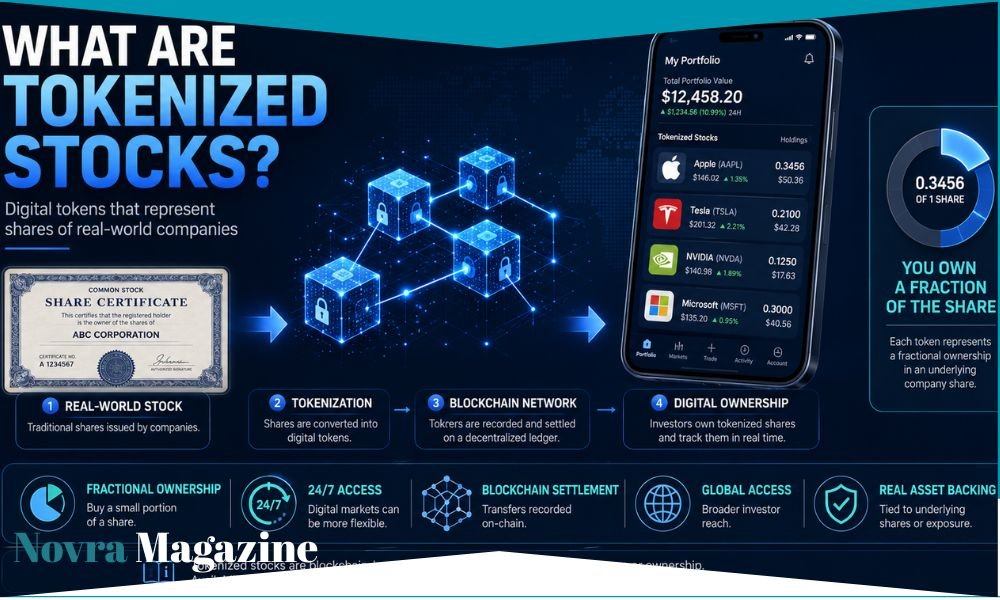
If you are asking what are tokenized stocks, imagine taking something familiar, such as an Apple or Nvidia share, and connecting it to blockchain technology. It sounds simple, but there is an important catch: a token that follows a stock does not always mean you actually own that stock. The SEC’s January 2026 statement on tokenized securities explains that several different structures exist. Some tokens can represent genuine securities and shareholder ownership. Others represent an indirect claim backed by shares. Some are simply contracts designed to follow a stock’s price. Understanding that difference is the key to understanding tokenized stocks.
What Are Tokenized Stocks in Simple Words?
A tokenized stock is a blockchain-based token connected to a traditional company share.
For example, imagine Apple stock.
Normally, you buy Apple shares through a broker. The traditional financial system keeps records showing your ownership.
With tokenization, blockchain technology can become part of the system used to record, transfer or represent that investment.
The SEC defines a tokenized security as a security represented in crypto-asset form where ownership records are maintained partly or fully through one or more crypto networks.
But that definition covers several different designs.
That is why seeing “AAPL token” does not automatically tell you what you own.
How Does a Tokenized Stock Work?
Let’s understand this simply.
Imagine one normal share is worth $200.
A system could create blockchain tokens connected to that share.
Depending on the structure, one token might represent one whole share.
The system might also allow smaller pieces, such as 0.1 or 0.01 of the economic value.
Blockchain records can then help track who holds the tokens and when they move.
But the legal structure behind that token is more important than the blockchain itself.
The SEC says tokenized securities can be created by the company issuing the security or by an unrelated third party. Those two models can give investors very different rights.
Do Tokenized Stocks Mean You Own Real Stocks?
Sometimes yes.
Sometimes no.
This is the most important answer in the article.
A tokenized stock can be structured so that the blockchain token represents the actual security.
But another product may simply track the share’s price.
A third product may be backed by real shares held by a custodian while the token holder owns a separate financial instrument.
The SEC specifically warns that tokenized-security structures differ in the rights they give holders.
So before buying anything called a tokenized stock, ask:
Do I legally own the underlying share, or do I only own a token linked to it?
That one question can change almost everything.
What Is a Real Tokenized Share?
A real tokenized share is a normal security represented using blockchain technology.
The company itself, or an authorised agent, can connect blockchain records with the official shareholder record.
In this model, transferring the token can also transfer ownership of the actual security.
The SEC explains that the main difference from traditional shares may simply be how ownership records are maintained. Instead of relying only on an ordinary database, blockchain records become part of the ownership system.
Importantly, the SEC says changing the format does not remove federal securities laws.
A stock is still a stock even when represented as a crypto token.
Can the Same Stock Exist in Normal and Tokenized Form?
Yes.
The SEC says one class of securities can potentially exist in several formats.
An investor might hold the traditional version.
Another investor might hold a tokenized version.
A properly designed system may even allow movement between the formats.
This is very different from creating an unrelated token that merely copies the price.
Think about two digital tickets for the same event.
They may look different in the app, but both can represent the same real admission right.
That is closer to the idea behind true tokenized securities.
What Is a Third-Party Tokenized Stock?
This is where things become more complicated.
A company unrelated to Apple, Tesla or Nvidia could buy the real shares and then create tokens connected to them.
The token issuer might hold the underlying stock with a custodian.
It then creates a financial product giving customers economic exposure to that stock.
The investor may therefore have a claim against the token structure rather than direct ownership rights against Apple, Tesla or Nvidia.
The SEC groups several of these arrangements under third-party tokenized-security models.
These products are not automatically bad.
They are simply different.
What Is a Synthetic Tokenized Stock?
A synthetic stock token can track a company’s share price without making you a shareholder.
For example, imagine Nvidia stock rises from $150 to $165.
A synthetic Nvidia token may be designed to rise by roughly the same amount.
The customer receives economic exposure.
But the customer may have no Nvidia voting rights, no direct ownership interest and no legal claim against Nvidia itself.
The SEC explains that linked securities and security-based swaps can provide economic exposure to another security without giving investors the ownership or governance rights associated with the underlying company.
This is why price tracking and ownership should never be treated as the same thing.
Why Does Real Ownership Matter?
Suppose two people each spend $1,000.
Person A owns real company shares.
Person B owns a synthetic token following those shares.
The price experience might look almost identical while everything works normally.
But other rights can be different.
Who gets to vote?
Who receives company communications?
What happens during a merger?
Who handles dividends?
What happens if the token company fails?
Who legally owes the investor money?
Those questions become much more important during unusual events.
That is why regulators focus on what a token legally represents rather than simply what name appears on the screen.
Do Tokenized Stocks Give Voting Rights?
Some do.
Others do not.
Nasdaq’s regulated U.S. tokenization model is designed so tokenized and traditional shares of the same company carry the same material rights.
Nasdaq says its model aims to preserve genuine ownership, voting rights, participation in corporate actions and normal legal shareholder status.
That means blockchain technology changes how the security is represented and delivered, not what the investor fundamentally owns.
However, many international stock tokens work differently.
They may provide price exposure without shareholder voting rights.
So never assume.
Check the product.
Do Robinhood Stock Tokens Give Voting Rights?
Robinhood’s European Classic Stock Tokens are a good example of why this question matters.
Robinhood clearly states that these products are derivative contracts.
Customers do not buy the actual underlying stock and do not receive normal shareholder rights such as voting.
The tokens follow the price of U.S. stocks and exchange-traded products.
But the relationship is between the investor and Robinhood Europe.
That means buying a Robinhood Classic Apple Stock Token is legally different from directly buying an Apple share.
The price exposure may look similar.
The ownership is different.
Do Tokenized Stocks Pay Dividends?
They can, but different products handle dividends differently.
A genuine tokenized share can potentially carry the same dividend rights as its traditional version.
A derivative token may instead provide a payment designed to reflect the dividend.
Robinhood says eligible Classic Stock Token holders can receive dividend-related benefits, even though the holders do not own the underlying shares directly.
Another platform, xStocks, uses a different system.
When an underlying company pays a dividend, xStocks says the cash is used to purchase additional shares. The token’s blockchain balance then adjusts through a mechanism called rebasing.
So “receives dividends” does not always mean cash arrives in exactly the same way as with an ordinary brokerage account.
What Happens When a Company Splits Its Stock?
Token systems must also handle stock splits.
Imagine you hold exposure equivalent to one share worth $400.
The company announces a four-for-one split.
After the split, the economic value should still be roughly the same, but the position should represent four shares worth around $100 each.
xStocks says its token balances automatically adjust when splits and reverse splits happen.
Robinhood also says corporate events such as splits, mergers, spinoffs and delistings can affect its Classic Stock Tokens, with the company adjusting positions when needed.
Corporate actions therefore reveal another important difference between platforms.
Someone has to make sure the token continues to match the asset it represents.
Are Tokenized Stocks the Same as Fractional Shares?
No.
Fractional shares and tokenized stocks can both allow smaller investments, but they are different ideas.
A fractional share simply means you own less than one complete share through a brokerage structure.
For example, you might own 0.2 of a share.
A tokenized security uses blockchain technology as part of the representation, recordkeeping or transfer system.
Tokenized products can also be fractional.
But being fractional does not make something tokenized.
And being tokenized does not automatically mean you own a fractional real share.
Why Are Tokenized Stocks Becoming Popular in 2026?
The main attraction is flexibility.
Traditional markets were built around systems that can involve brokers, clearing firms, custodians, transfer agents and other financial infrastructure.
Blockchain technology may help some of those systems work together more directly.
Nasdaq says properly designed tokenization could reduce friction, automate parts of corporate-action processing and make ownership records easier to connect while preserving existing investor protections.
Another attraction is trading time.
Some blockchain-based stock products can trade when the traditional U.S. market is closed.
Others can move between blockchain wallets or interact with decentralised finance.
That makes stocks behave more like internet-native digital assets.
Can Tokenized Stocks Trade 24/7?
Some can.
xStocks says its tokens can trade 24 hours a day, seven days a week on supported secondary markets.
Its direct issuance and redemption system operates mainly during periods aligned with underlying U.S. equity-market availability.
That creates an interesting situation.
Apple’s main stock market might be closed.
But an Apple-linked token could still trade elsewhere.
The token’s price is then created by buyers and sellers in that secondary market.
This provides more trading access.
But it can also create price differences when the main stock market is closed or token-market liquidity is thin.
Can Tokenized Stock Prices Be Different From Real Share Prices?
Yes.
A token may be designed to track a normal share, but secondary-market prices still depend on supply and demand.
xStocks says its secondary-market prices are determined independently by buyers and sellers on each platform.
Imagine Tesla closes at $300 on the main U.S. market.
Overnight, unexpected news appears.
A Tesla-linked token may begin trading at a different value because investors are reacting before traditional trading resumes.
That can be useful for price discovery.
It can also create extra volatility.
What Is Nasdaq Doing With Tokenized Stocks?
Nasdaq made one of the biggest moves in U.S. tokenization during 2026.
The SEC approved Nasdaq’s proposal allowing eligible listed securities to trade and settle in either traditional electronic form or tokenized form.
Nasdaq says the tokenized and normal versions use the same CUSIP, carry the same material rights and trade within the same market system.
That is important because Nasdaq is not trying to create a separate imitation of its stock market.
Its goal is to let the real security use newer technology.
Nasdaq describes the token as another delivery format for the same underlying ownership interest.
When Did the SEC Approve Nasdaq’s Tokenized Securities Plan?
The SEC approved Nasdaq’s proposal on March 18, 2026.
Nasdaq later described the approval as the first time a major U.S. exchange had received permission to enable securities to trade in tokenized form under that model.
This is a major change from earlier tokenized-stock experiments.
Instead of creating an offshore token merely linked to Nvidia, the regulated-market approach can preserve the actual Nvidia security and shareholder protections.
That difference is likely to remain important as tokenization grows.
Is the NYSE Also Working on Tokenized Stocks?
Yes.
The New York Stock Exchange filed rule changes in 2026 designed to enable securities to trade on the exchange in tokenized form.
The SEC published the NYSE filing in April 2026 as an immediately effective proposed rule change.
Related NYSE exchanges, including NYSE Arca, also submitted tokenization-related changes.
So blockchain-based securities are no longer only being explored by crypto companies.
Some of America’s largest traditional exchanges are now building tokenized-market infrastructure too.
Are Tokenized Stocks Legal in the United States?
Tokenized securities can exist legally in the United States.
But tokenization does not create an escape from securities laws.
The SEC says the format used to represent a security does not change the application of federal securities law.
A stock remains an equity security whether its ownership record is maintained using traditional databases or blockchain technology.
This principle is important.
You cannot simply put a stock-like investment on a blockchain and say:
“Now securities rules no longer apply.”
Regulators look at what the product actually is.
Are All International Stock Tokens Available in America?
No.
Some of the most popular blockchain stock products remain unavailable to U.S. investors.
For example, xStocks says its products are not offered in the United States or to U.S. persons. It also currently excludes residents of several other markets, including the United Kingdom, Canada and Australia.
Robinhood’s new generation of blockchain Stock Tokens is also not available to U.S. persons.
That is another reason readers should not assume a product seen online is legally available everywhere.
Rules depend on location.
What Are Robinhood Classic Stock Tokens?
Robinhood Classic Stock Tokens are available to eligible European users.
These are blockchain-recorded derivative contracts linked to U.S.-listed stocks and exchange-traded products.
Robinhood says customers are buying a contract rather than the actual share.
As of 2026, Robinhood advertises more than 2,000 Classic Stock Tokens for eligible European customers.
These products can be traded around the clock during the working week, and users can begin with small amounts.
However, they currently cannot be transferred to outside wallets.
That makes them very different from open blockchain tokens.
What Are Robinhood’s New 2026 Stock Tokens?
Robinhood launched another Stock Token product internationally in July 2026.
These newer tokens can be accessed through Robinhood Wallet in more than 120 countries, subject to local eligibility.
They are designed for 24/7 blockchain trading and can potentially be used in DeFi applications such as lending pools or as collateral.
But their legal structure is crucial.
Robinhood says these newer Stock Tokens are tokenised debt securities that give economic exposure to underlying securities.
They do not give investors legal or beneficial ownership rights in the actual underlying company.
They are also unavailable to U.S. persons and restricted in several other countries.
What Are xStocks?
xStocks are another major form of tokenized equity.
Their provider describes them as tracker certificates giving economic exposure to publicly traded stocks and ETFs.
Each xStock is backed one-for-one by the corresponding underlying security held with regulated custodians.
However, xStocks documentation is also clear that holders do not receive shareholder rights such as voting rights.
So once again:
Backed by stock does not necessarily mean direct stock ownership.
That distinction is extremely important.
How Big Are xStocks in 2026?
The market has expanded very quickly.
As of August 2026, the xStocks website lists 716 stocks and ETFs and reports more than $35 billion in transaction volume. Those figures come from the company itself and can continue changing.
Its examples include tokenized exposure linked to companies such as Apple, Nvidia, Amazon, Tesla, Microsoft and Meta.
xStocks also operates across several blockchain networks and can interact with wallets, exchanges and some DeFi protocols.
This shows how quickly the tokenized-equity market has grown outside the traditional U.S. brokerage system.
Can You Keep Tokenized Stocks in Your Own Crypto Wallet?
Some products allow this.
Others do not.
xStocks can be moved to supported self-custody blockchain wallets. Their documentation says the tokens can be transferred like other blockchain assets.
Robinhood’s newer international Stock Tokens are also designed to interact with Robinhood Wallet and the Robinhood Chain.
However, Robinhood Classic Stock Tokens currently cannot be sent to outside wallets or other platforms.
So “tokenized” does not always mean “freely transferable.”
Check the specific product.
Can Tokenized Stocks Be Used in DeFi?
Some can.
DeFi means decentralized finance.
Instead of leaving a token sitting in an account, some blockchain systems allow tokens to be used as collateral, placed into lending markets or traded through decentralized exchanges.
xStocks says its products can interact with supported DeFi systems, including lending and liquidity applications.
Robinhood’s July 2026 Stock Tokens are also designed to support activities such as lending and collateral use through blockchain applications.
This sounds powerful.
But it creates another layer of risk.
Now you are not only depending on the stock token.
You may also be depending on a smart contract, lending protocol, wallet and blockchain.
Are Tokenized Stocks Safer Than Crypto?
Not automatically.
A token linked to Microsoft may have a more familiar economic asset behind it than a random meme coin.
But tokenization can introduce risks that ordinary stock investors may not normally face in the same way.
There may be issuer risk.
Custodian risk.
Smart-contract risk.
Blockchain risk.
Liquidity risk.
Platform risk.
Legal risk.
And, of course, the underlying company’s stock can still fall.
Robinhood warns that investors in its European Classic Stock Tokens can lose their full investment because of market conditions or even Robinhood insolvency.
The word “stock” does not remove risk.
What Is Counterparty Risk?
Counterparty risk means your investment depends on another company keeping its promise.
Imagine you own a token contract designed to match Nvidia.
Nvidia may be perfectly healthy.
But your investment might also depend on the token issuer remaining financially healthy and correctly maintaining the product.
If the issuer fails, you may face a problem that a direct Nvidia shareholder does not face in exactly the same way.
The SEC’s tokenization guidance highlights this distinction by separating direct issuer-sponsored securities from third-party tokenized structures.
Always ask:
Who actually owes me my rights or money?
What Is Custody Risk?
Some tokenized products say they are backed by real shares.
That creates another question:
Where are those shares?
xStocks says its underlying securities are kept in segregated regulated custody accounts and that every product is collateralized one-for-one.
The structure also includes an independent security agent and publicly available proof-of-reserve information, according to its documentation.
Those protections are important.
But investors should still understand that owning a tracker certificate backed by Apple shares is different from personally having ordinary Apple shareholder rights.
What Is Smart-Contract Risk?
Blockchain tokens run through software.
Software can fail.
A smart contract may contain a bug.
A wallet may be compromised.
A blockchain bridge may be attacked.
A DeFi protocol can fail.
This means some tokenized stocks combine traditional investment risk with blockchain technology risk.
That is one reason direct regulated exchange tokenization and offshore blockchain products can feel very different.
Nasdaq’s approach aims to preserve traditional securities protections while changing the technology underneath ownership and settlement.
Are Tokenized Stocks Like Bitcoin?
No.
Both can use blockchain technology, but economically they are very different.
Bitcoin is a blockchain-native asset.
It does not represent shares in Apple, Tesla or another company.
A tokenized stock is connected to a traditional security or a financial contract based on that security.
So two assets can exist on similar technology while representing completely different things.
Think about the internet.
An email and an online bank account both use the internet.
That does not make an email the same thing as money.
Blockchain works in a similar way.
It is technology that can carry many different types of assets.
Can Tokenized Stocks Represent Private Companies?
They can provide exposure to private companies, but this area requires extra care.
A token using the name of a famous private company does not automatically represent real ownership in that company.
The SEC’s framework makes clear that third parties can create financial instruments linked to other securities or assets without transferring genuine ownership rights.
Private markets also have less continuous public pricing than companies listed on Nasdaq or NYSE.
That can make valuing a private-company-linked token harder.
Investors should always check whether they own actual equity or simply a contract whose price is based on an estimated private-company value.
What Are the Main Benefits of Tokenized Stocks?
Tokenized securities could eventually make financial markets easier to use.
Transactions may become more automated.
Assets can potentially move faster.
Fractional access can become simpler.
Some products can trade for longer hours.
Blockchain records can improve transparency.
Shares can potentially interact with digital wallets and other financial software.
Nasdaq believes tokenization can modernize complicated systems behind corporate actions and shareholder records while preserving regulated-market protections.
That is one reason traditional financial companies are taking the technology seriously.
What Are the Biggest Problems With Tokenized Stocks?
The biggest problem may be confusion.
An investor sees:
Tesla Token
and thinks:
Tesla Share
Those may not be the same thing.
The token might provide real ownership.
It might be a tracker certificate.
It could be a derivative.
It could be debt linked to Tesla.
It might be backed by Tesla shares held elsewhere.
All those products can potentially follow the same price while giving investors different rights.
The SEC’s 2026 guidance exists largely because the phrase “tokenized security” covers several legal structures.
How Can You Check a Tokenized Stock Before Buying?
Start with the legal description.
Do not begin with the chart.
Find out whether the token represents the actual security.
Check whether shares back the product.
See who holds those shares.
Find out whether you receive voting rights.
Understand how dividends are handled.
Check whether the token can be redeemed.
Find out what happens if the issuer fails.
Check where the product is regulated.
See whether you can move it to another wallet.
And confirm whether it is legally available in your country.
These questions are much more important than whether the token has a familiar company logo.
Will Tokenized Stocks Replace Normal Stocks?
Nobody knows.
But 2026 has brought tokenized securities much closer to the financial mainstream.
The SEC has published detailed guidance explaining the different legal models.
Nasdaq has received approval for tokenized-form trading within its regulated market framework.
NYSE has also filed rules enabling securities to trade in tokenized form.
Meanwhile, international blockchain products such as Robinhood Stock Tokens and xStocks are expanding different models of stock-linked investing.
The most likely near-term future may therefore involve several systems existing together.
Normal shares.
Real tokenized shares.
Custodial stock tokens.
Derivative stock tokens.
And blockchain-native financial products.
FAQs About What Are Tokenized Stocks
What are tokenized stocks?
Tokenized stocks are blockchain-based financial instruments connected to traditional company shares. Some represent actual securities, while others only provide economic exposure to the underlying share.
Do tokenized stocks mean real stock ownership?
Not always. The SEC describes both genuine tokenized securities and third-party products that may only provide indirect or synthetic exposure.
Do tokenized stocks give voting rights?
Some genuine tokenized shares can provide full voting rights. Other stock tokens, including Robinhood Classic Stock Tokens and xStocks, do not provide ordinary shareholder voting rights.
Do tokenized stocks pay dividends?
Some do. The exact method depends on the product. Some pass along dividend-related payments, while xStocks reinvests dividends and adjusts token balances.
Are tokenized stocks the same as normal stocks?
Sometimes a tokenized security can represent the same legal stock in a different technological format. Other stock tokens are separate derivatives, debt securities or tracker products.
Are tokenized stocks legal?
They can be legal, but regulations depend on the product and country. In the United States, a stock does not stop being a security simply because blockchain technology is used.
Can Americans buy tokenized stocks?
Regulated tokenized securities are developing within U.S. markets, including Nasdaq. However, many international products such as xStocks and Robinhood’s new international Stock Tokens are not available to U.S. persons.
Is Nasdaq using tokenized stocks?
Yes. The SEC approved Nasdaq’s framework in March 2026, allowing eligible securities to trade and settle in tokenized form while retaining the same material rights.
Is NYSE working on tokenized securities?
Yes. NYSE filed rule changes in 2026 designed to enable securities to trade in tokenized form.
Are Robinhood Stock Tokens real stocks?
Robinhood’s European Classic Stock Tokens are derivative contracts rather than actual underlying shares. Its newer international Stock Tokens are tokenised debt securities providing economic exposure without direct ownership rights in the underlying companies.
What are xStocks?
xStocks are tracker certificates providing economic exposure to shares and ETFs. They are backed one-for-one by underlying securities but do not provide ordinary shareholder voting rights.
Can tokenized stocks trade 24/7?
Some can. xStocks can trade 24/7 on supported secondary markets, and Robinhood’s newer international Stock Tokens are also designed for around-the-clock trading.
Can tokenized stocks be kept in a crypto wallet?
Some can. xStocks can be transferred through supported blockchain wallets, while Robinhood Classic Stock Tokens currently cannot leave Robinhood’s European platform.
Can tokenized stocks be used in DeFi?
Certain products can. xStocks and Robinhood’s newer international Stock Tokens support or are designed for activities involving decentralized exchanges, lending or collateral.
Are tokenized stocks safer than cryptocurrency?
Not automatically. Tokenized stocks can carry normal share-price risk plus issuer, custody, smart-contract, liquidity and regulatory risks.
Can tokenized stocks lose value?
Yes. If the underlying stock falls, a stock-linked token can also lose value. Some products also add counterparty or issuer risk. Robinhood warns that Classic Stock Token investors can lose their entire invested amount.
How many xStocks exist in 2026?
The xStocks website lists 716 tokenized stocks and ETFs as of August 2026. This number is a current company figure and can change.
Will all stocks become tokenized?
Nobody knows. Major U.S. exchanges are adopting tokenization technology, but traditional shares are likely to exist alongside tokenized formats for the foreseeable future.
Final Thoughts
The simple answer to what are tokenized stocks is:
They are investments connected to company shares but represented or tracked using blockchain technology.
The complicated part is what comes after that sentence.
A tokenized stock can mean several completely different things.
It can be the real company security represented through blockchain records.
It can be a token backed by shares held with a custodian.
Or it can simply be a financial contract designed to follow the stock’s price.
The SEC made these differences much clearer in January 2026 when it explained issuer-sponsored and third-party tokenized-security structures.
That distinction matters because real ownership comes with rights.
Nasdaq’s U.S. model is designed to preserve genuine ownership, voting rights, corporate-action participation and normal securities protections while allowing shares to exist in tokenized form.
Other products work differently.
Robinhood Classic Stock Tokens are derivatives.
You can gain exposure to Apple or Nvidia prices, but you do not become the direct shareholder simply by holding the token.
Robinhood’s newer international Stock Tokens use yet another structure.
They are tokenised debt securities giving economic exposure to stocks without direct legal or beneficial ownership rights in those companies.
xStocks offers another model.
Its tokens are backed one-for-one by underlying equities or ETFs held with regulated custodians, yet its own documentation says token holders do not receive shareholder voting rights.
That may sound confusing.
But there is an easy way to remember it.
Price exposure is not the same as ownership.
If Apple stock rises and your token also rises, that tells you how the product behaves financially.
It does not tell you what you legally own.
This is why investors should look beyond the token name.
Ask who issued it.
Ask what backs it.
Ask who holds the real shares.
Ask whether you can vote.
Ask how dividends work.
Ask what happens if the issuer goes bankrupt.
Ask whether you can move or redeem the token.
And check whether the product is even legally available where you live.
Tokenization still has exciting possibilities.
Nasdaq and NYSE are moving blockchain technology deeper into regulated U.S. securities markets.
International platforms are pushing another direction, where stock-linked assets can trade almost continuously, move through wallets and sometimes interact with DeFi.
Those two worlds may eventually come closer together.
If they do, investors could one day hold stocks, bonds, cash-like assets and cryptocurrencies in systems that can interact more easily.
But technology alone does not create investor protection.
And a blockchain token with “Tesla” written beside it does not automatically make you a Tesla shareholder.
So if there is one thing to remember when somebody asks what are tokenized stocks, remember this:
Always find out what the token legally represents before looking at what price it tracks.
For more info, visit novra magazine