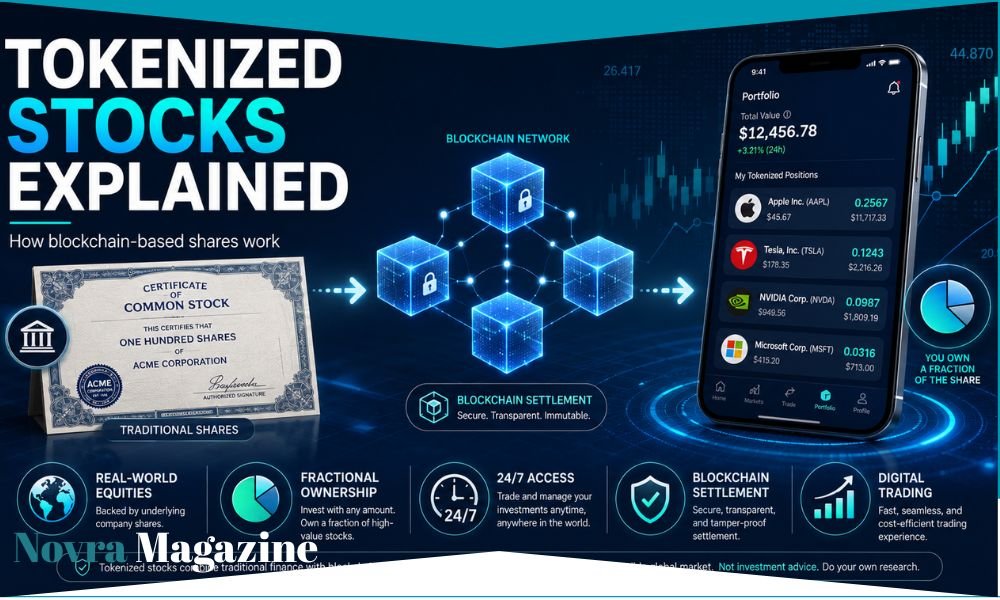
Imagine buying something that follows Apple, Tesla or Nvidia stock, but instead of seeing only a normal brokerage entry, you receive a blockchain token. That sounds like a normal share moved onto crypto rails, but it is not always that simple. For anyone searching tokenized stocks explained, the most important lesson is this: some products can represent real securities, while others only give you economic exposure to a stock’s price. In January 2026, the U.S. Securities and Exchange Commission explained tokenized securities and made clear that different structures can give investors very different rights. A token may represent genuine ownership, an indirect interest in shares held by a custodian, or simply a contract linked to the share price.
What Are Tokenized Stocks?
A tokenized stock is a digital, blockchain-based representation connected to a traditional stock.
Think about an ordinary share first.
Normally, your broker keeps an electronic record showing that you own shares.
Tokenization can add blockchain technology to that ownership or exposure.
FINRA says traditional securities such as stocks and bonds can be issued or transferred through blockchain technology using tokenization.
However, the words tokenized stock can describe several different products.
That is where things become confusing.
Two tokens may both say “Tesla” in an app while giving their holders completely different legal rights.
Does a Tokenized Stock Mean You Own a Real Share?
Sometimes.
But not always.
This may be the single most important fact in this whole article.
The SEC’s January 2026 staff statement describes several ways securities can be tokenized. One model involves the actual issuer or its agent putting ownership records on a blockchain. Another involves a third party holding the real stock and issuing a token linked to that holding. A third model can provide only synthetic exposure to the stock.
So before buying anything called a tokenized stock, ask:
What exactly does this token legally represent?
Do not assume the answer from the name.
What Is a Real Tokenized Share?
A real tokenized share can be the same underlying security represented using blockchain technology.
For example, a company or its transfer agent could record ownership partly through an onchain system.
The SEC says a company could even offer the same class of security in traditional and tokenized formats. If the tokenized version has substantially similar rights, it may be treated as the same class for certain securities-law purposes.
Think about it like this.
You have the same book.
One copy is printed on paper.
Another is digital.
The format changes.
The underlying thing does not necessarily change.
That is the model U.S. regulated exchanges are increasingly exploring.
What Is a Custodial Tokenized Stock?
This model works differently.
A third party buys or holds the real share.
Then it creates a blockchain token representing an interest connected with that share.
The SEC calls one version of this a tokenized security entitlement. The real underlying security remains in custody, while the token represents the holder’s direct or indirect interest in that security.
This can still give meaningful economic exposure.
But the legal relationship is different from being directly listed as the shareholder in the company’s own records.
That difference matters if the custodian, token issuer or platform experiences problems.
What Is a Synthetic Tokenized Stock?
A synthetic token can look like a stock investment without actually giving you ownership of the stock.
The SEC says a third party can issue a linked security or security-based swap whose value follows another security. In those structures, investors may receive economic exposure without receiving ownership, voting or other shareholder rights in the referenced company.
This is easy to misunderstand.
Imagine a token whose price moves with Nvidia.
Nvidia rises 5%.
Your token may also rise.
But that does not automatically mean you own Nvidia stock.
You may simply own a financial contract linked to Nvidia’s price.
Why Does the Difference Matter So Much?
Because a normal shareholder can have rights beyond price movement.
Depending on the stock and structure, those rights can include voting, corporate communications, distributions and participation in certain company events.
A synthetic token may provide none of those rights.
It may simply promise a financial return linked to the share.
The SEC specifically warns that third-party linked securities can provide exposure without giving holders rights or benefits from the company whose stock is being referenced.
That means you should never judge a token only by the company logo beside it.
Read what you actually own.
Do Tokenized Stocks Give Voting Rights?
It depends entirely on the product.
A true tokenized version of a normal share can be designed to preserve voting and other shareholder rights.
Nasdaq says its U.S. tokenized-share model is designed so tokenized and traditional shares carry the same material rights, including genuine ownership and governance rights.
But some products sold outside the U.S. work differently.
Robinhood says its European Classic Stock Tokens are derivative contracts and do not grant investors rights in the underlying securities.
So there is no universal answer.
Ask whether the product gives actual shareholder status.
Do Tokenized Stocks Pay Dividends?
Some can.
But once again, the structure matters.
A genuine tokenized share may carry the same economic rights as its traditional version.
Other token products may simply pass along an amount based on the dividend.
Robinhood says eligible holders of its European Classic Stock Tokens can receive dividend-related payments even though they do not own the underlying shares themselves.
xStocks uses another method.
Its documentation says corporate actions such as dividends and stock splits are reflected through an onchain rebasing system that changes token balances.
The result may feel similar economically.
The legal mechanism is not necessarily the same.
Are Tokenized Stocks the Same as Fractional Shares?
No.
They can both let people get small exposure to expensive stocks, but the technology and legal structure differ.
A fractional share is simply part of an ordinary share held through a brokerage arrangement.
A tokenized stock uses blockchain or distributed-ledger technology as part of how ownership or economic exposure is represented or transferred.
Some tokenized products are also divisible into very small units.
xStocks, for example, says its tokens can be held and transferred fractionally.
But “fractional” and “tokenized” do not mean the same thing.
Why Are Tokenized Stocks Becoming Popular in 2026?
One reason is trading flexibility.
Traditional U.S. stock markets have set trading sessions.
Blockchain markets can potentially operate much longer.
Some token platforms offer 24/7 access.
Another reason is settlement.
Blockchain systems can potentially reduce some of the waiting and back-office work involved in moving securities.
Nasdaq says tokenization could eventually make shareholder records, corporate actions and settlement more automated while keeping normal investor protections.
There is also a cultural reason.
Millions of people are already comfortable using crypto wallets.
For them, holding stocks, stablecoins and other assets through similar technology can feel natural.
Can Tokenized Stocks Really Trade 24/7?
Some already can outside traditional U.S. stock exchanges.
xStocks says supported tokens can trade around the clock on participating exchanges and decentralized-finance venues, although issuance and redemption follow a more limited schedule linked to U.S. equity-market hours.
Robinhood’s newer international Stock Tokens also advertise 24/7 trading for eligible users through its blockchain ecosystem. Those products are not available everywhere, including to U.S. persons.
However, 24/7 trading creates another question.
What happens when Apple stock’s main U.S. market is closed but an Apple-linked token is still trading?
Prices may depend more heavily on token-market liquidity and expectations during those hours.
That is one reason extended access should not automatically be confused with better pricing.
Are Tokenized Stocks Available in the United States?
The answer is changing quickly in 2026.
The United States is moving toward regulated tokenized securities inside its existing market system.
In March 2026, the SEC approved Nasdaq’s approach allowing eligible securities to trade and settle in tokenized form under the relevant framework. Nasdaq says tokenized and traditional versions of the same security share the same CUSIP, trade within the same market system and carry the same material rights.
The NYSE also filed rule changes in 2026 dealing with trading securities in tokenized form.
So tokenization is no longer only an offshore crypto experiment.
It is entering mainstream U.S. market infrastructure.
Does Tokenizing a Stock Remove Securities Laws?
No.
Putting a stock on a blockchain does not magically turn it into something other than a security.
The SEC’s position is straightforward: if the underlying financial instrument is a security, representing it as a crypto asset does not remove federal securities-law requirements.
FINRA makes the same broader point.
When member firms deal with crypto assets that are securities, normal federal securities laws and FINRA rules still apply.
This is an important difference between tokenized stocks and ordinary cryptocurrencies.
A tokenized Apple share does not become Bitcoin simply because both exist on blockchain technology.
What Is Nasdaq Doing With Tokenized Stocks?
Nasdaq’s 2026 model is important because it shows how tokenization can happen inside the existing U.S. stock market rather than creating a separate offshore market.
Nasdaq says tokenized and traditional shares of the same company can carry the same ownership interest and material rights while trading through the existing regulated market structure.
The blockchain part mainly changes how the security can be represented and settled.
The goal is not to create “fake Nasdaq stocks.”
It is to modernize the infrastructure behind real regulated securities.
That distinction separates Nasdaq’s approach from many third-party stock-linked tokens.
What Is the NYSE Doing With Tokenized Securities?
The New York Stock Exchange has also moved into tokenization.
In April 2026, the SEC published NYSE’s rule change covering the trading of securities in tokenized form.
NYSE has also discussed plans for tokenized securities infrastructure and longer trading access.
The direction is clear.
America’s largest traditional exchanges increasingly see blockchain as market infrastructure rather than something existing completely outside Wall Street.
That is a major change from only a few years ago.
Is FINRA Treating Tokenized Stocks Like Normal Securities?
Where tokenized instruments are securities, normal investor-protection duties continue to matter.
FINRA’s July 2026 regulatory notice specifically said that the duty of best execution is as fundamentally important for tokenized securities as it is for traditional securities.
Best execution simply means firms handling customer orders have duties around seeking favorable execution under applicable rules.
The technology does not erase that responsibility.
This again shows how regulators increasingly view tokenization:
new technology, but not necessarily a new excuse to remove old protections.
What Are Robinhood Stock Tokens?
Robinhood has become one of the most visible names in tokenized stocks.
Its European Classic Stock Tokens are not ordinary shares.
Robinhood clearly says they are derivative contracts that track publicly traded stocks and ETFs. Investors do not buy the actual stock when they buy those tokens.
The company currently offers more than 2,000 Classic Stock Tokens linked to U.S.-listed stocks and exchange-traded products for eligible EU and EEA customers.
They can be bought in small amounts and offer extended weekday trading.
But investors need to understand the product.
Price exposure is not the same as share ownership.
Do Robinhood Classic Stock Tokens Make You an Apple or Nvidia Shareholder?
No.
Robinhood’s own documentation says Classic Stock Tokens are contracts between the customer and Robinhood.
They follow the value of the underlying security but do not grant rights in it.
This means someone buying a Classic Apple Stock Token should not describe themselves in the same legal sense as a person who directly owns registered economic rights in an Apple share through a traditional brokerage structure.
The market exposure can look similar.
The legal ownership is different.
This is exactly why “tokenized stocks explained” needs more than one sentence.
What Are Robinhood’s New 2026 Stock Tokens?
Robinhood expanded the concept again in July 2026.
The company launched a newer generation of Stock Tokens through Robinhood Wallet in more than 120 countries, subject to local availability. It says eligible users can trade them 24/7 and use them in some decentralized-finance activities.
These are also important to understand correctly.
Robinhood says these newer Stock Tokens are tokenized debt securities that provide economic exposure to underlying securities.
They do not give holders legal or beneficial rights in the underlying companies.
They are also unavailable to U.S. persons and restricted in several other jurisdictions.
What Are xStocks?
xStocks is another major tokenized-equity system.
Its documentation says each xStock represents a publicly traded stock or ETF and is backed one-for-one by the corresponding underlying asset held with a regulated custodian.
These tokens can be moved across supported blockchain wallets and used with some decentralized-finance applications.
That is different from Robinhood’s Classic Stock Tokens, which currently stay inside Robinhood’s own European system.
xStocks says its products are not intended for distribution to people in the United States or other prohibited jurisdictions.
So worldwide availability should never be assumed.
How Big Have xStocks Become?
The project expanded quickly after launching in June 2025.
Kraken said in March 2026 that the platform had reached 100 tokenized stocks and ETFs and had generated more than $25 billion in total transaction volume since launch.
Kraken also said it wanted the range to grow beyond 500 tokenized equities by the end of 2026.
That is a company target, not a guaranteed outcome.
The larger point is that tokenized equities have moved from small experiments into products generating significant activity.
Can You Hold Tokenized Stocks in a Crypto Wallet?
Some types, yes.
xStocks says users can withdraw supported tokens into self-custody wallets and transfer them between supported blockchain systems.
Robinhood’s newer international Stock Tokens are also designed for its wallet and broader onchain ecosystem.
However, Robinhood’s older Classic Stock Tokens work differently.
Those cannot currently be sent to another wallet or platform.
Once again, one phrase — “stock token” — hides several completely different products.
Can Tokenized Stocks Be Used in DeFi?
Some can.
xStocks says its tokens can potentially interact with lending markets, liquidity pools and other decentralized-finance applications.
Robinhood’s 2026 international Stock Tokens are also being designed for activities such as use as collateral and lending through supported blockchain applications.
That creates new possibilities.
It also creates new risks.
A normal brokerage share sitting quietly in an account is one thing.
Moving a stock-linked token through smart contracts, lending pools and decentralized exchanges adds more technical systems that can potentially fail.
Greater flexibility usually brings greater responsibility.
Are Tokenized Stocks Safer Than Crypto?
Not automatically.
A token may be linked to a well-known company such as Apple, but the investor can still face risks created by the token structure.
Those may include:
Counterparty risk.
Custody risk.
Smart-contract risk.
Liquidity risk.
Regulatory risk.
Platform risk.
And ordinary stock-market risk.
Robinhood explicitly warns that its Classic Stock Token investors can lose their full investment because of market conditions or Robinhood insolvency.
Tokenization changes the technology.
It does not remove investment risk.
What Is Counterparty Risk?
Counterparty risk means another company has to keep its promise for your investment to work properly.
This matters especially with synthetic tokens.
Imagine you own a contract that promises to match Tesla’s price.
Tesla itself may be doing perfectly well.
But your contract also depends on the company that issued it.
If that issuer fails, your position can face a different type of risk than someone holding an ordinary Tesla share through established securities infrastructure.
The SEC’s tokenization statement makes this distinction clear by separating issuer-sponsored shares, custodial models and synthetic products.
Always ask who owes you what.
What Is Custody Risk?
Custody risk matters when a token is supposedly backed by real shares.
Where are those shares?
Who holds them?
Can investors verify they exist?
What happens if the token issuer fails?
What happens if the custodian fails?
xStocks says its products are backed one-for-one and use segregated custody structures, an independent security agent and proof-of-reserve measures.
Those are important design features.
But investors should still read the legal documents rather than assuming the word “backed” means the same thing as direct ownership.
What Is Smart-Contract Risk?
Blockchain tokens depend on software.
That software can contain bugs.
A bridge between blockchains can fail.
A wallet can be compromised.
A decentralized protocol can be attacked.
This is a new layer of risk that normal stockholders may not face in exactly the same way.
A tokenized investment can therefore combine two worlds:
Traditional financial risk.
And blockchain technology risk.
That does not make tokenization bad.
It means investors need to understand both sides.
Can Tokenized Stock Prices Move Away From the Real Share Price?
They can, especially on separate trading venues.
A token may be designed to track a normal stock.
But buyers and sellers still create the market price on the venue where the token trades.
If liquidity is weak or the main stock exchange is closed, temporary differences can become more important.
This is one reason Nasdaq has emphasized keeping tokenized and traditional versions inside the same market and liquidity pool rather than creating disconnected markets.
Nasdaq specifically warns that fragmented liquidity can weaken price discovery and increase costs.
What Happens When the Real Company Splits Its Stock?
Token providers need a method for corporate actions.
Suppose a company completes a two-for-one stock split.
A token system should somehow adjust the investor’s exposure.
Robinhood says it changes Classic Stock Token holdings when events such as splits, reverse splits, mergers, delistings, dividends and spinoffs affect the underlying security.
xStocks says it uses an onchain rebasing mechanism for dividends and stock splits.
Again, the result can resemble normal stock ownership economically.
The process may be very different underneath.
Can Tokenized Stocks Represent Private Companies?
They can represent exposure to private companies, but investors must be extremely careful about what that means.
Robinhood disclosed that it previously distributed promotional tokens referencing privately held U.S. companies.
Its SEC filing clearly says those tokens did not represent actual securities of the private companies and did not give holders the right to convert them into those companies’ shares.
That is a perfect example of why investors cannot assume a company name equals ownership.
A token labeled with a famous private business may simply be a financial product referencing that business.
Can Tokenized Stocks Make Private Investing Easier?
Potentially.
Private-company investing has traditionally been difficult for normal retail investors because access is limited.
Tokenization could create new ways to provide financial exposure.
But the legal details become even more important because private shares do not have the same public-market price discovery as Apple or Microsoft.
Robinhood has said private-market access is one of the areas it wants to develop further.
But investors should distinguish between owning genuine private-company equity and owning a token whose value merely references that company.
Those are very different things.
Are Tokenized Stocks Crypto?
Technically, they use blockchain-style crypto infrastructure.
But economically they can behave more like traditional securities or derivatives.
FINRA includes tokenized securities within its wider discussion of crypto assets because blockchain technology is used to issue or transfer them.
Yet buying a tokenized Microsoft security is not economically the same thing as buying Bitcoin.
One is connected to a company or financial contract.
The other is a native blockchain asset.
The technology may overlap.
The investment itself can be completely different.
Are Tokenized Stocks Securities?
Many are.
A stock does not stop being a security because somebody represents it on a blockchain.
The SEC’s January 2026 statement specifically defines tokenized securities as securities represented by crypto assets where ownership records are maintained partly or fully through crypto networks.
Some third-party stock tokens can instead be other kinds of securities, such as linked securities or security-based swaps.
The legal classification depends on how the product actually works.
The product name is not enough.
What Are the Biggest Benefits of Tokenized Stocks?
The main potential benefits are easy to understand.
Longer trading access.
Fractional ownership or exposure.
Faster movement of assets.
Potentially simpler settlement.
Blockchain transparency.
Wallet compatibility.
Possible use in decentralized finance.
And easier global access in markets where regulations permit it.
Nasdaq also believes tokenization could make corporate actions and ownership records more efficient while maintaining traditional market protections.
These benefits explain why both crypto firms and traditional exchanges are investing heavily in the technology.
What Are the Biggest Risks of Tokenized Stocks?
The biggest risk may simply be misunderstanding what you bought.
An investor sees:
“Apple Token.”
They think:
“I own Apple.”
But perhaps they own a derivative contract.
Maybe they have no voting rights.
Perhaps their claim is against a token issuer rather than Apple.
Maybe the token cannot be redeemed for a real share.
Then there are technical and market risks.
The safest approach is to read the legal description before looking at the price chart.
A beautiful app cannot change what the contract actually says.
How Can You Check a Tokenized Stock Before Buying?
Ask a few simple questions.
Is this the actual security or only exposure?
Who issued the token?
Who holds the underlying stock?
Is it backed one-for-one?
Can I redeem it?
Do I receive voting rights?
How are dividends handled?
What happens during a stock split?
Can I move it to my own wallet?
Where is it regulated?
What happens if the token issuer fails?
What investor protection applies?
If those answers are difficult to find, that itself is useful information.
Will All Stocks Eventually Become Tokenized?
Nobody knows.
But 2026 has clearly moved tokenization much closer to mainstream finance.
The SEC has published a detailed framework explaining tokenized securities.
Nasdaq has moved forward with tokenized trading inside the regulated U.S. market.
NYSE exchanges are also developing tokenized-securities rules.
FINRA is already discussing how traditional broker obligations such as best execution apply when tokenized securities are traded.
That does not mean traditional brokerage shares disappear tomorrow.
A more likely near-term future is that both forms exist together.
FAQs About Tokenized Stocks Explained
What are tokenized stocks?
Tokenized stocks are blockchain-based representations connected to traditional stocks. Some represent real securities, while others provide indirect or synthetic exposure.
Do tokenized stocks mean I own the real stock?
Not always. Some give genuine ownership, some represent an indirect interest in shares held by another party, and some simply track the share price.
Do tokenized stocks give voting rights?
Some genuine tokenized shares can. Synthetic or derivative stock tokens may not. Nasdaq’s U.S. model is designed to preserve shareholder rights, while Robinhood Classic Stock Tokens do not grant underlying shareholder rights.
Do tokenized stocks pay dividends?
Some structures pass through or economically reflect dividends, but the method varies. Robinhood and xStocks both describe mechanisms for handling dividend-related corporate actions.
Are tokenized stocks available 24/7?
Some international blockchain products trade around the clock. Traditional U.S. exchange tokenization is developing within regulated market structures, so trading arrangements can differ by product.
Are Robinhood Stock Tokens real shares?
Robinhood says its European Classic Stock Tokens are derivative contracts and do not give investors ownership rights in the underlying shares. Its newer international Stock Tokens are tokenized debt securities providing economic exposure rather than direct rights in the underlying company.
What are xStocks?
xStocks are blockchain tokens linked to publicly traded stocks and ETFs. Their provider says each token is collateralized one-for-one by the corresponding underlying asset.
Can Americans buy xStocks?
xStocks says its products are not intended for distribution in the United States or to U.S. persons.
Can Americans buy Robinhood international Stock Tokens?
Robinhood says its newer international Stock Tokens are not available to U.S. persons.
Is Nasdaq tokenizing stocks?
Yes. Nasdaq says the SEC approved its framework allowing eligible securities to trade and settle in tokenized form while retaining the same material rights and existing securities-law protections.
Is the NYSE working on tokenized stocks?
Yes. The SEC published NYSE tokenized-securities rule changes in 2026.
Are tokenized stocks regulated?
Regulation depends on the product and country. In the U.S., securities laws continue to apply when the tokenized instrument is a security.
Are tokenized stocks safer than crypto?
Not automatically. They may carry stock-market, counterparty, custody, liquidity, platform and blockchain risks.
Can tokenized stocks be stored in a wallet?
Some can. xStocks and Robinhood’s newer international Stock Tokens support blockchain-wallet use, while Robinhood Classic Stock Tokens currently cannot be moved to outside wallets.
Can tokenized stocks be used in DeFi?
Certain products can interact with decentralized exchanges, lending systems or collateral markets. Availability depends on the token and jurisdiction.
Are tokenized stocks the same as fractional shares?
No. A fractional share is part of a normal share. Tokenized stocks use blockchain technology to represent ownership or exposure.
Can a tokenized stock lose all its value?
Yes. Investors can lose money from the underlying stock falling, and some token structures add issuer or platform risk. Robinhood warns investors in its Classic Stock Tokens that they can lose their entire invested capital.
Will tokenized stocks replace normal stocks?
That is not confirmed. Traditional exchanges are clearly adopting tokenization technology, but ordinary securities are likely to continue alongside tokenized formats for the foreseeable future.
Final Thoughts
The easiest way to understand tokenized stocks explained is to remember one sentence:
A stock token is not automatically a stock.
Sometimes it can be.
Sometimes it represents an indirect interest in a real share.
And sometimes it is only a financial contract following the share’s price.
The SEC made that distinction much clearer in January 2026 when its staff described issuer-sponsored tokenized securities, custodial tokenized securities and synthetic structures.
That difference changes everything.
Voting rights.
Dividends.
Ownership.
Custody.
Bankruptcy risk.
Redemption.
Regulation.
Even who actually owes you money.
At the same time, tokenization itself is becoming far more serious.
Nasdaq is bringing tokenized securities into the existing U.S. market structure while aiming to keep the same ownership rights and protections as traditional shares.
NYSE is moving in the same broad direction.
FINRA is already discussing tokenized securities as part of normal broker-dealer regulation and says duties such as best execution remain important regardless of the technology used.
Outside the U.S., another market is developing.
Robinhood offers thousands of stock-linked tokens to eligible European investors, while its newer blockchain products are expanding into more international markets. But its own disclosures make clear that these products can provide economic exposure without making the token holder a shareholder in the underlying company.
xStocks takes yet another approach.
Its tokens are designed to be backed one-for-one by underlying stocks or ETFs, moved between wallets and used in some DeFi systems. They are also restricted from U.S. distribution.
All of this means the future may not contain one kind of “tokenized stock.”
There may be several.
Real shares placed on blockchain rails.
Custodial representations of shares.
Debt securities linked to shares.
Derivatives tracking shares.
Private-market exposure tokens.
And other structures that have not been widely built yet.
That makes education extremely important.
Do not ask only:
“What company does this token track?”
Ask:
“What exactly do I own?”
That small question can reveal whether you are buying a real security, an indirect claim or simply a price-tracking contract.
Tokenization could make markets faster, more global and easier to connect with blockchain technology.
It may also create new ways to trade, settle and use traditional investments.
But new technology does not remove old investment risks.
And blockchain cannot turn a weak legal claim into genuine company ownership.
For investors in 2026, that may be the most important lesson of all.
For more info, visit novra magazine